
Joint Supplements for Arthritis in Dogs & Cats: What Actually Works?
A veterinarian's evidence-based guide to joint supplement ingredients, product quality, and the products I recommend most often.
Do joint supplements really work? A veterinarian walks through the evidence behind glucosamine, chondroitin, ASU, MSM, green-lipped mussel, UC-II®, omega-3 fatty acids, and CBD — plus how to choose a quality product and which supplements I recommend for dogs and cats.

Quick answer
In this article you'll learn
- Whether joint supplements actually work — and what they can't do
- How to judge supplement quality, transparency, and manufacturing standards
- What the science says about each common ingredient
- Which ingredients have strong, moderate, or limited evidence
- The specific products Dr. Rene' recommends for dogs and for cats
- Answers to the joint supplement questions owners ask most
Introduction
One of the most common questions I hear in the exam room is:
“Do joint supplements actually work, or are they just expensive vitamins?”
The honest answer is... it depends.
Some supplements have growing scientific evidence showing they can improve comfort, mobility, and quality of life for certain pets with osteoarthritis. Others have very limited research behind them despite bold marketing claims. And unfortunately, some products simply don't contain what the label says they do.
Joint supplements are not magic pills, and they are not a cure for arthritis.
Once cartilage has been damaged, we cannot regenerate a normal, healthy joint with a supplement alone. Instead, the goal is to support joint health, reduce inflammation, improve comfort, and help pets stay active for as long as possible.
Can Joint Supplements Really Help?
For many dogs and cats, joint supplements can become an important piece of a much larger arthritis management plan.
Arthritis Is Best Managed with a Team Approach
If you've read my other arthritis articles, you've probably noticed a common theme:
There is rarely one treatment that does everything.
The most successful arthritis management plans combine multiple therapies that work together. Depending on your pet, that may include:
- Maintaining a healthy body weight
- Regular, low-impact exercise
- Physical rehabilitation
- Environmental modifications at home
- Prescription pain medications when appropriate
- Joint supplements
- Omega-3 fatty acids
- Monthly monoclonal antibody injections such as Librela® or Solensia®
- Other therapies recommended by your veterinarian
Think of arthritis management like building a toolbox. Every tool has a different job, and the best results often come from using several tools together rather than relying on just one.
Not Every Supplement Is Created Equal
Walk into any pet store or search online, and you'll find hundreds of products claiming to “support joint health.”
Some are excellent.
Some are mediocre.
Others rely more on clever marketing than on scientific evidence.
One of the biggest challenges for pet owners is that supplements are not regulated the same way as prescription medications. That means product quality, ingredient accuracy, and manufacturing standards can vary significantly from one company to another.
A product may contain excellent ingredients—but if those ingredients aren't present in the right amounts, aren't absorbed well, or aren't manufactured consistently, your pet may not receive the benefits you're hoping for.
That's one of the reasons I pay close attention not only to what is in a supplement, but also who makes it.
Setting Realistic Expectations
Even the best joint supplements take time to work.
Unlike prescription pain medications, which may improve comfort within hours or days, supplements often require several weeks before owners notice meaningful changes. Most veterinarians recommend giving a quality joint supplement at least 6 to 8 weeks before deciding whether it's helping.
The improvements are often gradual.
You may notice your dog getting up more easily after a nap.
Your cat may start jumping onto the couch again.
Your pet may seem more willing to go for walks, climb stairs, play, or interact with the family.
Sometimes the biggest sign that a supplement is helping is something owners don't notice until they stop giving it.
My Philosophy on Joint Supplements
How to Choose a Quality Joint Supplement
If you've ever searched online for a joint supplement, you've probably been overwhelmed by the number of choices.
Hundreds of products promise to “rebuild cartilage,” “reverse arthritis,” or “restore youthful mobility.” Some contain long lists of ingredients you've never heard of, while others claim to be veterinarian recommended or clinically proven.
So how do you know which ones are actually worth your money?
Unfortunately, there isn't a simple answer—but there are several important things I look for before recommending a joint supplement to my own clients.
1. Look Beyond the Marketing
Beautiful packaging and impressive claims don't always mean a product works.
Unlike prescription medications, dietary supplements don't have to go through the same approval process to demonstrate effectiveness before they are sold. As a result, companies can market products with very different levels of scientific support.
Whenever you see phrases like:
- “Miracle cure”
- “Repairs cartilage”
- “Works in every pet”
- “Clinically proven” (without citing any studies)
...take a step back and ask whether there is actual research supporting those claims.
Ask yourself, “Compared to what?” A supplement may improve comfort compared with no treatment at all, but that doesn't necessarily mean it's the best option available or that every claim made about it has been proven.
If something sounds too good to be true, it usually is.
2. Ingredients Matter—But So Does the Company Behind Them
Many joint supplements contain similar ingredients, but that doesn't mean they're all created equal.
The quality of the raw ingredients, how they're manufactured, how consistently they're produced, and whether the company invests in research all play an important role.
A product may have an impressive ingredient list on the label, but if those ingredients aren't present in the correct amounts—or aren't manufactured consistently—you may not get the results you're expecting.
That's one of the reasons I tend to recommend companies that invest in veterinary research, quality control, and manufacturing standards rather than simply creating another supplement to compete in a crowded market.
3. Look for Transparency
One thing I always appreciate in a company is transparency.
A reputable manufacturer should clearly tell you:
- Exactly what ingredients are included
- How much of each ingredient is present
- Recommended dosing
- Appropriate species and size recommendations
- Safety information
I'm cautious of products that hide behind “proprietary blends” without telling you exactly how much of each ingredient your pet is actually receiving.
4. Quality Control Is More Important Than Most Owners Realize
Supplements are only helpful if they consistently contain what the label says they contain.
Independent testing has shown that some supplements don't always match their labels. Others may contain significantly more—or less—of an ingredient than expected.
That's one reason I often recommend products made by companies that invest in quality assurance and rigorous manufacturing standards.
Consistency matters, especially when your pet will likely be taking a supplement every day for months—or even years.
5. More Ingredients Doesn't Always Mean a Better Supplement
Some products contain ten or fifteen different ingredients and market themselves as an “all-in-one” solution.
That doesn't necessarily make them more effective.
Sometimes a carefully formulated product built around a handful of well-studied ingredients is a better choice than a supplement packed with ingredients that have little evidence behind them.
I prefer products built around ingredients with the strongest available scientific evidence rather than simply the longest ingredient list.
6. Price Doesn't Always Reflect Quality
It's natural to assume the most expensive supplement must be the best.
Sometimes that's true.
Sometimes you're simply paying for marketing.
At the same time, the cheapest product on the shelf isn't always the best value either. If it contains low-quality ingredients or inconsistent amounts, you may spend money without seeing meaningful results.
When choosing a supplement, I encourage owners to think about value, not just price.
A product that consistently helps your pet stay comfortable may ultimately be a much better investment than a less expensive product that doesn't deliver the same benefit.
How I Decide What to Recommend
Owners often ask why I recommend certain brands more than others.
For me, it comes down to five questions:
- Is there good scientific evidence supporting the ingredients?
- Do I trust the company to consistently manufacture a quality product?
- Is the product backed by published research, not just marketing claims?
- Have I seen positive results in my own patients?
- Would I feel comfortable giving this to one of my own pets?
If the answer to those questions is yes, it's a product I'm much more likely to recommend.
Throughout the rest of this guide, we'll take a closer look at the most common joint supplement ingredients, discuss what the current research tells us, and I'll share where I believe each one fits into an evidence-based arthritis management plan.
My goal isn't to convince you that every pet needs a supplement.
My goal is to help you understand which products are worth considering, which claims deserve a healthy dose of skepticism, and how to make an informed decision alongside your veterinarian.
My goal has never been to recommend the most expensive supplement or the one with the longest ingredient list. My goal is to recommend products supported by the best available evidence that give your pet the greatest opportunity to stay comfortable, active, and enjoy life for as long as possible.
The Ingredients Behind Joint Supplements—What Does the Science Say?
Walk down the pet aisle of almost any store, and you'll find dozens of joint supplements with long ingredient lists and impressive claims. While many products contain the same handful of ingredients, not every ingredient has the same level of scientific evidence behind it.
Some have been studied for decades.
Others are newer and show considerable promise.
And a few have far more marketing behind them than science.
Let's take a closer look at the ingredients you're most likely to encounter.
Glucosamine
What is it?
Glucosamine is one of the oldest and most widely recognized ingredients found in joint supplements. It is a naturally occurring compound that the body uses to help produce cartilage and other important components of healthy joints.
How is it supposed to work?
The goal of glucosamine supplementation is to support cartilage health and help slow the breakdown of joint tissues. It may also have mild anti-inflammatory effects.
What does the research say?
Research in veterinary medicine has shown mixed results. Some studies have found modest improvements in comfort and mobility, while others have shown little measurable benefit when glucosamine is used alone.
That doesn't necessarily mean glucosamine is ineffective—it may simply work better as part of a combination product rather than as a stand-alone ingredient.
Chondroitin Sulfate
What is it?
Chondroitin sulfate is another naturally occurring component of healthy cartilage. It is commonly paired with glucosamine in veterinary joint supplements.
How is it supposed to work?
Chondroitin may help slow cartilage breakdown while supporting the joint's ability to retain water, improving shock absorption and overall joint function.
What does the research say?
Like glucosamine, the evidence is mixed but generally more encouraging when chondroitin is combined with other joint-support ingredients rather than used alone.
Avocado Soybean Unsaponifiables (ASU)
What is it?
Avocado soybean unsaponifiables, commonly called ASU, are natural extracts derived from avocados and soybeans.
How is it supposed to work?
Research suggests ASU may help reduce inflammatory chemicals within arthritic joints while supporting the health of cartilage cells.
What does the research say?
ASU has become one of the more interesting ingredients in veterinary joint health. While research is ongoing, studies suggest it may enhance the effects of glucosamine and chondroitin when the ingredients are used together.
MSM (Methylsulfonylmethane)
What is it?
MSM is a naturally occurring sulfur-containing compound commonly included in joint supplements.
How is it supposed to work?
MSM is thought to have mild anti-inflammatory and antioxidant properties that may help improve comfort.
What does the research say?
The veterinary evidence remains limited. Some studies suggest possible benefits, while others have not demonstrated significant improvements.
Green-Lipped Mussel
What is it?
Green-lipped mussel is a shellfish native to New Zealand that naturally contains omega-3 fatty acids along with several other bioactive compounds.
How is it supposed to work?
It may help reduce inflammation while supporting joint health through multiple pathways.
What does the research say?
Several veterinary studies have demonstrated improvements in mobility and comfort in dogs with osteoarthritis, although additional research is still ongoing.
UC-II® (Undenatured Type II Collagen)
What is it?
UC-II is a specialized form of undenatured type II collagen that works differently from most traditional joint supplements.
How is it supposed to work?
Rather than supplying building blocks for cartilage, UC-II appears to work by helping regulate the immune system's response to joint cartilage through a process known as oral immune tolerance.
What does the research say?
UC-II has generated considerable interest in recent years. Several studies suggest it may improve mobility and comfort in dogs with osteoarthritis, although additional long-term research is still needed.
Omega-3 Fatty Acids (EPA and DHA)
What are they?
Omega-3 fatty acids are among the best-studied nutritional therapies for osteoarthritis.
How are they supposed to work?
EPA and DHA help reduce inflammatory compounds throughout the body, including within arthritic joints.
What does the research say?
Among nutritional supplements, omega-3 fatty acids have some of the strongest scientific evidence for improving mobility and comfort in dogs with osteoarthritis.
CBD (Cannabidiol)
What is it?
CBD is a compound derived from hemp that has received significant attention for pain management in both people and pets.
How is it supposed to work?
CBD interacts with the body's endocannabinoid system, which plays a role in pain perception, inflammation, and overall nervous system function.
What does the research say?
Early veterinary studies suggest CBD may help improve comfort and activity in some dogs with osteoarthritis, but the research is still developing. We still have much to learn about ideal dosing, long-term safety, and which patients are most likely to benefit.
A Quick Comparison of the Evidence
The strength of the research varies considerably from one ingredient to another. This table offers a simple overview, but it is important to remember that evidence can differ based on the formulation, dosage, study design, and whether an ingredient was evaluated alone or as part of a combination product.
| Ingredient | General Strength of Veterinary Evidence | My Overall Perspective |
|---|---|---|
| Omega-3 fatty acids (EPA and DHA) | Strong | One of my most consistent nutritional recommendations |
| UC-II® | Moderate and promising | An interesting option with a different mechanism of action |
| ASU | Moderate and developing | A valuable addition to some combination products |
| Green-lipped mussel | Moderate and promising | May improve comfort and mobility as part of a broader plan |
| Glucosamine and chondroitin | Mixed | Best considered as part of a quality combination formulation |
| MSM | Limited | May contribute some benefit, but is rarely the reason I choose a product |
| CBD | Early and developing | Promising for some dogs, but product quality and dosing matter greatly |
This is not meant to rank every product on the market or suggest that every pet will respond the same way. A well-researched finished product may be more valuable than an individual ingredient with a recognizable name.
The Bottom Line
No single ingredient is a miracle cure for arthritis.
Instead, the best joint supplements combine ingredients with complementary mechanisms of action and are manufactured by companies committed to quality, consistency, and scientific research.
As you've probably noticed, there isn't one perfect ingredient. Each works differently, each has its own strengths and limitations, and the evidence supporting each one varies.
That's why I rarely recommend a supplement based on a single ingredient alone. I recommend products based on the strength of the entire formulation, the quality of the manufacturer, and the evidence supporting the finished product.
In the next section, I'll share the products I personally recommend most often in practice, explain why they've earned my trust, and discuss how I help families choose the right option based on both their pet's needs and their budget.
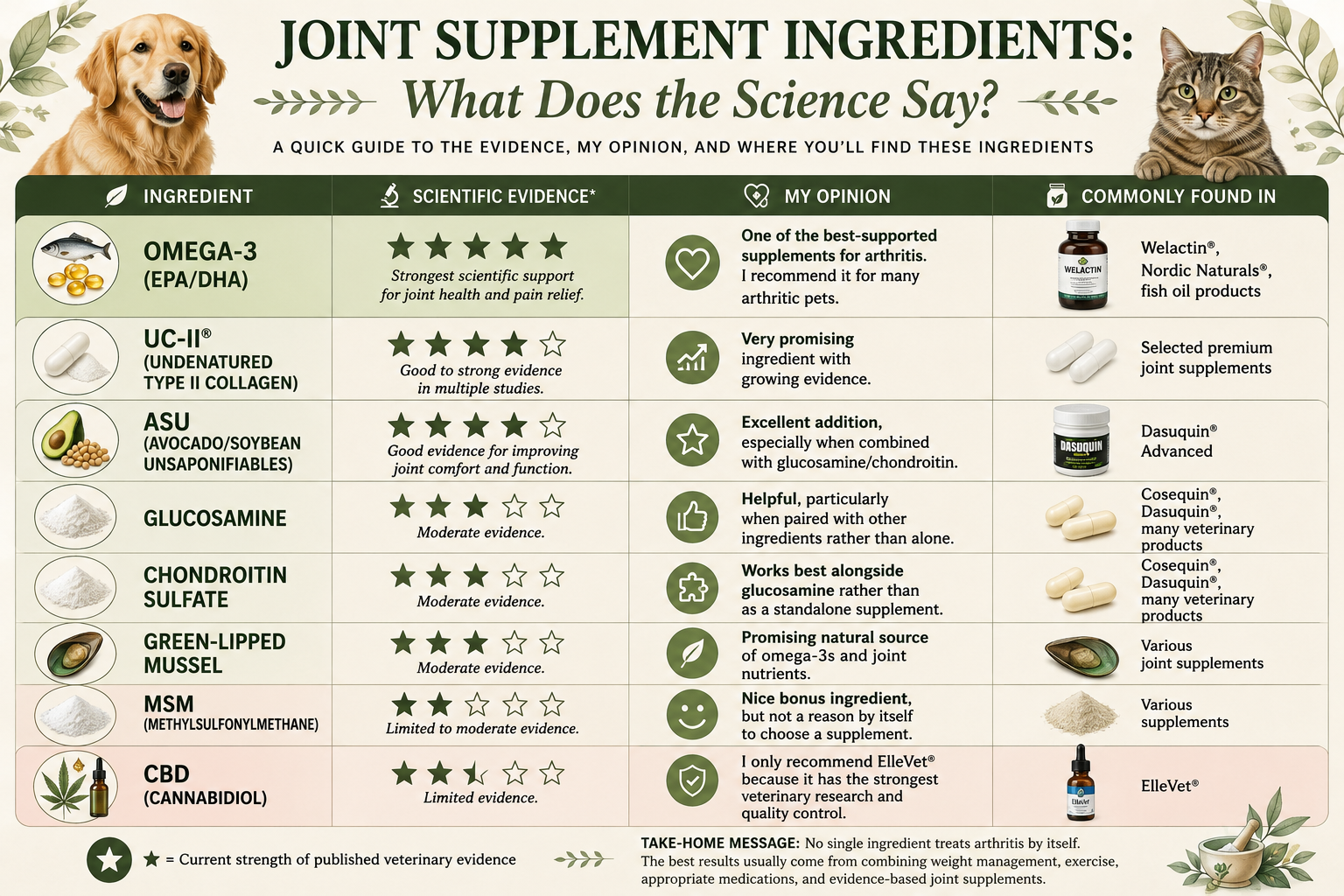
Not all joint supplements are created equal. Some ingredients have decades of scientific research behind them, while others have only limited evidence. Understanding what each ingredient does—and how strong the evidence is—can help you make more informed decisions when choosing a supplement for your pet.
My Recommendations for Dogs & Cats
After discussing the different ingredients and the research behind them, owners usually ask me the same question:
“Okay…if this were your own dog or cat, what would you use?”
I love that question because it gets to the heart of what owners really want to know.
Every patient is different, and there isn't a single supplement that's perfect for every dog or cat. Age, the severity of arthritis, other medical conditions, budget, lifestyle, and even how easily a product can be given all influence my recommendations.
That said, there are a handful of products I consistently recommend because they've earned my confidence through years of clinical experience, quality manufacturing, and the research supporting their ingredients.
The products below are ones I recommend most often—not because they're the only good options available, but because they're the products I know, trust, and have had good experiences using in my own patients.
My Recommendations for Dogs
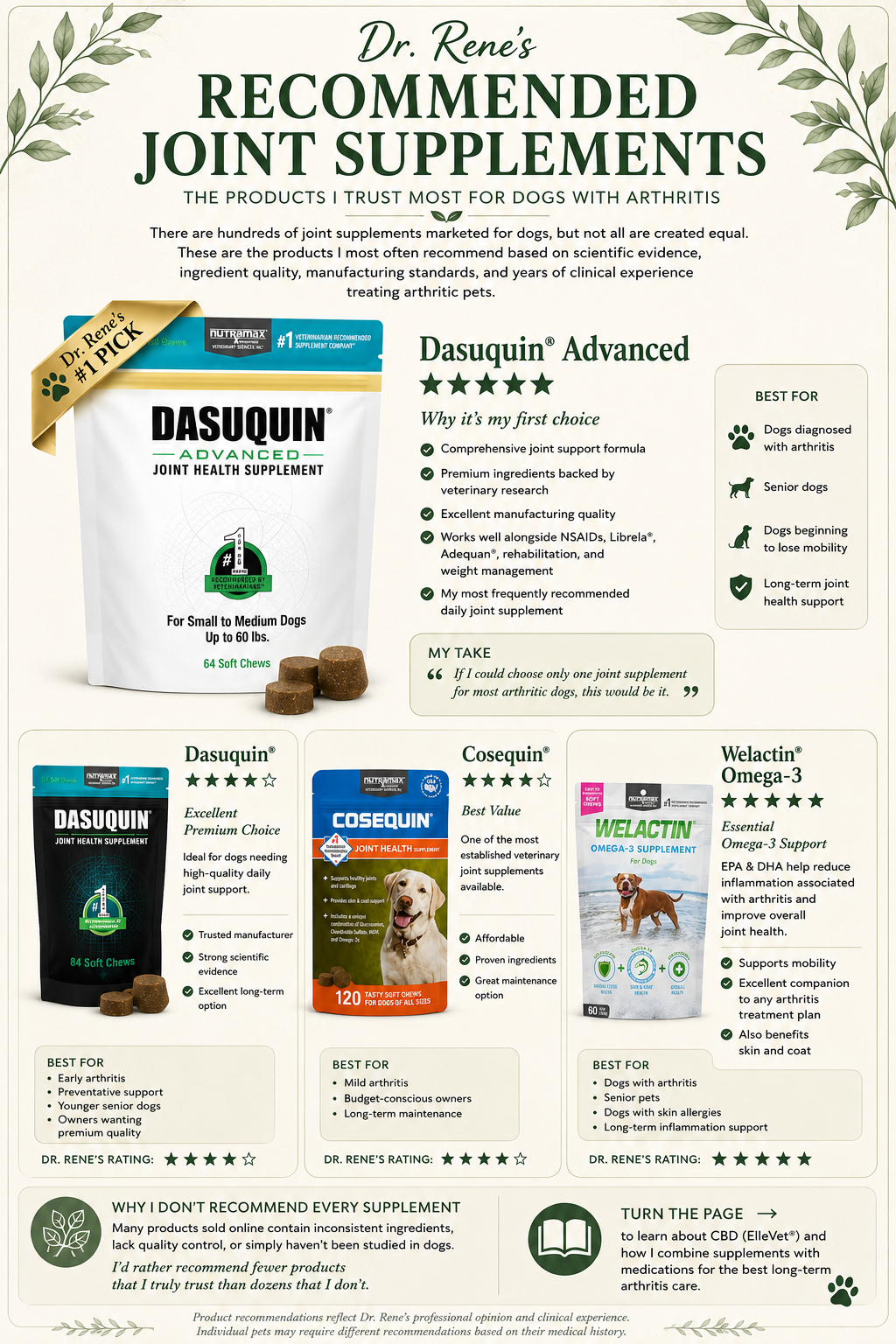
My First Choice for Most Dogs: Dasuquin® Advanced
If budget isn't the limiting factor, Dasuquin Advanced is usually my first recommendation for dogs with arthritis or those at high risk of developing joint disease.
I like it because it combines several joint-support ingredients into one comprehensive formulation rather than relying on glucosamine and chondroitin alone. Its ingredients are designed to support the joint through multiple pathways, making it one of the most complete over-the-counter joint supplements currently available.
No supplement can reverse arthritis, but if I'm choosing a daily joint supplement for one of my own dogs, this is typically where I start.
An Excellent Choice: Dasuquin®
Not every dog needs the Advanced formulation.
Traditional Dasuquin remains an excellent product and continues to be one of the supplements I recommend most frequently.
It contains glucosamine, chondroitin sulfate, and ASU—ingredients that have become the foundation of many veterinary joint-support protocols.
For many dogs with mild to moderate arthritis, Dasuquin may provide meaningful support as part of a broader arthritis management plan.
A Great Budget-Friendly Option: Cosequin®
One of the biggest mistakes I see owners make is assuming they must buy the most expensive product or skip supplements entirely.
That simply isn't true.
If Dasuquin Advanced isn't within your budget, I'd much rather see your pet receive Cosequin consistently than receive nothing at all.
Cosequin has been trusted in veterinary medicine for many years and remains a solid option for many families.
Consistency is far more important than purchasing the “perfect” supplement if you can't realistically continue giving it long term.
My Preferred Omega-3 Supplement: Welactin®
If there is one supplement category I recommend almost as consistently as joint supplements themselves, it's omega-3 fatty acids.
EPA and DHA have some of the strongest scientific evidence supporting their use in dogs with osteoarthritis.
My personal preference is Welactin because I trust the company's quality, consistency, and formulation.
Regardless of which brand you choose, I encourage owners to look beyond the marketing and pay attention to the actual EPA and DHA content rather than simply looking for the words fish oil on the label.
The total amount of fish oil is not the same as the amount of EPA and DHA your pet is receiving. Those are the numbers that matter most when evaluating an omega-3 supplement.
My Thoughts on CBD
CBD has become one of the fastest-growing areas of interest in veterinary medicine, but it's also one of the most confusing.
The research is encouraging, but it's still evolving.
One of my biggest concerns isn't whether CBD can help some pets—it's whether the product you're buying actually contains what the label says it contains.
Independent testing has shown that some CBD products marketed for pets contain inconsistent amounts of CBD, unexpected ingredients, contaminants, or measurable amounts of THC.
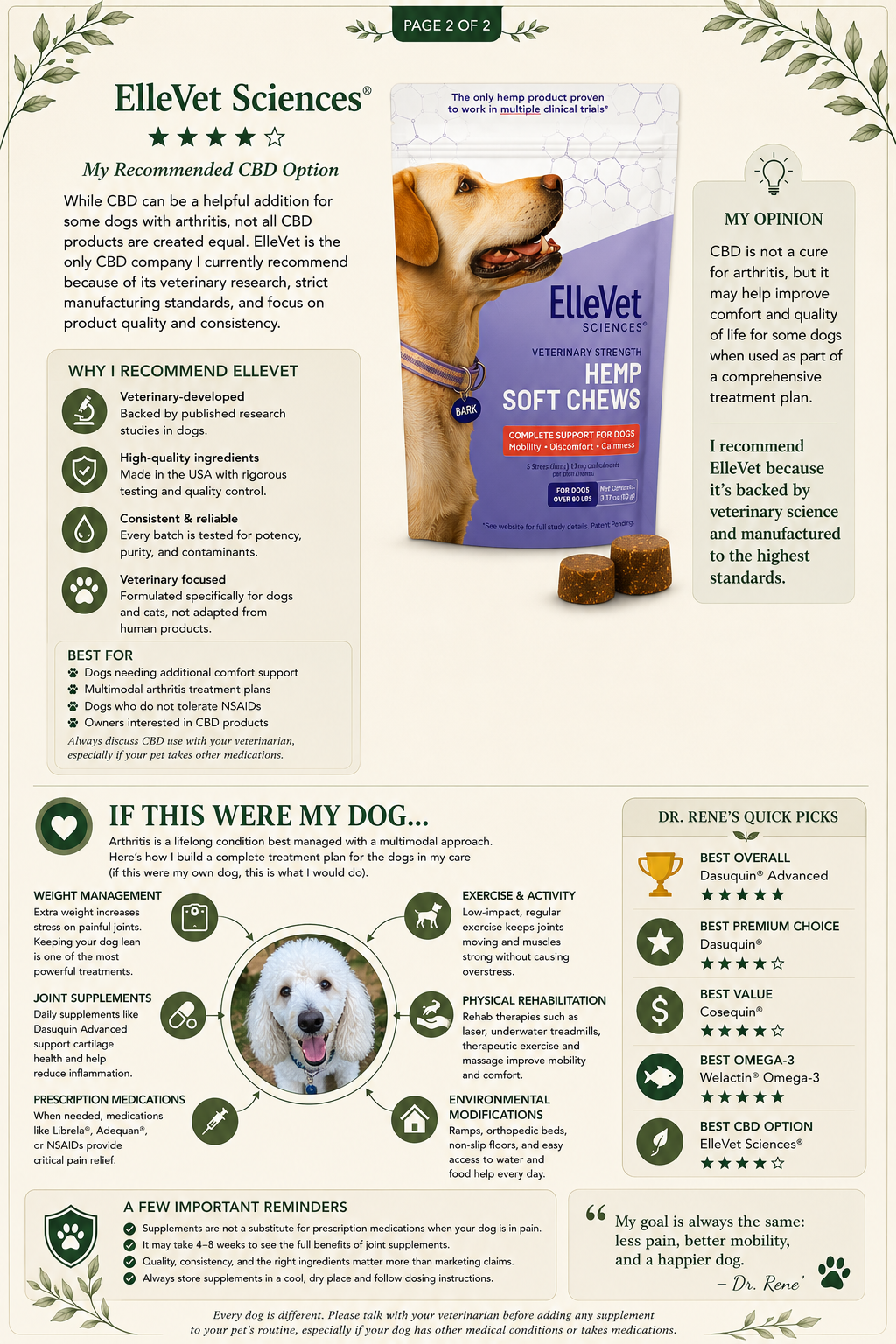
For that reason, when I recommend a CBD product, my personal preference is ElleVet®.
I appreciate the company's commitment to veterinary research, quality control, and manufacturing consistency. Those factors are especially important when we're discussing a product that a pet may take every day.
That doesn't mean every other CBD product is ineffective. It does mean that owners should be cautious about purchasing inexpensive or unverified products online simply because they have attractive packaging or positive reviews.
CBD can also interact with other medications and may not be appropriate for every patient, so I recommend discussing it with your veterinarian before adding it to your pet's arthritis treatment plan.
My Recommendations for Cats
Cat owners often ask whether my recommendations are different for feline patients.
The answer is yes—and no.
Many of the same ingredients found in canine joint supplements are also used in cats. However, there are fewer studies evaluating these products in feline arthritis, so many of my recommendations are based on a combination of the available research, clinical experience, and product quality.
When I recommend a joint supplement for a cat, I look for the same qualities that I do in dogs:
- Quality manufacturing
- Transparent ingredient lists
- Evidence-supported ingredients
- Products developed specifically for veterinary patients
- A formulation that the cat will actually eat
Let's be honest—none of that matters if your cat refuses to take it.
One of the biggest challenges with cats isn't choosing the right supplement.
It's finding one they'll tolerate consistently.
My Preferred Joint Supplement for Cats: Dasuquin® for Cats
For many cats, my first recommendation is Dasuquin for Cats.
It contains glucosamine, chondroitin sulfate, and ASU in a formulation specifically developed for feline patients.
Just as importantly, it comes as sprinkle capsules that many owners find easier to give than tablets.
Is it a miracle?
No.
But it is one of the products I trust most because of the company behind it, the quality of the formulation, and my clinical experience using it.
Omega-3 Fatty Acids for Cats
Cats with arthritis may also benefit from omega-3 fatty acids, although the research is not as extensive as it is in dogs.
Just as with dogs, I encourage owners to choose veterinary products that clearly list their EPA and DHA content rather than simply advertising that they contain fish oil.
Don't Forget Solensia®
If your cat already has painful arthritis, I don't want owners to think supplements are the only option.
One of the biggest advances in feline arthritis treatment has been Solensia®, a monthly monoclonal antibody injection that targets nerve growth factor (NGF), one of the primary drivers of arthritis pain.
Many cats experience meaningful improvements in comfort, mobility, jumping, grooming, and overall activity after starting Solensia.
For cats with moderate to severe arthritis, I often view joint supplements as one piece of the overall treatment plan—not the entire treatment plan.
Products I Approach With More Caution
There are many joint supplements on the market that may be perfectly safe, but I don't routinely recommend them because I haven't seen enough evidence—or enough manufacturing consistency—to confidently recommend them over products I already trust.
That doesn't necessarily mean they're bad products.
It simply means I prefer recommending products supported by stronger research, reliable quality-control standards, transparent labeling, and years of positive clinical experience.
I am especially cautious of products that:
- Promise to rebuild cartilage or reverse arthritis
- Hide ingredient amounts within proprietary blends
- Don't clearly list EPA and DHA concentrations
- Claim to be “clinically proven” without identifying the research
- Provide little information about manufacturing or quality testing
- Combine many ingredients at doses too low to be meaningful
A long ingredient list may look impressive, but more ingredients do not automatically make a better supplement.
How I Help Families Choose
When I help a family choose a supplement, I don't simply reach for the most expensive product.
I consider:
- The pet's age and current level of mobility
- Whether arthritis has been diagnosed or the pet is considered at risk
- The severity of the pet's pain and functional limitations
- Other medications and supplements the pet is already receiving
- Other medical conditions that may affect the recommendation
- Whether the product is available in a form the pet will reliably take
- The family's budget
- Whether the supplement can realistically be continued long term
The best recommendation on paper isn't helpful if the pet refuses to take it or the family can't reasonably maintain it.
The goal is to choose a product that is appropriate, evidence-informed, affordable, and practical for that individual household.
My Final Thoughts
Frequently Asked Questions
Choosing a joint supplement can feel overwhelming, especially with so many products claiming to be the “best.” Here are answers to some of the questions I hear most often from pet owners.
How long does it take for joint supplements to work?
Patience is important.
Unlike prescription pain medications, joint supplements don't usually provide immediate relief. Most pets need to take a supplement consistently for 6 to 8 weeks before you can fairly evaluate whether it's helping.
Some pets improve sooner, while others may take a little longer.
If your pet has severe arthritis, your veterinarian may recommend using a joint supplement alongside other treatments, such as prescription medications, physical rehabilitation, weight management, or injections like Librela® or Solensia®.
Can my pet take more than one joint supplement?
Sometimes—but more isn't always better.
Many products contain similar ingredients, so combining multiple supplements can result in unnecessary duplication without providing additional benefit.
Before adding a second supplement, check the ingredient list or ask your veterinarian to review your pet's current products. In many cases, it's better to choose one high-quality supplement than to combine several lower-quality ones.
Can I give fish oil and a joint supplement together?
Absolutely.
In fact, I frequently recommend this combination.
Joint supplements and omega-3 fatty acids work in different ways, so they often complement each other rather than compete with one another.
For many pets with arthritis, a quality joint supplement paired with an omega-3 supplement can be an excellent foundation for long-term joint support.
Should my puppy take a joint supplement?
Most healthy puppies do not need routine joint supplements.
However, some puppies may benefit from early joint support, particularly those at higher risk for orthopedic disease, such as large- and giant-breed dogs or pets with developmental orthopedic conditions.
If your puppy has hip dysplasia, elbow dysplasia, a history of orthopedic surgery, or another joint condition, talk with your veterinarian about whether a supplement is appropriate.
What about senior pets who don't have arthritis yet?
This is a common question, and one I hear more often every year.
Some owners choose to start a joint supplement before obvious arthritis develops, especially in large-breed dogs or highly active pets.
While supplements can't prevent arthritis entirely, they may support long-term joint health in some pets.
Whether preventative supplementation is appropriate depends on your pet's breed, age, activity level, and overall health.
Can cats take the same joint supplements as dogs?
Not always.
Some products are formulated specifically for dogs, while others are designed for cats. Even when the ingredients are similar, the dosing may be very different.
Always choose a product labeled for your pet's species or use a product specifically recommended by your veterinarian.
Are human joint supplements safe for pets?
I generally recommend choosing products made specifically for veterinary patients.
Human supplements may contain different ingredient concentrations, added flavorings, sweeteners such as xylitol (which is extremely dangerous for dogs), or other ingredients that may not be appropriate for pets.
Veterinary products also provide dosing instructions based on your pet's weight.
Can joint supplements replace prescription arthritis medications?
Usually not.
Joint supplements are designed to support joint health—not replace medications when a pet is experiencing significant pain.
Many pets with arthritis benefit from a multimodal approach that combines weight management, exercise, rehabilitation, prescription medications, injectable therapies like Librela® or Solensia®, environmental modifications, and carefully selected supplements.
Think of supplements as one tool in the toolbox—not the entire toolbox.
What if I don't notice any improvement?
First, make sure you've given the supplement enough time.
I generally recommend using a quality product consistently for at least 6 to 8 weeks before deciding whether it's helping.
If you still don't notice a difference, don't assume nothing can be done.
It may be time to:
- Re-evaluate your pet's arthritis.
- Consider a different supplement.
- Add omega-3 fatty acids.
- Discuss prescription medications.
- Explore physical rehabilitation or other therapies.
Arthritis treatment often requires adjustments over time, and that's completely normal.
Is the most expensive supplement always the best?
No.
Price alone doesn't determine quality.
Some premium products justify their cost through research, ingredient quality, and manufacturing standards. Others are simply marketed well.
On the other hand, the cheapest product isn't always the best value if it doesn't contain effective ingredients or isn't manufactured consistently.
I encourage owners to focus on evidence, quality, and consistency rather than price alone.
My Final Thoughts on Joint Supplements
Dr. Rene's Clinical Picks: Joint Supplements
There are hundreds of joint supplements marketed for dogs. While many contain similar ingredients, not all are backed by the same research or manufacturing standards. These are the products I most commonly recommend based on available evidence, quality control, and years of clinical experience.
Frequently asked questions
Educational only. This article is not a substitute for veterinary care. If your pet is unwell, please contact your veterinarian.
Next in this series
Arthritis Learning Series · Part 12 of 16
Part 13: Home Modifications for Arthritis: A Home That Works With Your Pet
Your pet's home environment can be as important as medication. Learn room-by-room changes — non-slip rugs, supportive beds, ramps, accessible bowls and litter boxes, and support harnesses — that make everyday life easier for arthritic pets.
Continue readingKeep reading
Adequan®, Librela®, and NSAIDs: Which Arthritis Treatment Does My Dog Need?
NSAIDs, Adequan®, and Librela® each treat arthritis in a completely different way. Learn what each one does, how they compare, and why combining them is often the most effective approach.
Read DiseasesArthritis Medications: Finding the Right Treatment for Your Pet
What's the best arthritis medication? Usually, there isn't just one. Learn how multimodal pain management combines medications, weight management, rehabilitation, and supplements—and why safety and realistic goals matter.
Read DiseasesCommon Myths About Arthritis: Separating Fact From Fiction
Aging isn't painful, a wagging tail doesn't rule out pain, and exercise doesn't wear joints out faster. Dr. Rene' separates arthritis fact from fiction.
Read DiseasesLibrela® for Dogs: A New Way to Treat Arthritis Pain
Librela® is a monthly injection that blocks Nerve Growth Factor to reduce arthritis pain in dogs. Learn how it works, who it helps, what to expect, and the reported side effects to discuss with your veterinarian.
Read DiseasesNSAIDs for Arthritis in Dogs & Cats: Benefits, Risks, and What Every Pet Owner Should Know
Are NSAIDs safe for long-term arthritis treatment? Learn how these medications reduce joint inflammation, what improvements to expect, which side effects to watch for, and why they should never be combined with human pain relievers.
Read DiseasesSolensia® for Cats: A New Way to Treat Arthritis Pain
Solensia® is a monthly monoclonal antibody injection approved to control osteoarthritis pain in cats. Learn how it blocks nerve growth factor, what improvements owners notice, who it may help, and the side effects to discuss with your veterinarian.
Read DiseasesExercise & Physical Rehabilitation: Motion Is Medicine
For most pets with arthritis, the goal isn't less movement—it's better movement. Learn which activities help, how physical rehabilitation and laser therapy fit in, how to exercise a cat, and when to stop.
Read DiseasesAdequan®: One of the Most Underused Arthritis Treatments in Veterinary Medicine
Adequan® Canine is one of the few FDA-approved medications designed to support joint health, not just relieve pain. Learn how it works, how it's given, which dogs benefit most, and why it's often overlooked.
Read DiseasesArthritis in Dogs and Cats: What Every Pet Owner Should Know
Arthritis is one of the most common causes of chronic pain in dogs and cats, yet the earliest signs are often mistaken for normal aging. Learn what happens inside an arthritic joint, which pets are at risk, and how early treatment can protect comfort and mobility.
Read DiseasesRecognizing Arthritis: The Signs Your Pet May Be Trying to Tell You
Most pets with arthritis never cry or limp dramatically. They simply stop doing the things they love. Learn the subtle signs of joint pain in dogs and cats, why pets hide discomfort, and when it is time to schedule a veterinary examination.
ReadKeep learning with Dr. Rene'
Browse the library, search another topic, or ask a question of your own.
Continue your journey
Loved this? Here's what to do next.
Every visit is a chance to understand your pet a little better. Pick your next step.
Explore the Learning Center
Browse evidence-based articles about symptoms, diseases, medications, treatments, preventive care, and more.
Explore ArticlesWatch Dr. Rene'
Prefer to watch instead of read? Explore practical veterinary education videos from Dr. Rene'.
Watch VideosGet Free Resources
Explore practical veterinary guides, checklists, and tools designed to help pet owners feel more informed and prepared.
Browse Free ResourcesProducts I Recommend
Browse pet products, supplies, and everyday essentials selected and recommended by Dr. Rene'.
See My RecommendationsEducational consultation
Want help understanding a diagnosis, test results, medications, or treatment options? Book educational guidance with Dr. Rene'. This does not replace veterinary care.
Learn more