
Arthritis in Dogs and Cats: What Every Pet Owner Should Know
Learn what arthritis is, why it develops, how common it really is, and why recognizing joint pain early can make such a meaningful difference.
Arthritis is one of the most common causes of chronic pain in dogs and cats, yet the earliest signs are often mistaken for normal aging. Learn what happens inside an arthritic joint, which pets are at risk, and how early treatment can protect comfort and mobility.

Quick answer
In this article you'll learn
- What arthritis is and what changes inside an affected joint
- Why arthritis causes pain, stiffness, and reduced mobility
- How the arthritis pain cycle can progressively worsen
- How commonly arthritis affects dogs and cats
- Why arthritis is not limited to elderly pets
- Which conditions and lifestyle factors increase a pet’s risk
Few things are harder than watching a pet who once raced across the yard, leaped onto the couch, or climbed effortlessly to the top of the cat tree begin to slow down.
Many pet owners assume it’s simply a normal part of getting older.
In reality, they’re often seeing one of the most common—and most treatable—causes of chronic pain in dogs and cats: arthritis.
The good news is that arthritis is not something your pet simply has to live with.
Today’s veterinarians have more treatment options than ever before to help pets stay comfortable, active, and happy. From weight management and physical rehabilitation to medications like Librela® and Solensia®, joint supplements, omega-3 fatty acids, acupuncture, laser therapy, and simple home modifications, there are many ways we can dramatically improve your pet’s quality of life.
The key is recognizing arthritis early—before your pet has spent months or even years silently living with chronic pain.
What Is Arthritis?
Imagine your pet’s joints as beautifully engineered hinges.
Every time your dog chases a tennis ball or your cat jumps onto a windowsill, the bones inside each joint glide smoothly against one another.
That effortless movement is possible because several important structures work together:
- Smooth cartilage covering the ends of the bones
- Thick joint fluid, called synovial fluid, that lubricates the joint
- A strong joint capsule that provides stability
- Ligaments that support the joint
- Muscles that absorb shock and help stabilize movement
When these structures are healthy, movement feels effortless.
Your pet doesn’t have to think about standing up, climbing stairs, chasing squirrels, or jumping onto furniture.
Healthy joints simply work.
Unfortunately, arthritis slowly changes that.
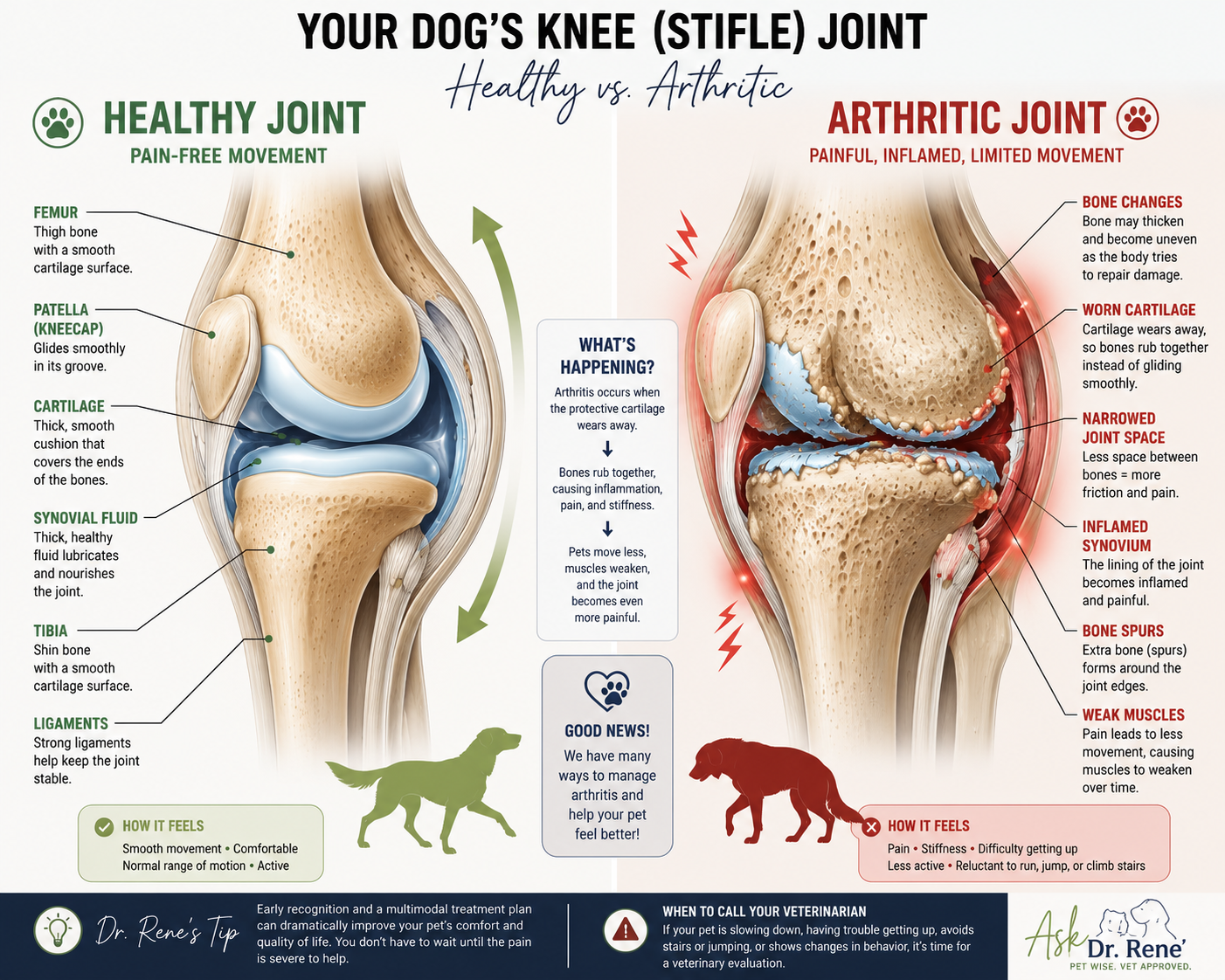
What Happens Inside an Arthritic Joint?
Arthritis—also called osteoarthritis or degenerative joint disease—develops when the protective cartilage covering the ends of the bones gradually wears away.
Interestingly, cartilage itself contains no nerves, so the early cartilage damage itself isn’t what causes pain.
The real problem begins as that protective cushion becomes thinner.
Without healthy cartilage:
- Bones no longer glide smoothly across one another.
- The joint becomes inflamed.
- Synovial fluid loses some of its protective and lubricating properties.
- The body attempts to repair the damage by producing extra bone, commonly called bone spurs.
- The joint capsule thickens and becomes less flexible.
- Surrounding muscles weaken as the pet begins using the joint less.
- Every movement becomes progressively more uncomfortable.
Over time, what was once a smooth, well-lubricated joint becomes stiff, inflamed, unstable, and painful.
Activities that once seemed effortless now hurt.
The Arthritis Cycle
One of the most frustrating aspects of arthritis is that it feeds on itself.
Pain causes pets to move less.
Less movement causes muscles to weaken.
Weaker muscles provide less support for already-damaged joints.
The joint becomes even more unstable and painful.
That increased pain causes even less movement.
This creates a vicious cycle that often continues for months—or even years—unless something interrupts it.
Fortunately, veterinarians don’t have to cure arthritis to dramatically improve a pet’s quality of life.
Our goal is to break this pain cycle.
When pain is reduced, pets naturally begin moving more. Increased movement strengthens muscles, improves joint support, maintains flexibility, and helps preserve mobility.
One positive change often leads to another.
Arthritis Is Incredibly Common
Many people are surprised to learn just how common arthritis really is.
Dogs
Research has shown that arthritis develops much earlier than most people realize.
Young Dogs: 8 Months to 4 Years
- Nearly 40% have radiographic evidence of arthritis in at least one joint.
- Approximately 20% already show physical signs of pain or decreased mobility.
Middle-Aged Dogs: 4 to 7 Years
- About 60% have radiographic evidence of arthritis.
- Approximately 40–50% show clinical signs of pain and reduced mobility.
Senior Dogs: 8 Years and Older
- Between 80% and 90% have radiographic evidence of arthritis.
- Roughly 80% experience physical symptoms associated with arthritis.
Cats
Cats tell an even more surprising story.
Studies have shown that approximately 60% of cats over six years of age have physical and radiographic evidence of arthritis.
By 12 years of age, more than 90% have arthritis affecting at least one joint.
Perhaps most surprising, early joint damage can begin developing in some cats as young as 1 to 2 years of age.
So why don’t more owners recognize it?
Because cats are masters at hiding pain.
Unlike dogs, cats rarely limp or cry out.
Instead, they make subtle changes in their daily routine.
They may:
- Jump less often or hesitate before jumping.
- Climb down from furniture instead of jumping.
- Sleep more than they used to.
- Stop visiting favorite elevated resting places.
- Use intermediate surfaces, such as chairs or stools, before reaching higher locations.
- Miss the litter box—especially when defecating—because climbing into the box is uncomfortable.
- Become less social or spend more time hiding.
- Walk with a stiff gait or appear slightly hunched after resting.
Many owners simply assume these are normal signs of aging.
In reality, many of these cats are living with chronic pain that can often be dramatically improved with treatment.
Arthritis Is Not Just an Old Pet Disease
Although arthritis becomes more common with age, it is not simply a disease of old pets.
Many younger dogs and cats develop arthritis because of inherited orthopedic conditions, previous injuries, or abnormal joint development.
Common risk factors include:
Developmental Conditions
- Hip dysplasia
- Elbow dysplasia
- Patellar luxation
- Other developmental orthopedic diseases
Previous Injuries
- Cruciate ligament tears
- Previous fractures
- Repetitive athletic injuries
Lifestyle Factors
- Obesity
Genetics
- Large- and giant-breed dogs
- Family history of orthopedic disease
Some pets begin developing arthritis as early as two years of age, particularly if they experienced joint injuries or developmental orthopedic disease during puppyhood or kittenhood.
Recognizing these risk factors allows veterinarians and pet owners to begin managing joint health long before severe arthritis develops.
The Bottom Line
Arthritis is common, painful, and progressive—but it is also manageable.
Changes that appear to be simple aging may actually be your pet’s way of adapting to chronic joint pain. The earlier arthritis is recognized, the sooner you and your veterinarian can begin protecting mobility, strengthening supporting muscles, reducing discomfort, and preserving the activities your pet still loves.
Your pet may not be able to tell you where it hurts, but changes in movement, behavior, and daily routines can speak volumes.
Frequently asked questions
Educational only. This article is not a substitute for veterinary care. If your pet is unwell, please contact your veterinarian.
Next in this series
Arthritis Learning Series · Part 1 of 16
Part 2: Recognizing Arthritis: The Signs Your Pet May Be Trying to Tell You
Most pets with arthritis never cry or limp dramatically. They simply stop doing the things they love. Learn the subtle signs of joint pain in dogs and cats, why pets hide discomfort, and when it is time to schedule a veterinary examination.
Continue readingKeep reading
Recognizing Arthritis: The Signs Your Pet May Be Trying to Tell You
Most pets with arthritis never cry or limp dramatically. They simply stop doing the things they love. Learn the subtle signs of joint pain in dogs and cats, why pets hide discomfort, and when it is time to schedule a veterinary examination.
Read DiseasesSolensia® for Cats: A New Way to Treat Arthritis Pain
Solensia® is a monthly monoclonal antibody injection approved to control osteoarthritis pain in cats. Learn how it blocks nerve growth factor, what improvements owners notice, who it may help, and the side effects to discuss with your veterinarian.
Read DiseasesHome Modifications for Arthritis: A Home That Works With Your Pet
Your pet's home environment can be as important as medication. Learn room-by-room changes — non-slip rugs, supportive beds, ramps, accessible bowls and litter boxes, and support harnesses — that make everyday life easier for arthritic pets.
ReadKeep learning with Dr. Rene'
Browse the library, search another topic, or ask a question of your own.
Continue your journey
Loved this? Here's what to do next.
Every visit is a chance to understand your pet a little better. Pick your next step.
Explore the Learning Center
Browse evidence-based articles about symptoms, diseases, medications, treatments, preventive care, and more.
Explore ArticlesWatch Dr. Rene'
Prefer to watch instead of read? Explore practical veterinary education videos from Dr. Rene'.
Watch VideosGet Free Resources
Explore practical veterinary guides, checklists, and tools designed to help pet owners feel more informed and prepared.
Browse Free ResourcesProducts I Recommend
Browse pet products, supplies, and everyday essentials selected and recommended by Dr. Rene'.
See My RecommendationsEducational consultation
Want help understanding a diagnosis, test results, medications, or treatment options? Book educational guidance with Dr. Rene'. This does not replace veterinary care.
Learn more