
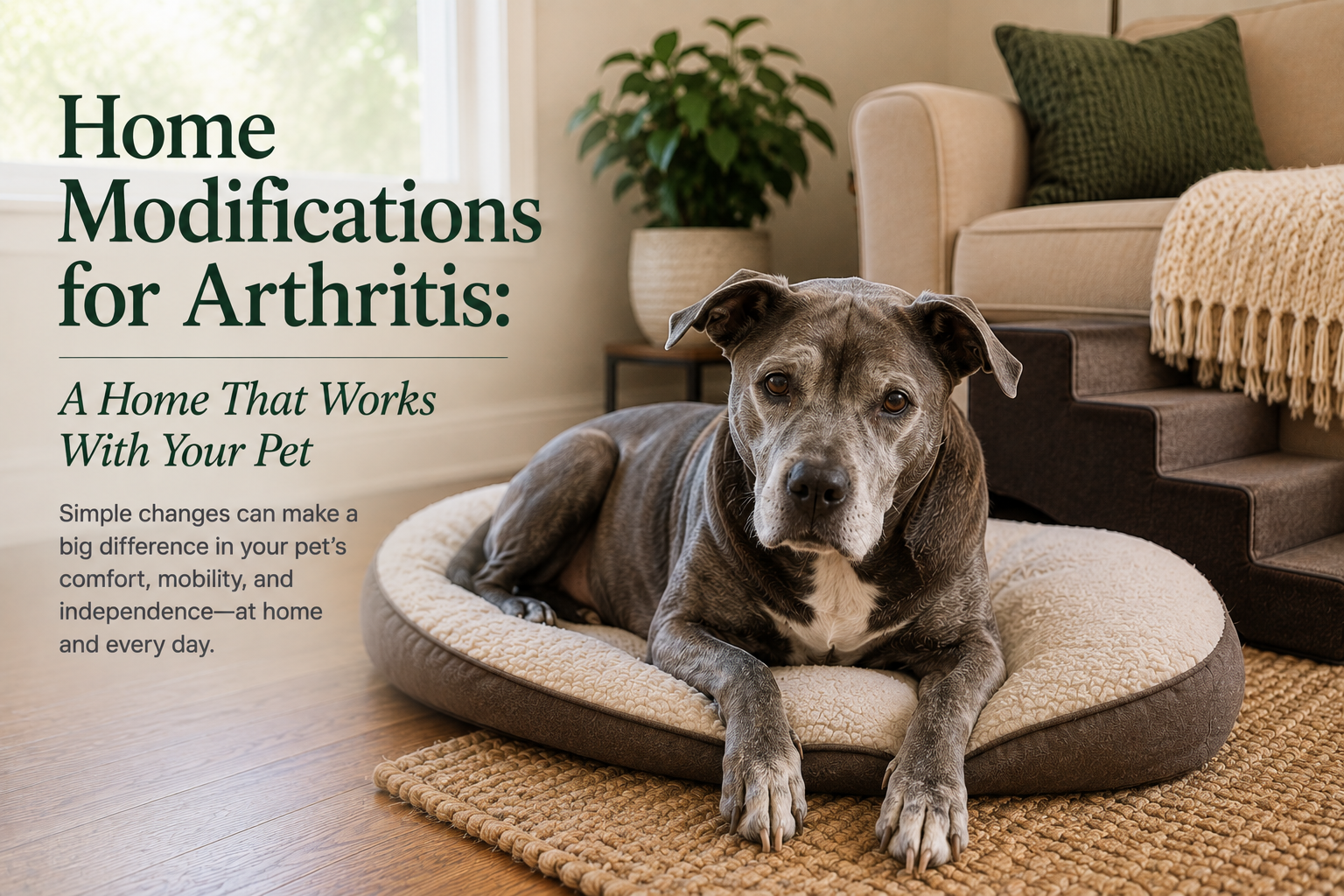
Home Modifications for Arthritis: A Home That Works With Your Pet
Traction, orthopedic beds, ramps, easier food and litter access, and mobility aids — simple changes that help arthritic dogs and cats move with comfort and confidence.
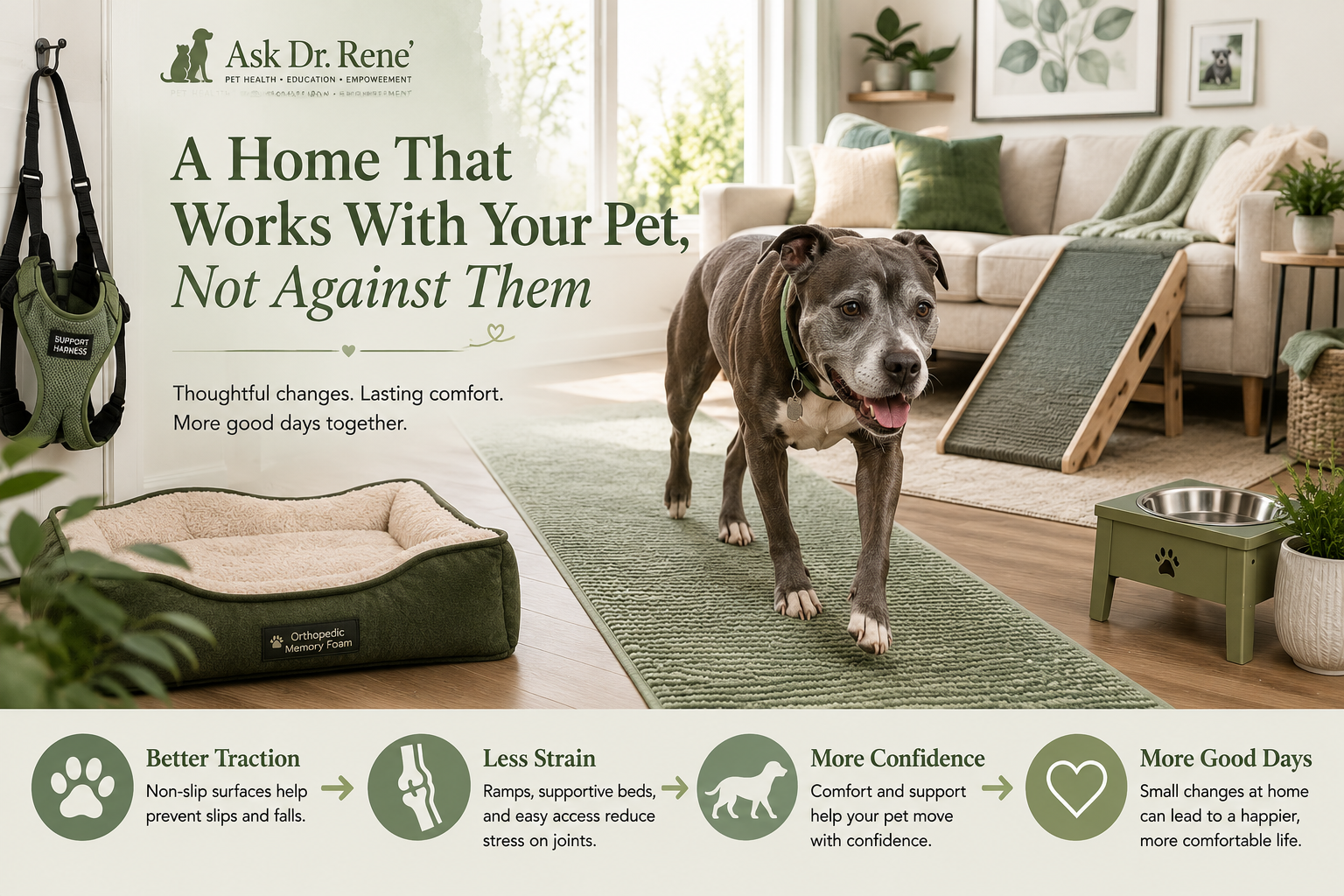
Your pet's home environment can be as important as medication. Learn room-by-room changes — non-slip rugs, supportive beds, ramps, accessible bowls and litter boxes, and support harnesses — that make everyday life easier for arthritic pets.
Quick answer
In this article you'll learn
- Why the home environment matters as much as medication
- How slippery floors erode a pet's confidence
- What to look for in an orthopedic bed
- When a ramp is better than stairs, and how to teach it
- How to make food, water, and litter boxes easier to use
- Which mobility aids help — and when to start them
- A room-by-room arthritis-friendly home checklist
When we think about treating arthritis, medications are often the first thing that come to mind.
Pain medications, joint supplements, weight loss, and rehabilitation are all incredibly important—but there's another piece of the puzzle that often gets overlooked: your pet's home environment.
The way your home is set up can have a tremendous impact on how comfortably your pet moves every single day. In many cases, small changes around the house can make daily activities easier, reduce the risk of injury, and help your pet stay independent for longer.
The best part? Many of these improvements are simple, affordable, and can be made today.
Why Your Home Matters
Arthritis doesn't just cause sore joints. It changes the way your pet moves through the world.
A dog that once leaped into the car without a second thought may now pause before jumping. A cat that used to race to the top of the cat tree may suddenly choose to stay on the floor.
These changes aren't laziness. They're often your pet's way of avoiding movements that have become painful or difficult.
As arthritis progresses, many pets naturally begin to:
- Take shorter steps
- Walk more slowly
- Slip more easily
- Hesitate before jumping
- Avoid stairs
- Sleep more
- Spend less time playing
Confidence Matters
Imagine slipping on an icy sidewalk. Even after you catch yourself, you're probably going to walk more cautiously the rest of the way.
Our pets experience something very similar. If your dog slips trying to stand up on hardwood floors, or your cat loses their footing while jumping onto the couch, they remember that experience.
Over time, many pets begin avoiding those situations altogether—not because they can't do them, but because they aren't confident they can do them safely. Restoring that confidence can be just as important as treating the pain itself.
Small Changes Can Make a Big Difference
You don't need to remodel your entire house to help an arthritic pet. Often, it's the little things that have the biggest impact: adding traction where your dog walks every day, giving your cat an easier way to reach a favorite window, providing a supportive bed that's easy to get in and out of, or using a ramp instead of asking your dog to jump into the car.
Take a slow walk through your home and imagine seeing it from your pet's perspective. Where do they spend most of their time? Where do they have to jump? Are there slippery areas they cross every day? Is their food and water easy to access? Does your cat have to climb or jump to reach the litter box?
Floors & Traction: Helping Your Pet Find Their Footing
If I could recommend just one home modification for most arthritic pets, it would be this: improve their traction.
Hardwood, laminate, tile, polished concrete, and luxury vinyl flooring may look beautiful, but they can be challenging for pets with arthritis. When their feet slide out from underneath them, painful joints have to work even harder to regain balance—and sometimes they can't.
Repeated slipping can lead to:
- Increased joint pain
- Muscle strains
- Falls
- Fear of walking on certain surfaces
- Loss of confidence
- Less daily activity
Signs your pet needs better traction include walking slowly across hardwood or tile, spreading their legs farther apart for balance, slipping when turning corners, struggling to stand after lying down, hesitating before entering certain rooms, or choosing to walk on rugs whenever possible.
You don't have to cover your entire house with carpet. Focus on hallways, living rooms, the path to food and water bowls, the route to the back door, areas around beds, in front of stairs, around litter boxes, and near favorite furniture. Creating a continuous path of secure footing is often more helpful than a single rug in the middle of a room.
Look for rugs or runners that have a non-slip backing, stay flat against the floor, are thick enough to provide traction without becoming a tripping hazard, and are easy to wash.
Don't forget nail care. When nails become too long, they reduce the amount of paw pad that contacts the floor—less paw pad means less natural grip. Trimming the fur between the paw pads also helps many dogs, since excess hair acts like a slipper on smooth floors.
Toe grips, paw wax, grip socks, and adhesive paw pads help some pets, while others dislike wearing them. Every pet is different.
Older cats face the same challenges. Providing stable surfaces near favorite resting places, food bowls, and litter boxes can make moving around the home much easier.
Beds & Resting Areas: Giving Achy Joints the Support They Need
Pets with arthritis usually rest more than they used to, which makes their bed part of their treatment plan.
When an arthritic pet lies on a hard surface for hours, the weight of their body places constant pressure on sore joints. A supportive bed distributes weight more evenly, reducing pressure points on hips, elbows, shoulders, and spine.
When shopping for an orthopedic bed, look for one that:
- Uses supportive memory foam or high-density foam
- Is thick enough that your pet doesn't sink through to the floor
- Is large enough for your pet to stretch out comfortably
- Has a washable, durable cover
- Holds its shape over time
Many dogs love bolstered beds, but the raised sides shouldn't make it difficult to get in or out. If your dog struggles to step over the edge, a low-profile orthopedic bed may be a better choice.
Place beds where your pet already likes to spend time, and consider a comfortable bed on each floor so your pet doesn't have to climb stairs just to rest.
Many arthritic pets enjoy gentle warmth. If you use a heated pet bed, follow the manufacturer's safety instructions, make sure your pet can move away if they become too warm, and avoid human heating pads unless your veterinarian specifically recommends them.
Ramps & Stairs: Helping Your Pet Get Where They Want to Go
For many pets with arthritis, the hardest part of the day isn't walking across the yard—it's getting up. Into the car. Onto the couch. Up the porch steps.
Every jump down from a bed, couch, or vehicle sends force back through already painful joints.
Your pet doesn't have to refuse to jump before a ramp becomes helpful. Signs a ramp may help include:
- Hesitating before jumping
- Taking multiple attempts to get into the car
- Needing a running start
- Slipping during takeoff or landing
- Crying out after jumping
- Avoiding favorite furniture
Ramps generally place less stress on arthritic joints than stairs because they allow your pet to walk instead of climb. They're often my first recommendation for large or heavy dogs, pets with hip arthritis or knee problems, dogs with neurologic disease, and pets that have difficulty balancing.
Choose a ramp with a non-slip surface, a sturdy feel, enough width for confident footing, and the gentlest incline your space allows. A steep ramp may be almost as difficult as jumping.
Most pets need time to learn a ramp is safe. Start with it flat on the ground, reward your pet for walking across it, and gradually add incline. Never force or pull your pet onto the ramp.
Many older cats benefit from a small ramp or sturdy steps to reach a favorite windowsill, the couch, the bed, or a low cat tree.
Food, Water & Litter Boxes: Making Everyday Routines Easier
Some of the most important moments happen dozens of times a day: walking to the water bowl, standing to eat breakfast, using the litter box.
If bending down causes discomfort—especially for dogs with arthritis in the neck, shoulders, elbows, or front legs—raising food and water bowls may reduce strain. However, elevated feeding has been associated with an increased risk of gastric dilatation-volvulus (bloat) in some large and giant breed dogs, so discuss it with your veterinarian first.
If your home has multiple floors, place water bowls in several locations so your pet doesn't have to walk long distances or climb stairs every time they're thirsty.
For arthritic cats, one of the biggest quality-of-life improvements has nothing to do with medication—it's the litter box. Consider:
- A litter box with one low entry side
- A larger box that allows easy turning
- A box that doesn't require climbing or jumping
- Placement in a quiet, easily accessible location
Ideally, each level where your cat spends time should have a litter box, fresh water, and a comfortable resting place.
Pay attention if your pet stops finishing meals while standing, drinks less water, begins eliminating outside the litter box, hesitates before entering it, or seems uncomfortable while eating. These changes aren't always behavioral.
Harnesses & Mobility Aids: Providing Support Without Taking Away Independence
Introducing a mobility aid earlier can prevent falls, reduce strain, and help your pet stay active longer. Signs your pet may benefit include difficulty standing after lying down, trouble climbing stairs, struggling to get into the car, frequent slipping, hind-leg weakness, and fatiguing more quickly than they used to.
Support harnesses let you assist your dog without putting pressure on their neck. Sturdy handles make it easier to help your dog stand, assist with stairs, support them getting into the car, and steady them on slippery surfaces.
Rear-end support slings fit beneath the abdomen or hips and let you gently lift part of your dog's weight while they continue walking—especially helpful after long naps, during bathroom breaks, on stairs, and during flare-ups.
Full-body harness systems assist all four limbs and are useful for pets with arthritis affecting multiple joints or with both orthopedic and neurologic conditions.
Wheelchairs can be life-changing for carefully selected patients with severe mobility limitations, but they don't treat arthritis and most dogs still need enough strength in their unaffected limbs. Work with your veterinarian or a rehabilitation specialist before choosing one.
Your Arthritis-Friendly Home Checklist
You don't have to make every change overnight. Start with one or two improvements, see how your pet responds, and build from there.
Around the house:
- Place non-slip runners or rugs in frequently traveled areas
- Make sure rugs have a non-slip backing
- Keep nails trimmed to improve traction
- Trim excess hair between the paw pads if recommended
- Remove clutter from common walking paths
Resting areas:
- Provide a supportive orthopedic bed
- Place beds where your pet naturally spends time
- Consider additional beds on different floors
- Make sure your pet can easily get in and out of the bed
Food and water:
- Keep fresh water readily available
- Add bowls if your home has multiple levels
- Discuss elevated bowls with your veterinarian
Cars, furniture, and stairs:
- Use a ramp whenever jumping has become difficult
- Consider pet stairs for appropriate small dogs
- Use a support harness if recommended
Cats:
- Provide a low-entry litter box
- Place litter boxes on every level where your cat spends time
- Add steps or ramps to favorite resting places
Seasonal Tips
Winter: allow a longer warm-up before walks, provide cozy orthopedic bedding, use a coat for dogs that tolerate them, and limit time outdoors during extreme cold.
Summer: walk during cooler morning or evening hours, bring water on longer outings, watch for signs of overheating, and avoid hot pavement.
Rainy weather: shorter walks, indoor enrichment, gentle stretching, and puzzle toys can help keep your pet active until the weather improves.
Frequently asked questions
Educational only. This article is not a substitute for veterinary care. If your pet is unwell, please contact your veterinarian.
Next in this series
Arthritis Learning Series · Part 13 of 16
Part 14: Common Myths About Arthritis: Separating Fact From Fiction
Aging isn't painful, a wagging tail doesn't rule out pain, and exercise doesn't wear joints out faster. Dr. Rene' separates arthritis fact from fiction.
Continue readingKeep reading
Arthritis in Dogs and Cats: What Every Pet Owner Should Know
Arthritis is one of the most common causes of chronic pain in dogs and cats, yet the earliest signs are often mistaken for normal aging. Learn what happens inside an arthritic joint, which pets are at risk, and how early treatment can protect comfort and mobility.
Read DiseasesRecognizing Arthritis: The Signs Your Pet May Be Trying to Tell You
Most pets with arthritis never cry or limp dramatically. They simply stop doing the things they love. Learn the subtle signs of joint pain in dogs and cats, why pets hide discomfort, and when it is time to schedule a veterinary examination.
Read DiseasesExercise & Physical Rehabilitation: Motion Is Medicine
For most pets with arthritis, the goal isn't less movement—it's better movement. Learn which activities help, how physical rehabilitation and laser therapy fit in, how to exercise a cat, and when to stop.
ReadKeep learning with Dr. Rene'
Browse the library, search another topic, or ask a question of your own.
Continue your journey
Loved this? Here's what to do next.
Every visit is a chance to understand your pet a little better. Pick your next step.
Explore the Learning Center
Browse evidence-based articles about symptoms, diseases, medications, treatments, preventive care, and more.
Explore ArticlesWatch Dr. Rene'
Prefer to watch instead of read? Explore practical veterinary education videos from Dr. Rene'.
Watch VideosGet Free Resources
Explore practical veterinary guides, checklists, and tools designed to help pet owners feel more informed and prepared.
Browse Free ResourcesProducts I Recommend
Browse pet products, supplies, and everyday essentials selected and recommended by Dr. Rene'.
See My RecommendationsEducational consultation
Want help understanding a diagnosis, test results, medications, or treatment options? Book educational guidance with Dr. Rene'. This does not replace veterinary care.
Learn more