
Solensia® for Cats: A New Way to Treat Arthritis Pain
A monthly injection that targets feline arthritis pain—and what every cat owner should know about its benefits and reported risks.
Solensia® is a monthly monoclonal antibody injection approved to control osteoarthritis pain in cats. Learn how it blocks nerve growth factor, what improvements owners notice, who it may help, and the side effects to discuss with your veterinarian.

Quick answer
In this article you'll learn
- Why cats hide arthritis pain so well
- What Solensia® is and how blocking NGF reduces pain
- How it differs from traditional pain medications
- The behavioral improvements owners commonly notice
- Common side effects and reported serious adverse events
- What monitoring looks like over time
Introduction
Cats are masters at hiding pain.
Unlike dogs, they rarely limp or cry when arthritis develops. Instead, they quietly stop doing the things they once loved—jumping onto the windowsill, climbing the cat tree, chasing toys, or greeting you at the door.
Many owners assume their cat is “just slowing down with age.”
In reality, many senior cats are living with chronic osteoarthritis pain.
One of the newest treatments available is Solensia®, a monthly injectable medication specifically developed for cats with osteoarthritis pain.
Like Librela® in dogs, Solensia belongs to a newer class of medications called monoclonal antibodies. Rather than treating inflammation directly, it targets one of the body's major pain pathways.
For many cats, the changes can be surprisingly subtle—but incredibly meaningful.
Owners often tell me:
“He's jumping onto the bed again.”
“She's grooming herself like she used to.”
“He's playing with toys for the first time in years.”
At the same time, every medication has potential benefits and potential risks. Understanding both helps owners make informed decisions together with their veterinarian.
What Is Solensia?
Solensia is a monthly injectable monoclonal antibody approved for the control of osteoarthritis pain in cats.
Rather than affecting many different body systems, Solensia targets a single protein involved in pain transmission called Nerve Growth Factor (NGF).
What Is Nerve Growth Factor?
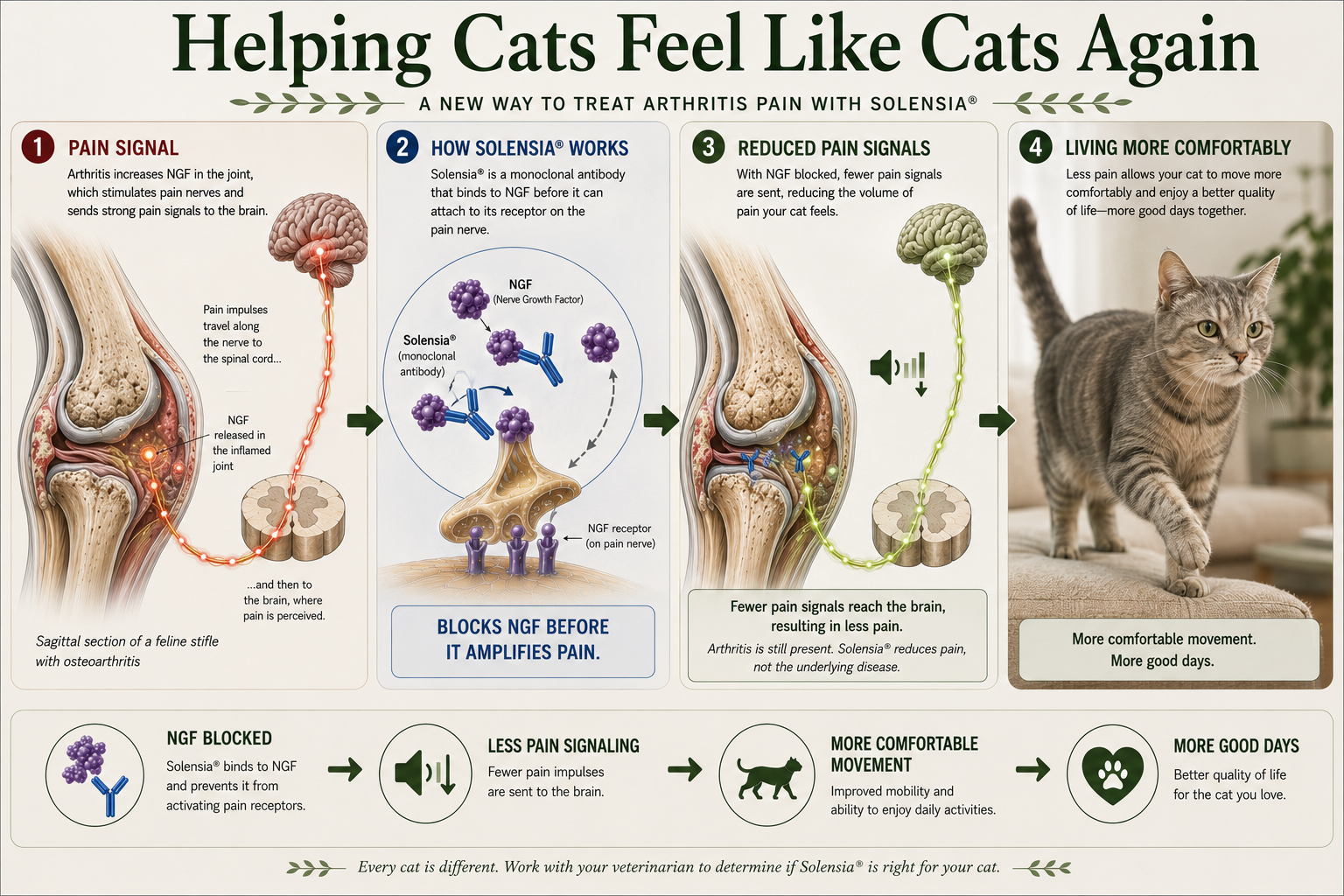
NGF is a naturally occurring protein that becomes elevated in painful arthritic joints.
As NGF binds to pain receptors, it amplifies pain signals traveling from the joint to the brain.
Think of it like turning the volume knob higher on pain.
Solensia binds to NGF before it reaches its receptor, reducing the intensity of pain signals.
It does not repair damaged cartilage.
It does not cure arthritis.
It helps cats experience less pain while living with arthritis.
How Is Solensia Different From Traditional Pain Medications?
Traditional medications often reduce inflammation or affect multiple pain pathways.
Solensia works differently.
It specifically targets NGF, reducing pain signaling without acting like a traditional NSAID.
For many cats—especially those with concurrent diseases such as chronic kidney disease—this different mechanism of action may make it an appropriate option, although every cat should be evaluated individually by a veterinarian.
What Can Owners Expect?
Every cat responds differently.
Some owners notice changes within the first few weeks.
Others observe gradual improvement over the first two or three monthly injections.
The changes are often behavioral rather than dramatic.
Owners frequently notice:
- Jumping onto furniture again
- Improved grooming
- More interaction with the family
- Better mobility
- Increased willingness to climb stairs
- More interest in toys
- Improved comfort while resting
- Better overall attitude
Sometimes the biggest improvement is simply:
“My cat acts like herself again.”
Who Is a Good Candidate?
Solensia may be appropriate for cats with osteoarthritis pain, particularly those who:
- Have confirmed arthritis
- Have difficulty taking daily medications
- Need long-term pain management
- May not be ideal candidates for long-term NSAID therapy
- Benefit from a multimodal arthritis management plan
Your veterinarian will determine whether Solensia is appropriate based on your cat's medical history, physical examination, and overall health.
Are There Side Effects?
Like every medication, Solensia has potential risks as well as potential benefits.
Many cats tolerate Solensia well and experience meaningful improvements in comfort and mobility.
However, owners should understand both the common side effects and the less common but more serious adverse events reported after approval.
Commonly Reported Side Effects
Commonly reported reactions include:
- Vomiting
- Diarrhea
- Injection-site discomfort
- Mild lethargy
- Decreased appetite
These are often mild and temporary, but your veterinarian should be informed if they occur.
Serious Adverse Events Have Been Reported
Rare but serious adverse events have also been reported through post-marketing safety monitoring.
Reported events have included:
- Difficulty walking
- Weakness
- Seizures
- Collapse
- Severe lethargy
- Death in rare reported cases
As with Librela, post-marketing reports do not prove that Solensia caused every reported event. Many cats receiving Solensia are elderly and have multiple concurrent medical conditions.
Nevertheless, these reports are important and should be part of the discussion before beginning treatment.
When Should You Contact Your Veterinarian?
Contact your veterinarian promptly if your cat develops:
Monitoring Your Cat
Although routine bloodwork monitoring is not required specifically because of Solensia, regular veterinary examinations remain important.
Regular monitoring helps ensure your cat continues to receive the most appropriate care as arthritis changes over time.
Your veterinarian may evaluate:
- Mobility
- Body weight
- Muscle condition
- Grooming behavior
- Activity level
- Pain assessment
- Overall quality of life
Treatment plans may be adjusted over time as arthritis progresses or other health conditions change.
Is Solensia a Cure?
No.
Solensia does not reverse arthritis or regenerate damaged cartilage.
Instead, it reduces pain so cats can move more comfortably and enjoy their normal behaviors again.
For many cats, that means:
- Better mobility
- More jumping
- Better grooming
- More interaction
- Greater confidence
- Improved quality of life
Like every arthritis treatment, Solensia works best as part of a comprehensive management plan that may include weight management, environmental modifications, and regular veterinary care.
Dr. Rene's Perspective
Take-Home Message
Frequently asked questions
Educational only. This article is not a substitute for veterinary care. If your pet is unwell, please contact your veterinarian.
Next in this series
Arthritis Learning Series · Part 11 of 16
Part 12: Joint Supplements for Arthritis in Dogs & Cats: What Actually Works?
Do joint supplements really work? A veterinarian walks through the evidence behind glucosamine, chondroitin, ASU, MSM, green-lipped mussel, UC-II®, omega-3 fatty acids, and CBD — plus how to choose a quality product and which supplements I recommend for dogs and cats.
Continue readingKeep reading
Arthritis Medications: Finding the Right Treatment for Your Pet
What's the best arthritis medication? Usually, there isn't just one. Learn how multimodal pain management combines medications, weight management, rehabilitation, and supplements—and why safety and realistic goals matter.
Read DiseasesArthritis in Dogs and Cats: What Every Pet Owner Should Know
Arthritis is one of the most common causes of chronic pain in dogs and cats, yet the earliest signs are often mistaken for normal aging. Learn what happens inside an arthritic joint, which pets are at risk, and how early treatment can protect comfort and mobility.
Read DiseasesLibrela® for Dogs: A New Way to Treat Arthritis Pain
Librela® is a monthly injection that blocks Nerve Growth Factor to reduce arthritis pain in dogs. Learn how it works, who it helps, what to expect, and the reported side effects to discuss with your veterinarian.
ReadKeep learning with Dr. Rene'
Browse the library, search another topic, or ask a question of your own.
Continue your journey
Loved this? Here's what to do next.
Every visit is a chance to understand your pet a little better. Pick your next step.
Explore the Learning Center
Browse evidence-based articles about symptoms, diseases, medications, treatments, preventive care, and more.
Explore ArticlesWatch Dr. Rene'
Prefer to watch instead of read? Explore practical veterinary education videos from Dr. Rene'.
Watch VideosGet Free Resources
Explore practical veterinary guides, checklists, and tools designed to help pet owners feel more informed and prepared.
Browse Free ResourcesProducts I Recommend
Browse pet products, supplies, and everyday essentials selected and recommended by Dr. Rene'.
See My RecommendationsEducational consultation
Want help understanding a diagnosis, test results, medications, or treatment options? Book educational guidance with Dr. Rene'. This does not replace veterinary care.
Learn more