
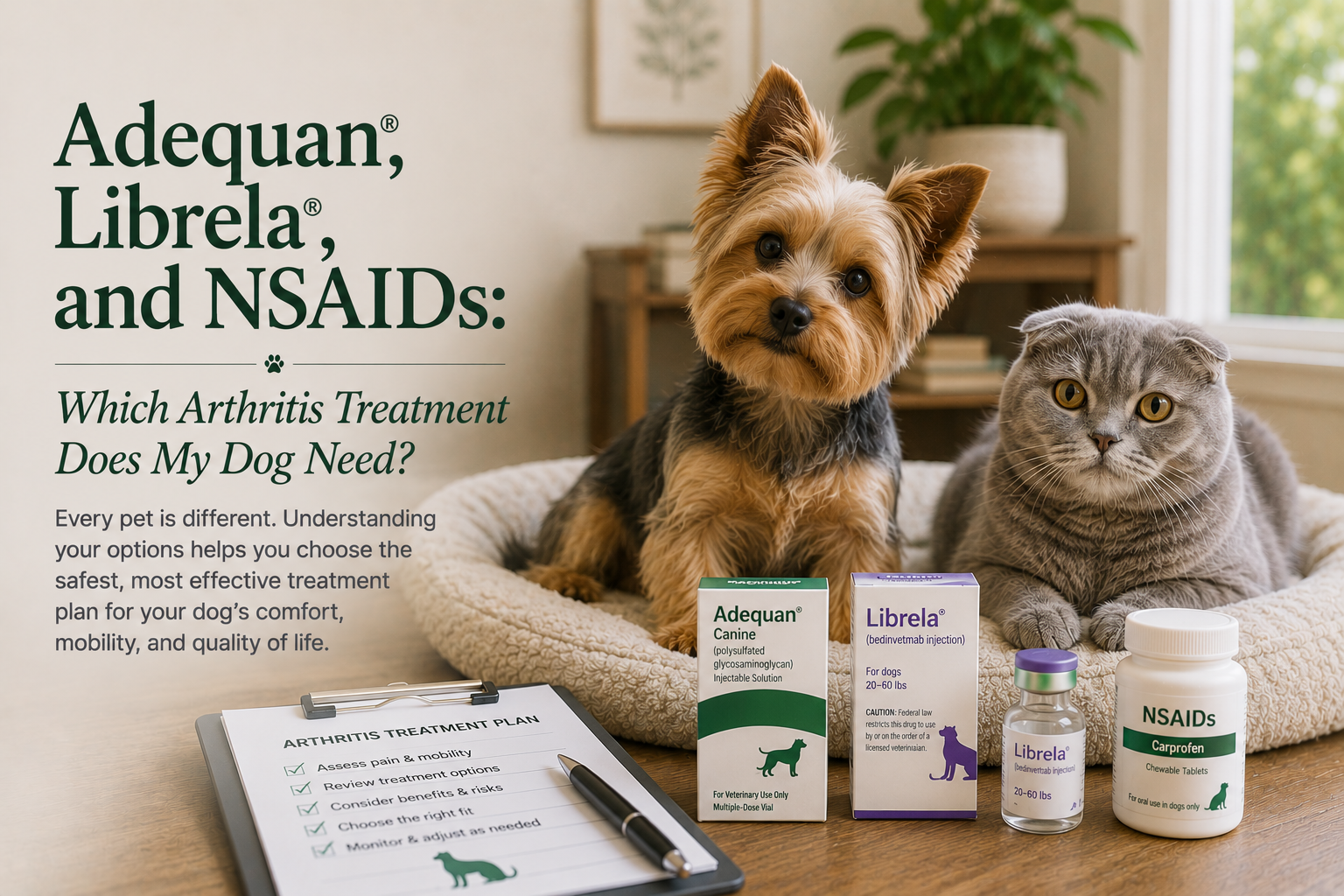
Adequan®, Librela®, and NSAIDs: Which Arthritis Treatment Does My Dog Need?
Three very different arthritis therapies—and why many dogs do best when they work together.
NSAIDs, Adequan®, and Librela® each treat arthritis in a completely different way. Learn what each one does, how they compare, and why combining them is often the most effective approach.
Quick answer
In this article you'll learn
- How NSAIDs, Adequan®, and Librela® each work
- The strengths and limitations of NSAIDs
- Why Adequan® is an investment in long-term joint health
- How Librela® reduces pain signals to the brain
- Which treatments can safely be combined
- Why not every dog needs all three
One of the most common questions I hear from owners is:
“If my dog is already getting Librela®, do they still need Adequan®?”
Or...
“Can I stop my dog's anti-inflammatory medication now that they're getting injections?”
It's an understandable question.
After all, if several treatments help arthritis, why would a dog need more than one?
The answer is simple:
Because they work in completely different ways.
Rather than competing with one another, these medications often complement each other.
Understanding the difference helps explain why veterinarians frequently recommend using more than one arthritis therapy at the same time.

NSAIDs: Reducing Pain and Inflammation
Examples include:
- Carprofen (Rimadyl®, Novox®)
- Meloxicam (Metacam®)
- Deracoxib (Deramaxx®)
- Firocoxib (Previcox®)
- Robenacoxib (Onsior®)
These medications work by blocking inflammatory chemicals (COX enzymes) that contribute to pain and inflammation.
For many dogs, NSAIDs provide rapid and significant pain relief.
They're often the first prescription medication used for osteoarthritis.
Strengths
- Excellent pain control.
- Strong scientific evidence.
- Rapid onset of action.
- Improve daily comfort and mobility.
Limitations
- Do not repair damaged cartilage.
- Require monitoring in many patients.
- Not appropriate for every dog, especially those with certain kidney, liver, stomach, or bleeding disorders.
Adequan®: Supporting the Joint
Adequan works very differently.
Instead of primarily blocking pain, it helps support the health of the joint itself.
Research suggests it may:
- Protect cartilage.
- Reduce cartilage breakdown.
- Improve joint lubrication.
- Reduce inflammation within the joint.
Adequan doesn't usually provide the dramatic pain relief that an NSAID can, but over time it may help preserve joint function.
I often think of Adequan as an investment in the long-term health of the joint.
Librela®: Turning Down the Pain Signal
Librela is one of the newest arthritis treatments available.
Rather than acting on inflammation or cartilage, Librela targets a protein called nerve growth factor (NGF), which plays an important role in transmitting pain.
By blocking NGF, Librela helps reduce the pain signals reaching the brain.
Many owners notice improvements in:
- Rising from lying down.
- Walking.
- Climbing stairs.
- Playing.
- Overall activity.
It is given as a once-monthly injection by your veterinarian.
So...Which One Is Better?
The honest answer is:
None of them.
They're designed to do different jobs.
Think of arthritis like a three-legged stool.
Each treatment supports a different part of the problem.
| Treatment | Primary Goal |
|---|---|
| NSAIDs | Reduce inflammation and pain |
| Adequan® | Support and protect the joint |
| Librela® | Reduce pain signals traveling to the brain |
That's why many dogs benefit from more than one treatment.
Can They Be Used Together?
Yes—and they often are.
Depending on your dog's medical history, your veterinarian may recommend combinations such as:
- Weight management + NSAID.
- NSAID + Adequan.
- Librela + Adequan.
- Librela + rehabilitation.
- NSAID + Librela (in selected patients).
- All three, along with exercise and home modifications.
Using multiple therapies that work in different ways is called multimodal pain management, and it's considered one of the most effective approaches to treating chronic arthritis.
Will Every Dog Need All Three?
No.
Some dogs do beautifully with weight management and an NSAID.
Others may receive only Librela.
Some respond exceptionally well to Adequan.
And some dogs with advanced arthritis truly benefit from combining all three.
There isn't a single recipe that works for every patient.
That's why regular rechecks and individualized treatment plans are so important.
My Perspective
Quick Comparison
| Feature | NSAIDs | Adequan® | Librela® |
|---|---|---|---|
| Primary purpose | Pain & inflammation | Joint support | Pain control |
| How quickly it works | Days | Weeks | Often within days to a month |
| Helps protect cartilage | No | Yes | No |
| Monthly injection | No | Sometimes (maintenance varies) | Yes |
| Can be combined with the others | Yes | Yes | Yes |
| Long-term role | Pain management | Joint preservation | Chronic pain management |
My Recommendation
I don't think of these as competing therapies.
I think of them as teammates.
For many dogs, combining the right treatments—along with weight management, exercise, rehabilitation, and regular veterinary care—provides far better results than relying on any single medication alone.
Frequently asked questions
Educational only. This article is not a substitute for veterinary care. If your pet is unwell, please contact your veterinarian.
Next in this series
Arthritis Learning Series · Part 10 of 16
Part 11: Solensia® for Cats: A New Way to Treat Arthritis Pain
Solensia® is a monthly monoclonal antibody injection approved to control osteoarthritis pain in cats. Learn how it blocks nerve growth factor, what improvements owners notice, who it may help, and the side effects to discuss with your veterinarian.
Continue readingKeep reading
Librela® for Dogs: A New Way to Treat Arthritis Pain
Librela® is a monthly injection that blocks Nerve Growth Factor to reduce arthritis pain in dogs. Learn how it works, who it helps, what to expect, and the reported side effects to discuss with your veterinarian.
Read DiseasesArthritis Medications: Finding the Right Treatment for Your Pet
What's the best arthritis medication? Usually, there isn't just one. Learn how multimodal pain management combines medications, weight management, rehabilitation, and supplements—and why safety and realistic goals matter.
Read DiseasesAdequan®: One of the Most Underused Arthritis Treatments in Veterinary Medicine
Adequan® Canine is one of the few FDA-approved medications designed to support joint health, not just relieve pain. Learn how it works, how it's given, which dogs benefit most, and why it's often overlooked.
ReadKeep learning with Dr. Rene'
Browse the library, search another topic, or ask a question of your own.
Continue your journey
Loved this? Here's what to do next.
Every visit is a chance to understand your pet a little better. Pick your next step.
Explore the Learning Center
Browse evidence-based articles about symptoms, diseases, medications, treatments, preventive care, and more.
Explore ArticlesWatch Dr. Rene'
Prefer to watch instead of read? Explore practical veterinary education videos from Dr. Rene'.
Watch VideosGet Free Resources
Explore practical veterinary guides, checklists, and tools designed to help pet owners feel more informed and prepared.
Browse Free ResourcesProducts I Recommend
Browse pet products, supplies, and everyday essentials selected and recommended by Dr. Rene'.
See My RecommendationsEducational consultation
Want help understanding a diagnosis, test results, medications, or treatment options? Book educational guidance with Dr. Rene'. This does not replace veterinary care.
Learn more