
Librela® for Dogs: A New Way to Treat Arthritis Pain
How this monthly monoclonal antibody injection turns down arthritis pain—and what every owner should know about the benefits and reported risks.
Librela® is a monthly injection that blocks Nerve Growth Factor to reduce arthritis pain in dogs. Learn how it works, who it helps, what to expect, and the reported side effects to discuss with your veterinarian.

Quick answer
In this article you'll learn
- What Librela® is and how blocking NGF reduces pain
- How Librela® differs from traditional NSAIDs
- What improvements owners typically notice, and how quickly
- Which dogs tend to be good candidates
- Common side effects and the serious adverse events that have been reported
- What to monitor and when to call your veterinarian
Introduction
If your dog has been diagnosed with arthritis, your veterinarian may have mentioned a medication called Librela®.
For many owners, this is the first time they've heard of it.
Unlike traditional arthritis medications that reduce inflammation, Librela works in an entirely different way.
It's part of a newer class of medications called monoclonal antibodies that target one of the body's key pain pathways.
For many dogs, Librela has been life-changing.
Owners often tell me things like:
“He's playing with toys again.”
“She can get into the car by herself.”
“I didn't realize how much pain she had been living with.”
At the same time, no medication is perfect.
Librela isn't the right choice for every dog, and it's important to understand both its benefits and its potential risks before deciding whether it's the right fit for your pet.
What Is Librela?
Librela is a monthly injectable monoclonal antibody approved for the control of osteoarthritis pain in dogs.
Unlike pain medications that affect many different parts of the body, Librela was designed to target a single protein involved in transmitting pain.
That protein is called Nerve Growth Factor (NGF).
What Is Nerve Growth Factor?
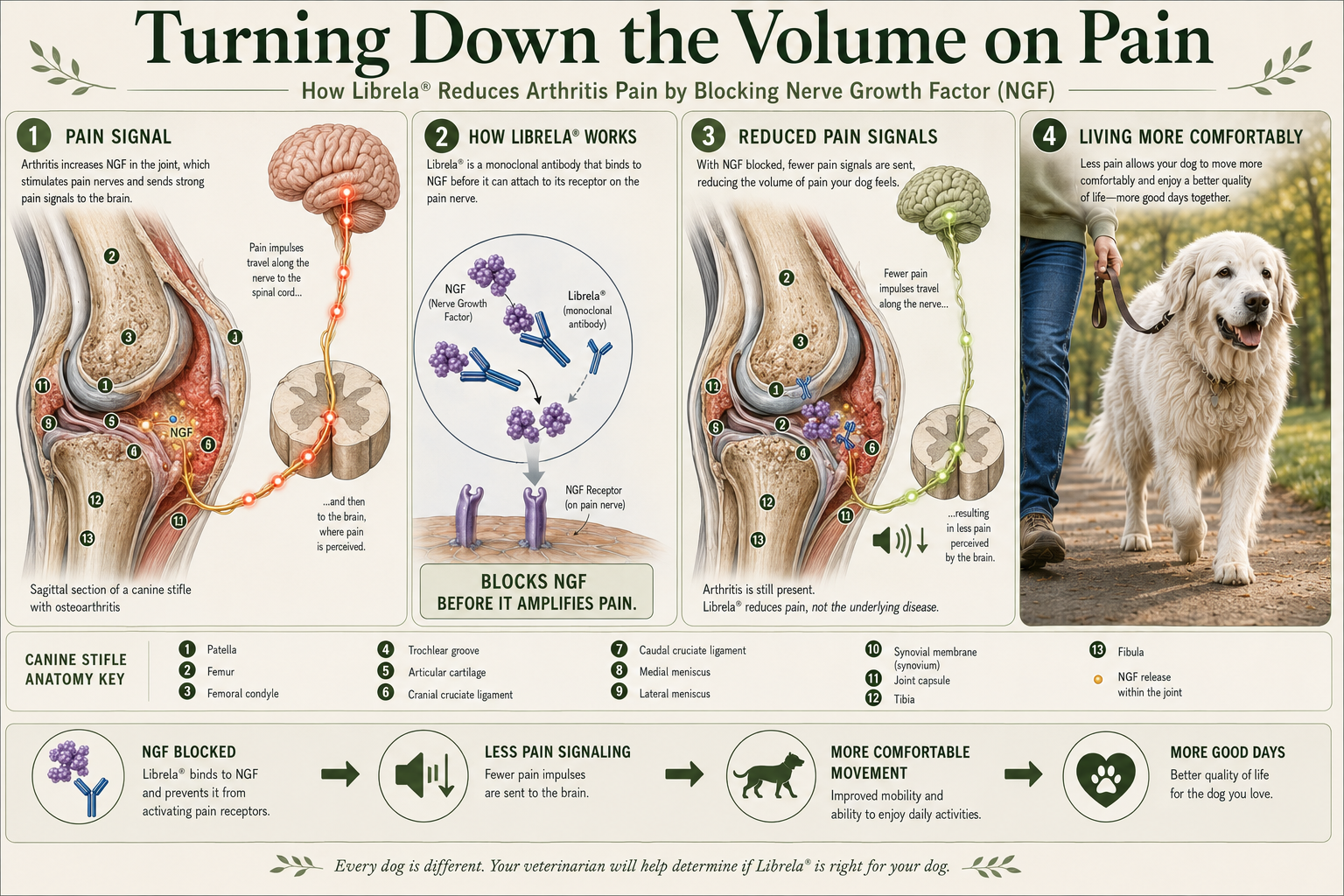
Nerve Growth Factor, or NGF, is a naturally occurring protein in the body.
One of its jobs is helping pain nerves become more sensitive after injury or inflammation.
In an arthritic joint, NGF levels increase.
As NGF binds to pain receptors, it amplifies pain signals traveling from the joint to the brain.
Think of it like someone turning up the volume on a speaker.
The arthritis is still present, but the pain signal becomes louder.
Librela works by attaching to NGF before it can activate those pain receptors.
In simple terms, it turns the volume back down.
It doesn't repair damaged cartilage or cure arthritis.
What it can do is significantly reduce the pain associated with the disease.
How Is Librela Different From NSAIDs?
One of the biggest differences owners should understand is how these medications work.
Traditional NSAIDs reduce inflammation by blocking enzymes involved in the inflammatory process.
Librela doesn't reduce inflammation directly.
Instead, it blocks Nerve Growth Factor (NGF), reducing the transmission of pain signals from the affected joint to the brain.
Because they work differently, some dogs respond better to one treatment than another, and many dogs benefit from a multimodal arthritis management plan that combines medications with weight management, rehabilitation, exercise, and environmental modifications.
Librela® vs NSAIDs
| Librela® | NSAIDs | |
|---|---|---|
| How it works | Monoclonal antibody that binds Nerve Growth Factor (NGF) to reduce pain signal transmission | Blocks enzymes in the inflammatory pathway to reduce inflammation and pain |
| How it's given | Monthly injection given in the veterinary hospital | Daily oral medication given at home |
| Effect on inflammation | Does not reduce inflammation directly | Directly reduces inflammation |
| Typical monitoring | No routine bloodwork required; recheck comfort and mobility | Routine bloodwork recommended for long-term use |
| Common side effects | Injection-site soreness, temporary lethargy, decreased appetite, vomiting, diarrhea | Digestive upset, and less commonly kidney or liver effects |
| Often chosen when | Daily pills are difficult, or NSAIDs aren't tolerated | Inflammation is a major driver of pain and the dog tolerates NSAIDs well |
What Can Owners Expect?
One of the most common questions I hear is:
“How quickly will it work?”
The answer varies from dog to dog.
Some owners notice improvement within the first week.
Others may not notice significant improvement until after the second monthly injection.
Most improvements are subtle rather than dramatic.
Owners commonly report:
- Easier time standing up
- More enthusiasm for walks
- Better ability to climb stairs
- Jumping onto furniture again
- More interest in playing
- Improved overall attitude
- Sleeping more comfortably
Sometimes the biggest clue is simply hearing:
“He acts like himself again.”
Who Is a Good Candidate?
Librela may be appropriate for dogs with osteoarthritis pain, particularly those who:
- Need additional pain control
- Cannot tolerate NSAIDs because of underlying medical conditions or side effects
- Have difficulty taking daily oral medications
- Would benefit from a long-acting monthly treatment
- Need another component of a multimodal arthritis treatment plan
Your veterinarian will determine whether Librela is appropriate based on your dog's overall health, arthritis severity, medical history, and current medications.
Are There Side Effects?
Like every medication, Librela has potential risks as well as potential benefits.
The vast majority of dogs tolerate Librela well, and many experience meaningful improvements in comfort and mobility.
However, no medication is completely risk-free. Understanding the possible adverse effects helps owners make informed decisions alongside their veterinarian.
Commonly Reported Side Effects
The more commonly reported side effects include:
- Mild soreness at the injection site
- Temporary lethargy
- Decreased appetite
- Vomiting
- Diarrhea
These signs are often mild and self-limiting, but you should still let your veterinarian know if they occur.
Serious Adverse Events Have Been Reported
Following approval, veterinarians and owners have reported rare but serious adverse events through post-marketing safety monitoring. These reports have resulted in updates to the official prescribing information and client information sheet.
Reported serious adverse events include:
- Difficulty walking or loss of coordination (ataxia)
- Weakness or difficulty standing
- Paresis or paralysis
- Proprioceptive deficits (reduced awareness of limb position)
- Seizures
- Urinary incontinence or changes in urination
- Increased thirst
- Marked lethargy or inability to rise
In some reported cases, these events have been severe enough to result in euthanasia or death.
It is important to understand that post-marketing reports do not automatically prove that Librela caused these events. Many dogs receiving Librela are older patients with multiple medical conditions, making it difficult to determine whether the medication, an underlying disease, or another factor contributed to the outcome.
Even so, these reports are taken seriously by veterinary regulatory agencies, and owners should be aware of them before making treatment decisions.
What About Rapidly Progressive Osteoarthritis?
Another concern receiving increased attention within the veterinary community is rapidly progressive osteoarthritis (RPOA).
A small number of dogs have experienced unexpectedly rapid deterioration of affected joints after receiving Librela.
At this time, researchers have not established that Librela directly causes RPOA, and studies are ongoing to better understand whether a true association exists or whether other factors explain these cases.
While this appears to be uncommon, it is an important topic to discuss with your veterinarian, especially if your dog has advanced arthritis or multiple affected joints.
When Should You Contact Your Veterinarian?
Contact your veterinarian immediately if your dog develops:
- New weakness
- Difficulty standing
- Loss of coordination
- Knuckling or dragging a limb
- Sudden reluctance to walk
- Seizures
- Loss of bladder control
- Persistent vomiting or diarrhea
- Any sudden or concerning change after receiving Librela
Prompt evaluation allows your veterinarian to determine whether the signs may be related to Librela or another medical condition requiring treatment.
Monitoring Your Dog
One advantage of Librela is that it does not require the routine bloodwork monitoring commonly recommended for dogs receiving long-term NSAIDs.
Regular monitoring helps ensure your dog continues to receive the most appropriate care as arthritis changes over time.
During follow-up visits, your veterinarian may evaluate:
- Mobility
- Pain level
- Muscle mass
- Body weight
- Body condition score
- Activity level
- Overall quality of life
Regular monitoring helps ensure your dog continues to receive the most appropriate care as arthritis changes over time.
Is Librela a Cure?
No.
Librela does not reverse arthritis or rebuild damaged cartilage.
By reducing pain, many dogs become more active, which can lead to:
- Better muscle strength
- Improved mobility
- Greater confidence
- Increased daily activity
- Better overall quality of life
For most dogs, Librela is one piece of a comprehensive arthritis management plan that also includes weight management, regular exercise, rehabilitation, environmental modifications, and ongoing veterinary care.
Dr. Rene's Perspective
One of the most important parts of my job is helping owners make informed decisions—not making the decision for them.
Every arthritis treatment has potential benefits and potential risks. My goal is to explain both honestly so that, together, we can choose the option that best fits each individual dog and family.
For many dogs, Librela has been truly life-changing.
I've seen dogs return to greeting their families at the door, carrying their favorite toys, asking for walks, and enjoying activities their owners thought were gone forever.
I've also had conversations with families about reported adverse events and why careful monitoring after treatment is so important.
Good medicine isn't about pretending risk doesn't exist.
It's about understanding those risks, putting them into context, monitoring patients closely, and choosing the treatment plan that offers the greatest overall benefit for each individual dog.
How We Discuss Librela at Our Hospital
When I recommend Librela, my goal isn't to convince anyone to say “yes” or “no.” My goal is to make sure every family has the information they need to make the decision that feels right for their dog.
During our discussion, we talk about:
- How Librela works and how it's different from traditional NSAIDs
- The potential benefits, including improved comfort, mobility, and quality of life for many dogs with arthritis
- The possible side effects, from the more common mild reactions to the rare but serious adverse events that have been reported through post-marketing safety monitoring
- Whether Librela is a good fit based on your dog's age, medical history, other health conditions, current medications, and the severity of their arthritis
- What to watch for after each injection and when to contact us if something doesn't seem right
I also encourage every family to read both the manufacturer's client information and the FDA client information, and to ask questions. There is no such thing as a “bad” question when it comes to your pet's health.
If we decide Librela is the right choice, we'll create a monitoring plan and continue to evaluate your dog's comfort, mobility, and quality of life over time.
If it's not the right fit, we'll discuss other evidence-based options and build a treatment plan together.
My philosophy is simple: informed owners make the best partners in their pet's care.
My job is to provide honest, balanced information so we can make thoughtful decisions together—always with your dog's well-being at the center of the conversation.
Take-Home Message
Librela has changed the way veterinarians manage osteoarthritis pain by offering a targeted monthly therapy that works differently from traditional anti-inflammatory medications.
For many dogs, it provides meaningful improvements in comfort, mobility, and quality of life.
Like every medication, however, it also carries potential risks.
Understanding both the benefits and the potential risks allows owners to have informed conversations with their veterinarian and choose the treatment plan that best fits their dog's individual needs.
The goal isn't simply to reduce pain.
Frequently asked questions
Educational only. This article is not a substitute for veterinary care. If your pet is unwell, please contact your veterinarian.
Next in this series
Arthritis Learning Series · Part 9 of 16
Part 10: Adequan®, Librela®, and NSAIDs: Which Arthritis Treatment Does My Dog Need?
NSAIDs, Adequan®, and Librela® each treat arthritis in a completely different way. Learn what each one does, how they compare, and why combining them is often the most effective approach.
Continue readingKeep reading
Adequan®, Librela®, and NSAIDs: Which Arthritis Treatment Does My Dog Need?
NSAIDs, Adequan®, and Librela® each treat arthritis in a completely different way. Learn what each one does, how they compare, and why combining them is often the most effective approach.
Read DiseasesAdequan®: One of the Most Underused Arthritis Treatments in Veterinary Medicine
Adequan® Canine is one of the few FDA-approved medications designed to support joint health, not just relieve pain. Learn how it works, how it's given, which dogs benefit most, and why it's often overlooked.
Read DiseasesArthritis Medications: Finding the Right Treatment for Your Pet
What's the best arthritis medication? Usually, there isn't just one. Learn how multimodal pain management combines medications, weight management, rehabilitation, and supplements—and why safety and realistic goals matter.
ReadKeep learning with Dr. Rene'
Browse the library, search another topic, or ask a question of your own.
Continue your journey
Loved this? Here's what to do next.
Every visit is a chance to understand your pet a little better. Pick your next step.
Explore the Learning Center
Browse evidence-based articles about symptoms, diseases, medications, treatments, preventive care, and more.
Explore ArticlesWatch Dr. Rene'
Prefer to watch instead of read? Explore practical veterinary education videos from Dr. Rene'.
Watch VideosGet Free Resources
Explore practical veterinary guides, checklists, and tools designed to help pet owners feel more informed and prepared.
Browse Free ResourcesProducts I Recommend
Browse pet products, supplies, and everyday essentials selected and recommended by Dr. Rene'.
See My RecommendationsEducational consultation
Want help understanding a diagnosis, test results, medications, or treatment options? Book educational guidance with Dr. Rene'. This does not replace veterinary care.
Learn more