
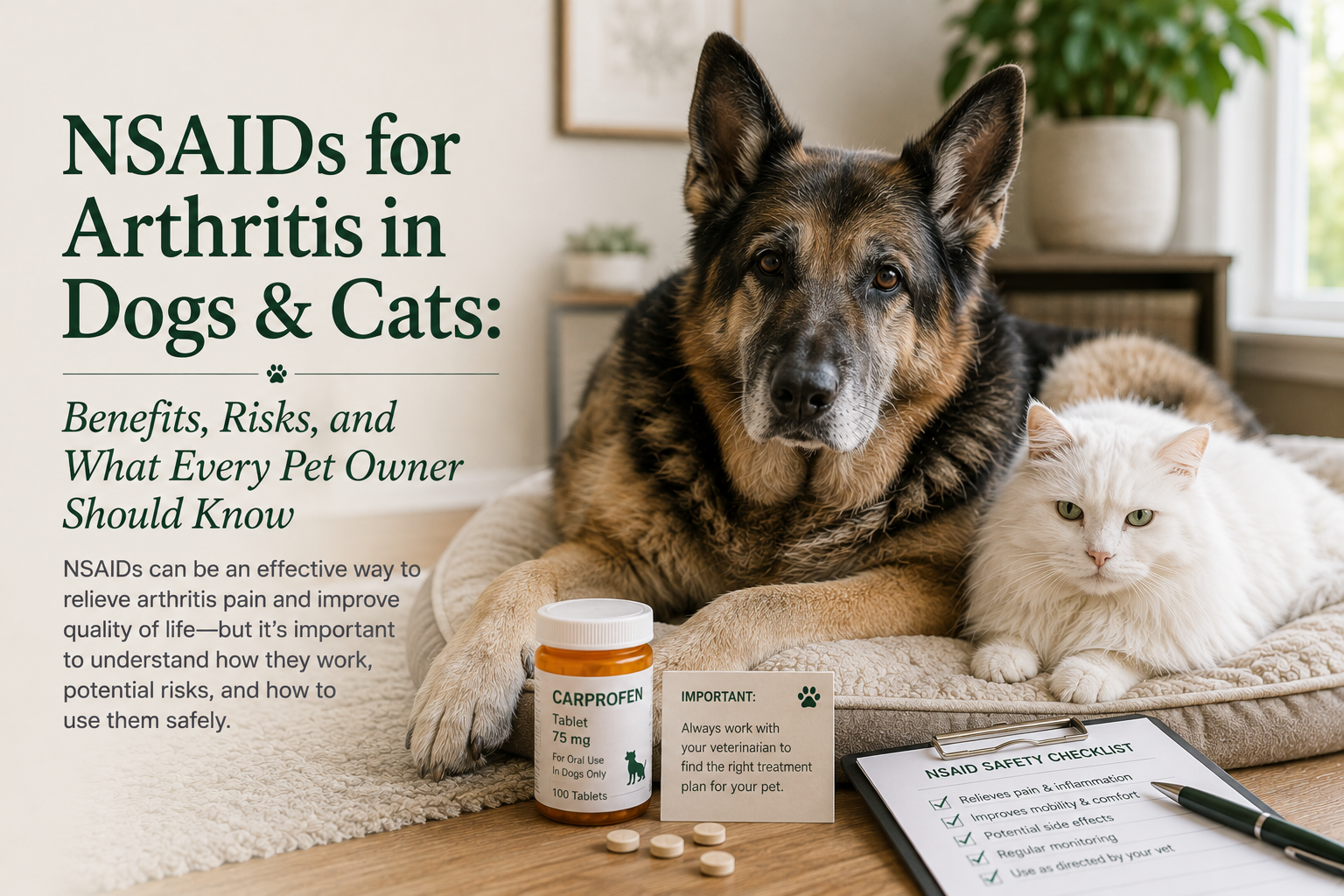
NSAIDs for Arthritis in Dogs & Cats: Benefits, Risks, and What Every Pet Owner Should Know
How anti-inflammatory medications help arthritic pets, what side effects to watch for, and why veterinary monitoring matters.
Are NSAIDs safe for long-term arthritis treatment? Learn how these medications reduce joint inflammation, what improvements to expect, which side effects to watch for, and why they should never be combined with human pain relievers.
Quick answer
In this article you'll learn
- What NSAIDs are and how they reduce joint inflammation
- Which NSAIDs are commonly used in dogs and cats
- What improvements to realistically expect
- How veterinarians assess whether NSAIDs are safe for your pet
- Which side effects should prompt a call to your veterinarian
- Why human pain medications can be dangerous or fatal for pets
Introduction
When a pet is diagnosed with arthritis, one of the first treatment options your veterinarian may discuss is an NSAID.
For some owners, that conversation brings relief.
For others, it brings concern.
Questions like:
"I've heard these medications can hurt the kidneys."
"Are they safe for long-term use?"
"Will my pet have to take them forever?"
"Is there something more natural instead?"
These are all reasonable questions—and ones I hear every week.
The good news is that when used appropriately and monitored carefully, NSAIDs remain one of the most effective and well-studied treatments for arthritis pain in dogs.
They aren't the right choice for every pet, but for many, they can dramatically improve comfort, mobility, and quality of life.
What Are NSAIDs?
NSAID stands for Non-Steroidal Anti-Inflammatory Drug.
These medications are designed to reduce:
- Pain
- Inflammation
- Swelling
- Joint stiffness
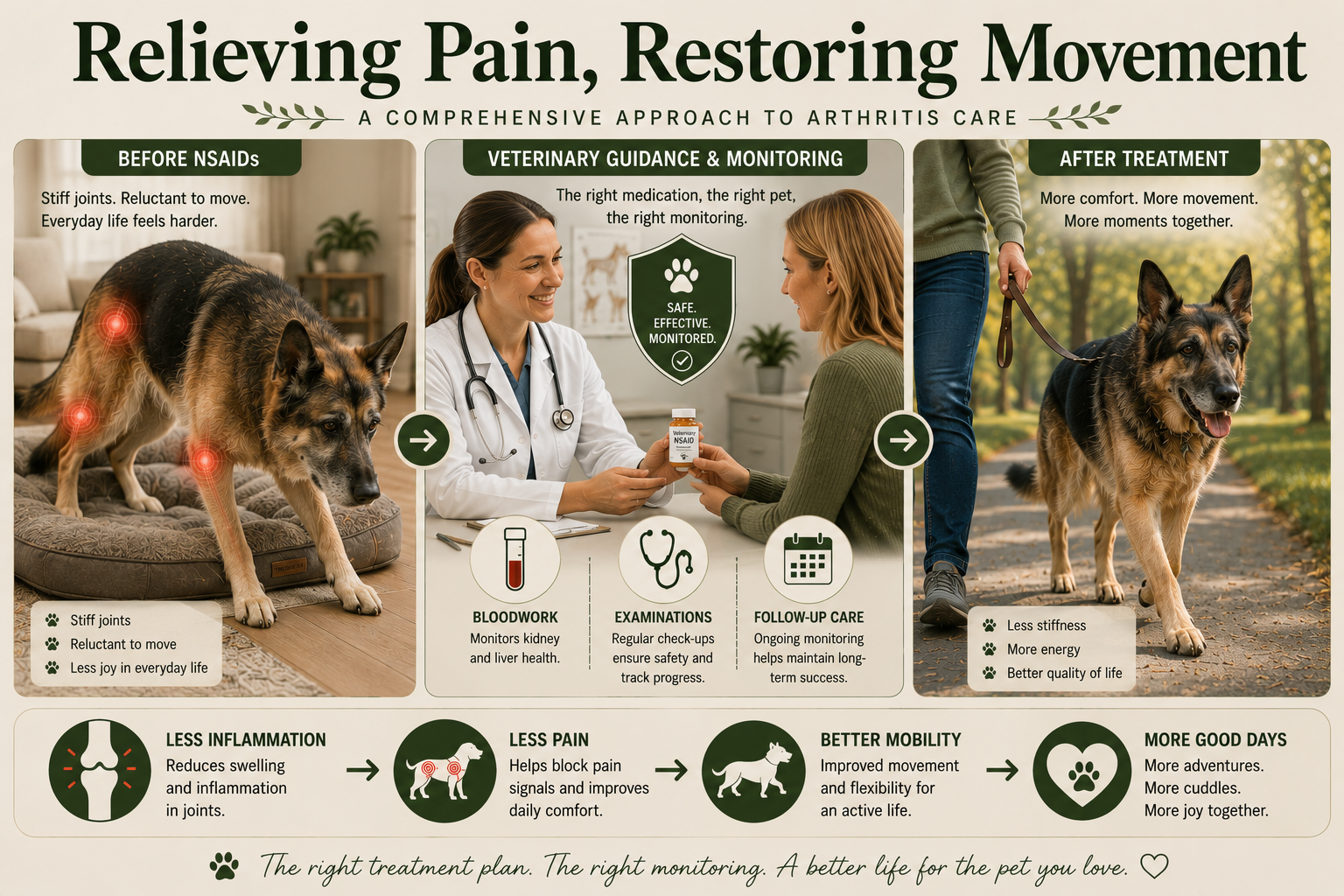
Unlike joint supplements, which may take weeks to show benefits, NSAIDs often begin improving comfort within days.
For many pets, they allow everyday activities—walking, climbing stairs, playing, or simply getting up after a nap—to become much easier again.
Why Inflammation Matters
Arthritis isn't simply "worn-out joints."
It's an active inflammatory disease.
As cartilage breaks down, the body responds by producing inflammatory chemicals inside the joint.
Those chemicals increase:
- Pain
- Swelling
- Stiffness
- Ongoing joint damage
NSAIDs work by reducing many of those inflammatory signals, helping break the cycle of chronic pain.
This is why pets often don't just move better after starting NSAIDs—they frequently seem happier, more playful, and more engaged with their families.
Common Veterinary NSAIDs
Your veterinarian will choose the medication that's most appropriate for your pet's individual needs.
Common NSAIDs for dogs include:
- Carprofen (Rimadyl®, Novox®, Vetprofen®)
- Meloxicam
- Deracoxib (Deramaxx®)
- Firocoxib (Previcox®)
- Galliprant® (grapiprant)*
For cats, options are much more limited because cats process medications differently than dogs.
Depending on your cat's condition and your veterinarian's recommendations, medications such as meloxicam or robenacoxib (Onsior®) may be used in carefully selected situations.
Dr. Rene's Note
Galliprant® is technically not a traditional NSAID. It works by blocking a specific pain receptor (the EP4 receptor) rather than broadly reducing inflammation. Because owners often hear about it alongside NSAIDs, I'm including it here, but it has a different mechanism of action and may be recommended for certain dogs based on their individual health needs.
What Improvements Should You Expect?
Many owners expect their pet to suddenly start acting like a puppy or kitten again.
While that sometimes happens, most improvements are more subtle.
You may notice your pet:
- Getting up more easily after resting
- Walking with less stiffness
- Climbing stairs more comfortably
- Wanting longer walks
- Playing more often
- Jumping onto furniture again
- Greeting family members at the door
- Sleeping more comfortably
- Becoming more interactive
Often, owners don't realize how much discomfort their pet was experiencing until they see these positive changes.
Are NSAIDs Safe?
This is probably the question I hear most often.
The answer is:
For most appropriately selected pets, yes.
Like every medication, NSAIDs have potential risks.
That's why veterinarians carefully evaluate whether they're a good choice for each individual pet.
Before starting long-term treatment, your veterinarian may recommend:
- Bloodwork
- A physical examination
- Reviewing other medications
- Evaluating kidney and liver function
- Assessing hydration status
- Discussing any other medical conditions
These steps help ensure the medication can be used as safely as possible.
Possible Side Effects
Most pets tolerate NSAIDs very well.
However, owners should know what to watch for.
Contact your veterinarian promptly if your pet develops:
- Vomiting
- Diarrhea
- Loss of appetite
- Black or tarry stools
- Vomiting blood
- Lethargy
- Increased thirst
- Increased urination
- Yellow discoloration of the skin or gums
- Weakness
- Behavioral changes
If any of these occur, stop the medication and contact your veterinarian immediately.
Why Monitoring Matters
Arthritis is a lifelong disease.
That means many pets take NSAIDs for months—or even years.
Regular monitoring helps your veterinarian ensure the medication continues to be both safe and effective.
Depending on your pet's age, overall health, and the medication being used, this may include:
- Periodic bloodwork
- Urinalysis
- Blood pressure checks (in some patients)
- Weight monitoring
- Follow-up examinations
- Adjustments to the treatment plan
Monitoring isn't a sign that something is wrong.
It's simply part of providing the safest long-term care possible.
Never Combine Pain Medications Without Veterinary Guidance
One of the most dangerous mistakes owners can make is combining medications on their own.
Never give:
- Ibuprofen (Advil®, Motrin®)
- Naproxen (Aleve®)
- Diclofenac
- Aspirin
- Acetaminophen (Tylenol®)
unless your veterinarian has specifically instructed you to do so.
Many human pain medications can cause severe stomach ulcers, kidney failure, liver damage, or even death in dogs and cats.
Likewise, never combine prescription NSAIDs with steroids (such as prednisone) unless your veterinarian specifically directs you to do so.
NSAIDs Are Often Just One Part of the Plan
One of the biggest misconceptions is that arthritis treatment is simply "give a pill."
In reality, the best outcomes usually come from combining NSAIDs with other therapies, including:
- Weight management
- Exercise
- Physical rehabilitation
- Omega-3 fatty acids
- Joint supplements
- Home modifications
- Librela® or Solensia® when appropriate
- Other pain medications in selected cases
That's called multimodal pain management, and it's considered the gold standard for treating chronic arthritis pain.
Dr. Rene's Perspective
One of the most common things owners tell me after starting an NSAID is:
"I didn't realize how much pain my dog was in until I saw him feeling better."
That's something I hear over and over again.
Dogs are incredibly good at adapting to chronic pain. Sometimes we don't appreciate how much they've quietly given up until effective pain control allows them to enjoy those activities again.
Frequently asked questions
Educational only. This article is not a substitute for veterinary care. If your pet is unwell, please contact your veterinarian.
Next in this series
Arthritis Learning Series · Part 7 of 16
Part 8: Adequan®: One of the Most Underused Arthritis Treatments in Veterinary Medicine
Adequan® Canine is one of the few FDA-approved medications designed to support joint health, not just relieve pain. Learn how it works, how it's given, which dogs benefit most, and why it's often overlooked.
Continue readingKeep reading
Arthritis Medications: Finding the Right Treatment for Your Pet
What's the best arthritis medication? Usually, there isn't just one. Learn how multimodal pain management combines medications, weight management, rehabilitation, and supplements—and why safety and realistic goals matter.
Read DiseasesLibrela® for Dogs: A New Way to Treat Arthritis Pain
Librela® is a monthly injection that blocks Nerve Growth Factor to reduce arthritis pain in dogs. Learn how it works, who it helps, what to expect, and the reported side effects to discuss with your veterinarian.
Read DiseasesJoint Supplements for Arthritis in Dogs & Cats: What Actually Works?
Do joint supplements really work? A veterinarian walks through the evidence behind glucosamine, chondroitin, ASU, MSM, green-lipped mussel, UC-II®, omega-3 fatty acids, and CBD — plus how to choose a quality product and which supplements I recommend for dogs and cats.
ReadKeep learning with Dr. Rene'
Browse the library, search another topic, or ask a question of your own.
Continue your journey
Loved this? Here's what to do next.
Every visit is a chance to understand your pet a little better. Pick your next step.
Explore the Learning Center
Browse evidence-based articles about symptoms, diseases, medications, treatments, preventive care, and more.
Explore ArticlesWatch Dr. Rene'
Prefer to watch instead of read? Explore practical veterinary education videos from Dr. Rene'.
Watch VideosGet Free Resources
Explore practical veterinary guides, checklists, and tools designed to help pet owners feel more informed and prepared.
Browse Free ResourcesProducts I Recommend
Browse pet products, supplies, and everyday essentials selected and recommended by Dr. Rene'.
See My RecommendationsEducational consultation
Want help understanding a diagnosis, test results, medications, or treatment options? Book educational guidance with Dr. Rene'. This does not replace veterinary care.
Learn more