
Allergy Learning Center · Part 21
How I Build an Allergy Treatment Plan: A Veterinarian's Decision Tree
Understanding How Veterinarians Think Through Chronic Allergies—One Step at a Time

Every allergy dog is different. Learn how veterinarians evaluate itching, rule out underlying problems, and build individualized treatment plans using medications, skin care, environmental management, and long-term strategies.
About a 9 minute read
"Why Didn't My Dog Get the Same Treatment as My Neighbor's Dog?"
This is one of the best questions owners can ask.
Your neighbor's dog has allergies.
Your dog has allergies.
One takes Apoquel®.
Another receives Cytopoint®.
Another started allergy immunotherapy.
Another is eating a prescription diet.
So...
Who's right?
The answer is:
They all might be.
Because treating allergies isn't about finding the best medication.
It's about finding the best plan for that individual dog.
Every allergy appointment is like solving a puzzle.
Before I decide which medications—or whether medication is even the first step—I ask myself a series of questions.
This article walks you through exactly how I think about that process.
Step 1: Is This Really Allergies?
Before I reach for any allergy medication, I ask:
Could something else be causing the itching?
We think about:
- Fleas
- Flea allergy dermatitis
- Mange
- Ringworm
- Bacterial infections
- Yeast infections
- Food allergy
- Hormonal disease
- Autoimmune disease
- Pain
- Anxiety or compulsive licking
Remember:
Itching is a symptom—not a diagnosis.
Step 2: Are Fleas Truly Controlled?
This question comes before almost everything else.
Because one flea can trigger weeks of itching in a flea-allergic dog.
I ask:
- Is every pet in the home protected?
- Is prevention given consistently?
- Could environmental fleas still be present?
If the answer is no...
That's often where we start.
Step 3: Is There an Infection?
Many itchy dogs don't just have allergies.
They also have:
- Bacterial skin infections
- Yeast infections
- Ear infections
These infections make dogs dramatically itchier.
Sometimes treating the infection alone provides enormous relief.
There's no point trying to judge an allergy medication if the skin is still infected.
Step 4: Is It Seasonal or Year-Round?
This question changes everything.
Seasonal
Maybe only spring.
Maybe ragweed season.
Maybe late summer.
These dogs often need treatment only during flare-ups.
Year-Round
These dogs often need:
- Long-term medication
- Allergy testing
- Immunotherapy
- Environmental management
The treatment strategy is very different.
Step 5: Could Food Be Playing a Role?
If the history fits...
I may recommend an elimination diet trial.
Especially if the dog has:
- Year-round itching
- Recurrent ear infections
- Gastrointestinal signs
- Young age of onset
Food allergies are diagnosed differently than environmental allergies.
So we need to know which one we're dealing with.
Step 6: How Uncomfortable Is This Dog Today?
Some dogs are mildly itchy.
Others are miserable.
If a dog is:
- Not sleeping
- Chewing feet raw
- Bleeding
- Developing hot spots
We need rapid relief.
That urgency affects which treatments we choose first.
Step 7: What Will This Family Realistically Be Able to Do?
Medicine only works if it can actually be given.
I think about questions like:
- Can this owner give a pill every day?
- Would monthly injections be easier?
- Can they bathe their dog weekly?
- Would allergy shots fit their schedule?
- Can they commit to a food trial?
The best treatment plan is one that fits both the dog and the family.
Step 8: What Are My Treatment Options?
Once we've answered the previous questions, we can start building a plan.
Steroids
I consider steroids when I need rapid relief, but I generally avoid relying on them long-term because of their well-known side effects.
Apoquel®
Apoquel is often an excellent choice for dogs that need fast itch relief and whose families are comfortable giving a daily medication.
Cytopoint®
Cytopoint is especially helpful when owners prefer an injection, when pills are difficult to give, or when we want a medication that specifically targets IL-31.
Zenrelia®
Zenrelia is another targeted itch medication that may be appropriate for some dogs. As with any newer medication, I consider the dog's overall health, current evidence, approved indications, and the family's goals when deciding whether it fits into the treatment plan.
Atopica®
Atopica works differently than the medications above. Because it takes longer to become effective, I generally think of it as a long-term immune-modulating option rather than a medication for immediate itch relief.
Allergy Immunotherapy
If a dog has confirmed environmental allergies and we're thinking long-term, immunotherapy is often the only treatment specifically designed to modify the underlying allergic response rather than simply controlling symptoms.
Step 9: Rarely Is It Just One Treatment
One of the biggest misconceptions owners have is that I spend the appointment trying to choose one medication.
Usually...
I'm building a combination.
For example:
- Flea prevention
- Weekly bathing
- Ear medication
- Cytopoint
- Omega-3 fatty acids
Or perhaps:
- Apoquel
- Medicated shampoo
- Environmental management
- Allergy immunotherapy
The best plans are often layered.
Veterinary medicine isn't about finding one perfect medication.
It's about building the right plan.
Step 10: Is the Plan Working?
This may be the most important question of all.
Every follow-up visit I ask:
Is the dog:
- Sleeping better?
- Itching less?
- Getting fewer ear infections?
- Getting fewer skin infections?
- Happier?
- Needing fewer medications?
If not...
We adjust the plan.
⭐ My Decision Tree
When I evaluate an itchy dog, my thought process usually looks something like this:
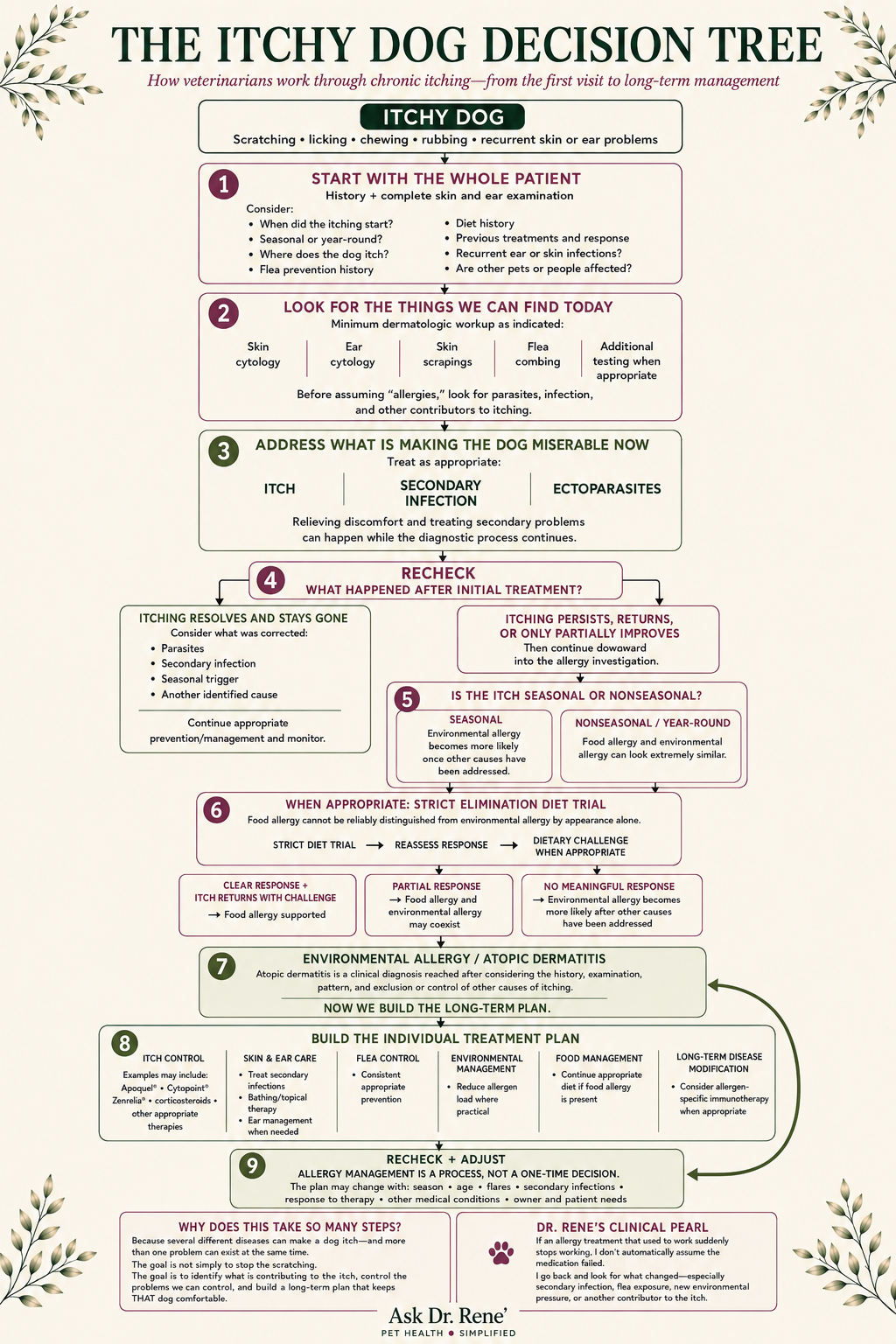
- Itchy dog
- Is it really allergies?
- Fleas controlled?
- Skin or ear infection?
- Seasonal or year-round?
- Need a food trial?
- How severe is the itch?
- Rapid relief needed?
- Owner preferences & lifestyle
- Build the treatment plan
- Reevaluate and adjust
Every dog follows a slightly different path.
That's why no two treatment plans are exactly alike.
❤️ What Success Looks Like
One of my goals isn't simply to stop itching today.
It's to build a plan that keeps your dog comfortable for years.
Success often means:
- Sleeping through the night
- Fewer ear infections
- Fewer antibiotics
- Healthier skin
- Less licking
- Less need for steroids
- Better quality of life
The Bottom Line
Every allergy dog deserves an individualized treatment plan.
Rather than relying on one medication for every patient, veterinarians evaluate the whole picture: the cause of the itching, the presence of infections, flea control, seasonality, lifestyle, and long-term goals.
By building a plan tailored to each dog and adjusting it over time, we can often provide better comfort, fewer flare-ups, and a much higher quality of life.
Key Takeaways
- There is no single "best" allergy medication.
- Every treatment plan starts with finding the underlying cause of the itch.
- Fleas, infections, food allergies, and environmental allergies all influence treatment decisions.
- Many dogs benefit from a combination of therapies rather than one medication alone.
- The best treatment plan is one that fits both the dog and the family.
- Allergy management is an ongoing process that evolves over time.
References & Further Reading
- Miller J, Simpson A, Bloom P, et al. 2023 AAHA Management of Allergic Skin Diseases in Dogs and Cats Guidelines. J Am Anim Hosp Assoc. 2023;59(6):255–284. doi:10.5326/JAAHA-MS-7396
- Hensel P, Santoro D, Favrot C, Hill P, Griffin C. Canine atopic dermatitis: detailed guidelines for diagnosis and allergen identification. BMC Vet Res. 2015;11:196. PMID: 26260508
- Olivry T, DeBoer DJ, Favrot C, Jackson HA, Mueller RS, Nuttall T, Prélaud P; International Committee on Allergic Diseases of Animals. Treatment of canine atopic dermatitis: 2015 updated guidelines from the International Committee on Allergic Diseases of Animals (ICADA). BMC Vet Res. 2015;11:210. PMID: 26276051
- Outerbridge CA, Jordan TJM. Current Knowledge on Canine Atopic Dermatitis: Pathogenesis and Treatment. Adv Small Anim Care. 2021;2:101–115. PMID: 35721364
Next in this series
Canine Allergy Learning Center · Part 21 of 23
Part 22: Is My Dog's Allergic Reaction an Emergency?
Most allergies are uncomfortable—not life-threatening. Learn to recognize facial swelling, hives, difficulty breathing, collapse, and anaphylaxis, and know when your dog needs immediate veterinary care.
Continue readingContinue Learning
Is It Really Allergies?
Where every itchy dog workup begins — and what else can look exactly like allergies.
Read articleThe Three Types of Allergies in Dogs
Environmental, flea, and food allergies — how veterinarians tell them apart.
Read articleWhy Flea Prevention Matters
Flea allergy dermatitis, the flea life cycle, and why year-round prevention matters.
Read articleApoquel for Dogs
How Apoquel works, how quickly it acts, and what to know about long-term use.
Read articleCytopoint for Dogs
The injectable antibody that targets IL-31 — how it works and who it fits.
Read articleAllergy Immunotherapy
The only treatment designed to change the allergic response rather than mask it.
Read articleElimination Diet Trials
How food allergies are actually diagnosed — and why the trial has to be strict.
Read articleBathing an Allergy Dog
One of the most overlooked allergy treatments, and how to do it well.
Read articleEnvironmental Management
Practical home strategies that lower your dog's overall allergen load.
Read article