
Allergy Learning Center · Part 9
Apoquel® for Dogs: Everything Pet Owners Should Know
How It Works, Safety, Side Effects, Cancer Concerns, and When We Use It

Apoquel® has transformed the way veterinarians treat allergic itch in dogs. Learn how it works, what the research tells us about safety, and why it's become one of the most commonly prescribed allergy medications in veterinary medicine.
About a 10 minute read
"I Read Some Scary Things About Apoquel Online."
This is one of the first things many owners tell me after I recommend Apoquel.
If you've searched the internet, you've probably found two very different opinions.
Some people describe Apoquel as life-changing.
Others warn that it's dangerous.
So who's right?
The truth is that, like every prescription medication, Apoquel has both benefits and potential risks.
My goal isn't to convince every owner to use it—or to avoid it.
My goal is to help you understand how it works, what we know from years of research and clinical experience, and how veterinarians decide whether it's the right choice for an individual dog.
What Is Apoquel?
Apoquel® (oclacitinib) is a prescription medication approved for the control of allergic itching and the treatment of atopic dermatitis in dogs.
It belongs to a group of medications called Janus kinase (JAK) inhibitors.
That sounds complicated...
But the basic idea is actually straightforward.
Instead of broadly suppressing inflammation like steroids, Apoquel targets specific signaling pathways involved in itch and allergic inflammation.
This more targeted approach is one reason it has become such an important option in veterinary dermatology.
How Does Apoquel Work?
When a dog has allergies, the immune system releases chemical messengers called cytokines.
Some of these cytokines tell the nervous system:
"This skin itches."
Apoquel blocks the activity of specific JAK enzymes that help transmit several of these itch and inflammatory signals.
As those signals are reduced, the sensation of itching decreases.
Importantly, Apoquel is more selective than steroids. It doesn't shut down the immune system in the same broad way corticosteroids do, although it still influences parts of the immune response.
An Easy Way to Think About It
Imagine your dog's immune system is a busy office building.
Steroids are a little like turning off the electricity to the entire building.
Everything quiets down—but many normal activities are affected too.
Apoquel is more like silencing a handful of the phones that keep ringing with "itch" messages.
The office keeps functioning, but one of the biggest problems becomes much quieter.
No analogy is perfect, but this illustrates why Apoquel often controls itching with fewer whole-body effects than steroids.
How Quickly Does Apoquel Work?
One of the reasons veterinarians like Apoquel is how quickly it can provide relief.
Many dogs begin showing improvement within several hours.
For many patients, itching is noticeably reduced within the first 24 hours.
Maximum improvement often continues over the next several days as inflammation settles and damaged skin begins to heal.
Which Dogs Does Apoquel Help the Most?
Apoquel is especially effective for dogs with:
- Environmental allergies (atopic dermatitis)
- Seasonal allergies
- Chronic allergic itching
- Dogs that need rapid itch relief while other treatments are taking effect
Many veterinarians also use Apoquel while working through an allergy diagnosis because reducing itch improves quality of life while additional testing or diet trials are underway.
When Doesn't Apoquel Work Well?
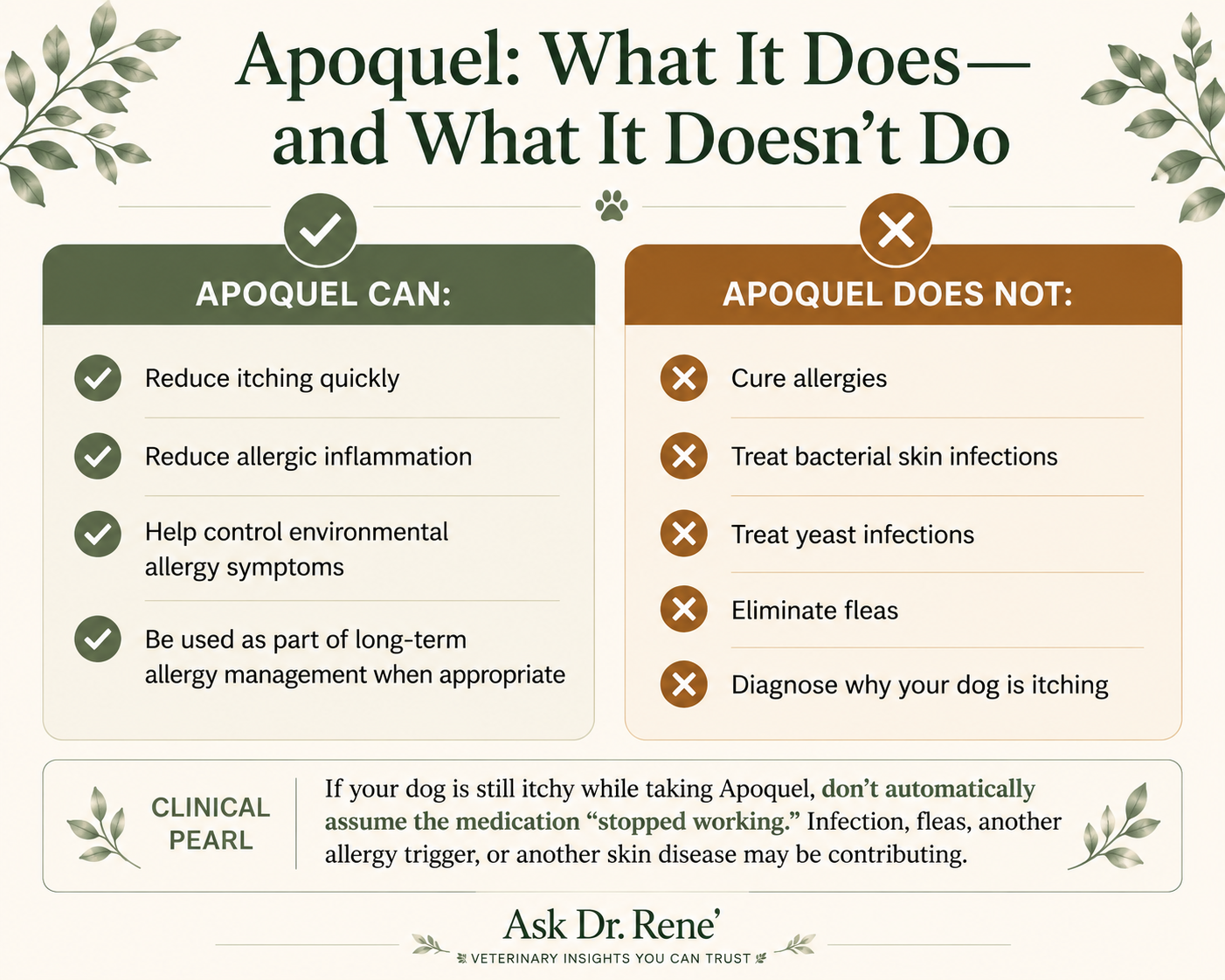
Although Apoquel is an excellent medication, it isn't a cure for every itchy dog.
It may be less effective when:
- Fleas remain uncontrolled.
- A significant bacterial or yeast infection is present.
- The primary problem is pain rather than itch.
- A foreign body is causing licking.
- Behavioral or compulsive licking is the main issue.
Sometimes Apoquel is working exactly as expected—but another problem has developed that also needs treatment.
Can Apoquel Stop Working?
Owners sometimes tell me:
"It worked great for years, and now it doesn't seem to help."
There are several possible reasons.
Your dog's allergies may have progressed.
A skin or ear infection may have developed.
A new allergy may have appeared.
Or the original diagnosis may need to be revisited.
True medication failure does happen, but it's far from the only explanation.
That's why dogs that suddenly become itchier despite Apoquel deserve another examination rather than simply increasing the dose.
What Side Effects Can Apoquel Cause?
Like every prescription medication, Apoquel can cause side effects.
Fortunately, many dogs tolerate it very well.
Common Side Effects
Some dogs may experience:
- Vomiting
- Diarrhea
- Decreased appetite
- Mild lethargy
These are often temporary and may improve as the body adjusts.
Less Common Side Effects
Because Apoquel influences parts of the immune system, some dogs may develop:
- Skin infections
- Ear infections
- Papillomas (viral warts)
- Demodex mite overgrowth in susceptible dogs
These problems are uncommon but important to recognize.
The Cancer Question
This is probably the question I'm asked more than any other about Apoquel.
"Does Apoquel cause cancer?"
The honest answer is:
Current evidence has not shown that Apoquel causes cancer in healthy dogs.
So why does this concern exist?
Because Apoquel affects parts of the immune system, veterinarians have long discussed whether it could influence the body's ability to recognize or control existing abnormal cells.
For dogs with a known or suspected malignancy, the decision to use Apoquel should be individualized after discussing the risks and benefits with your veterinarian.
For the average healthy dog with allergic skin disease, Apoquel has been used successfully in a very large number of patients over many years.
Like all medications, ongoing research continues to improve our understanding, and treatment decisions should always consider the individual dog rather than internet anecdotes.
Do Dogs Need Bloodwork While Taking Apoquel?
This is another common question.
Unlike some medications, Apoquel does not require routine bloodwork for every dog simply because they're taking it.
However, regular wellness examinations remain important.
For dogs taking Apoquel long term, many veterinarians—including me—still recommend periodic bloodwork as part of overall preventive health care, especially in older dogs or those with other medical conditions.
The goal isn't just to monitor the medication.
It's to monitor the whole patient.
What About Newer Medications Like Zenrelia®?
Apoquel is no longer the only oral JAK inhibitor available for dogs with allergic itching.
Zenrelia® (ilunocitinib) is another medication in this class.
Like Apoquel, it works by targeting itch-related immune signaling pathways and has shown excellent effectiveness for many dogs with allergic skin disease.
However, there are some important differences.
Zenrelia is a newer medication, so veterinarians have less long-term real-world experience with it than they do with Apoquel.
In addition, its FDA-approved labeling includes a boxed warning related to vaccination timing because treatment may reduce a dog's response to certain vaccines. For that reason, veterinarians carefully plan vaccination schedules before starting Zenrelia in appropriate patients.
Neither medication is universally "better."
The best choice depends on your dog's age, medical history, vaccination status, lifestyle, and the goals of treatment.
As more long-term experience with Zenrelia becomes available, our recommendations will continue to evolve.
Questions I Encourage Every Owner to Ask About Apoquel
If your veterinarian recommends Apoquel, consider asking:
- Is my dog's itching most likely caused by allergies?
- Could my dog also have a skin or ear infection?
- How quickly should I expect improvement?
- What side effects should I watch for?
- How will we know if Apoquel is the right long-term choice?
- If Apoquel isn't enough, what other options are available?
Good questions lead to better conversations—and better treatment plans.
The Bottom Line
Apoquel has changed the way veterinarians manage allergic skin disease by providing rapid itch relief without the broad effects of corticosteroids.
Like every prescription medication, it has both benefits and potential risks, and it's not the right choice for every dog.
For many patients, however, it has dramatically improved quality of life by helping control chronic allergic itch and reducing the need for repeated steroid treatments.
The best treatment isn't determined by internet opinions.
It's determined by thoughtful conversations between you and your veterinarian about what's best for your individual dog.
Key Takeaways
- Apoquel is not a steroid or an antihistamine.
- It works by selectively reducing itch-related immune signaling.
- Many dogs improve within the first 24 hours.
- It works best for allergic itching, especially environmental allergies.
- Side effects are possible but many dogs tolerate the medication well.
- Current evidence has not shown that Apoquel causes cancer in healthy dogs, but treatment decisions should always be individualized.
- Zenrelia is another oral JAK inhibitor with important differences, including current vaccination-related precautions.
- The goal is to improve your dog's comfort while creating a safe, long-term allergy management plan.
References & Further Reading
- Miller J, Simpson A, Bloom P, et al. 2023 AAHA Management of Allergic Skin Diseases in Dogs and Cats Guidelines. J Am Anim Hosp Assoc. 2023;59(6):255–284. doi:10.5326/JAAHA-MS-7396
- Cosgrove SB, Wren JA, Cleaver DM, et al. A blinded, randomized, placebo-controlled trial of the efficacy and safety of the Janus kinase inhibitor oclacitinib (Apoquel) in client-owned dogs with atopic dermatitis. Vet Dermatol. 2013;24(6):587–597, e141–e142. PMID: 24581322
- Cosgrove SB, Cleaver DM, King VL, et al. Long-term compassionate use of oclacitinib in dogs with atopic and allergic skin disease: safety, efficacy and quality of life. Vet Dermatol. 2015;26(3):171–179, e35. PMID: 25688708
- U.S. Food and Drug Administration. Apoquel (oclacitinib) approved animal-drug labeling and safety-related labeling information (NADA 141-345 / 141-555). FDA Center for Veterinary Medicine, Animal Drugs @ FDA.
Next in this series
Canine Allergy Learning Center · Part 9 of 23
Part 10: Cytopoint® for Dogs: Everything Pet Owners Should Know
How Cytopoint works, how quickly it may relieve itching, how long it lasts, its safety profile, and when veterinarians recommend it.
Continue readingContinue Learning
Why Do Steroids Work So Well—And Why Don't We Want to Depend on Them?
Prednisone, dexamethasone, and steroid injections — why they work so fast, and why repeated use carries risk.
Read articleThe Three Types of Allergies in Dogs
Flea allergies, environmental allergies, and food allergies — how they differ and why it matters.
Read articleWhy Does My Dog Keep Getting Skin Infections?
Bacterial and yeast infections often flare alongside allergies — and can make medication look like it stopped working.
Read articleWhy Does My Dog Keep Getting Ear Infections?
Recurring ear infections are usually a symptom of an underlying problem — most often allergies.
Read articleWhy Does My Dog Keep Licking Their Feet?
Constant licking of the feet has several causes — allergies are only one of them.
Read article