
Allergy Learning Center · Part 8
Why Do Steroids Work So Well—And Why Don't Veterinarians Want to Depend on Them?
Understanding Prednisone, Dexamethasone, and Steroid Injections for Dogs with Allergies

Steroids can provide dramatic relief from itching, inflammation, and allergic skin disease. They're among the most effective medications in veterinary medicine—but like every powerful medication, they also come with important risks.
About a 10 minute read
"The Steroid Shot Always Works."
I've heard this sentence thousands of times.
And here's the thing...
You're right.
Steroids often work incredibly well.
Many dogs stop itching within hours.
They finally sleep through the night.
Their skin begins to heal.
Owners feel relieved.
Veterinarians feel relieved.
So...
Why do so many veterinarians hesitate when owners ask for another steroid injection?
The answer isn't because steroids are "bad."
It's because they're powerful.
And with great power comes the potential for significant side effects—especially when they're used repeatedly or for long periods of time.
What Are Steroids?
Steroids—more accurately called corticosteroids or glucocorticoids—are medications that mimic cortisol, one of the body's natural hormones produced by the adrenal glands.
They are among the most powerful anti-inflammatory medications available in veterinary medicine.
Common examples include:
- Prednisone
- Prednisolone
- Dexamethasone
- Triamcinolone
- Methylprednisolone
- Long-acting steroid injections (such as Depo-Medrol®)
Although these medications are different, they all work in similar ways.
Why Do Steroids Work So Quickly?
Allergies create inflammation.
Inflammation causes itching.
Steroids interrupt that process at multiple points throughout the immune system.
Instead of blocking just one inflammatory pathway...
They suppress many of them.
That's why the response can be so dramatic.
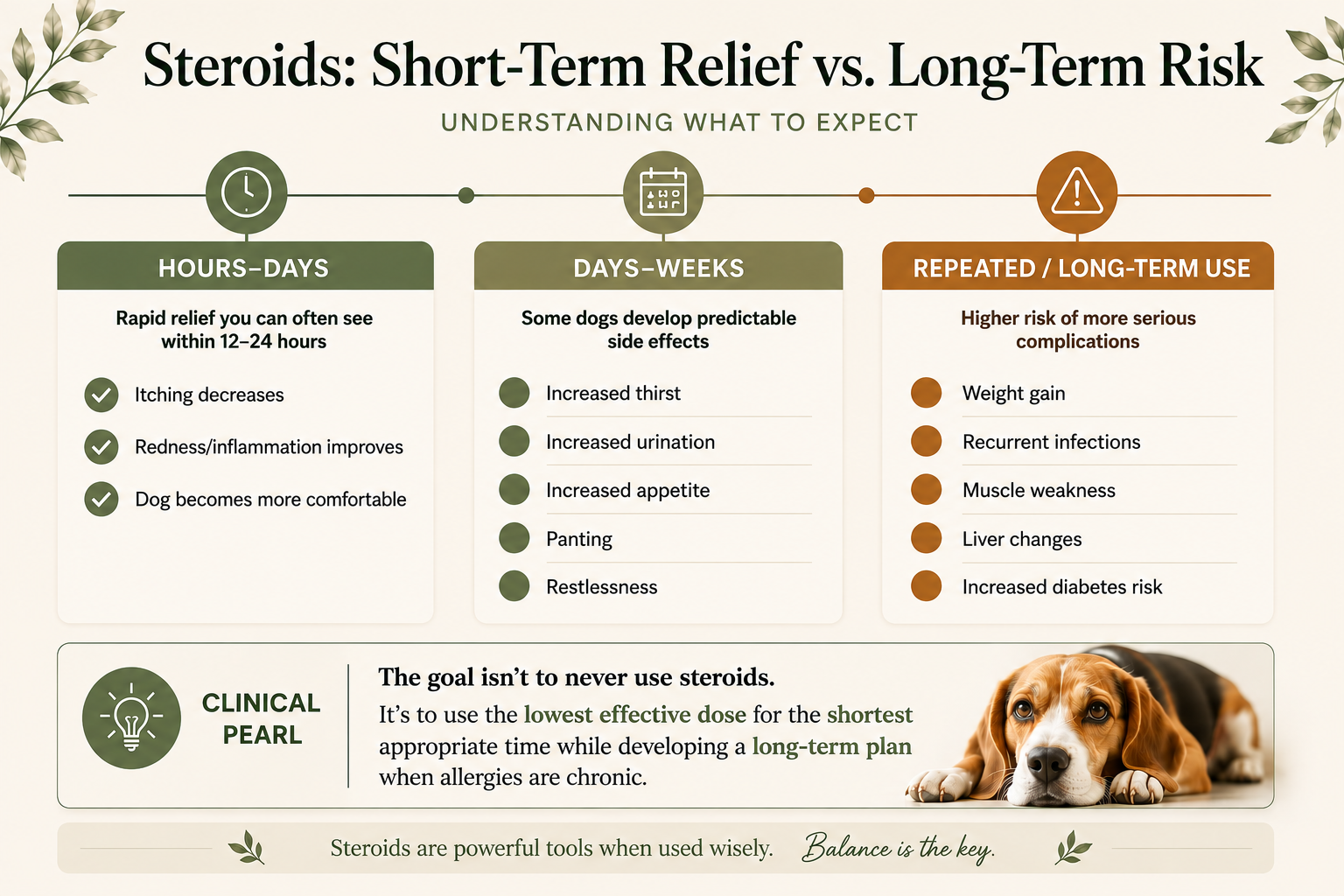
Many owners notice improvement within:
- 12–24 hours
- Sometimes even sooner
For dogs with severe allergic flare-ups, that rapid relief can be life-changing.
The Benefits of Steroids
When used appropriately, steroids can be excellent medications.
They can:
- Rapidly reduce itching
- Decrease inflammation
- Improve comfort
- Help skin begin healing
- Reduce swelling
- Improve quality of life during severe flare-ups
For some emergencies, steroids can even be lifesaving.
The goal isn't to avoid steroids completely.
The goal is to use them wisely.
Why Long-Term Steroid Use Can Become a Problem
Because steroids affect nearly every organ system, long-term use can produce widespread side effects.
Some dogs experience only mild changes.
Others develop much more serious complications.
That's why veterinarians carefully weigh the benefits against the risks before recommending repeated or prolonged steroid therapy.
Common Side Effects
Many dogs develop predictable side effects within days of starting steroids.
These include:
- Increased thirst
- Increased urination
- Increased appetite
- Panting
- Restlessness
- Muscle weakness
These effects usually improve after the medication is discontinued or the dose is reduced.
Weight Gain
One of the most common long-term consequences is weight gain.
Steroids significantly increase appetite.
Many owners tell me:
"He's starving all the time."
Dogs often begin begging, stealing food, or acting constantly hungry.
Unfortunately, excess weight also makes allergies, arthritis, and mobility problems worse.
Increased Risk of Infections
Because steroids suppress the immune system, they also reduce the body's ability to fight infection.
Dogs receiving long-term steroids are more likely to develop:
- Skin infections
- Ear infections
- Urinary tract infections
- Slower wound healing
Sometimes the infection isn't new.
It's simply an overgrowth of bacteria or yeast that the immune system would normally keep under control.
Diabetes
One complication we take very seriously is steroid-induced diabetes mellitus.
Steroids increase blood sugar and reduce the body's sensitivity to insulin.
Although not every dog develops diabetes, repeated steroid use increases the risk—particularly in dogs already predisposed to the disease.
Liver Changes
Long-term steroid use commonly affects the liver.
Many dogs develop:
- Elevated liver enzymes
- Enlarged liver
- Steroid hepatopathy (a characteristic, often reversible change within liver cells)
These changes are one reason routine monitoring is recommended for dogs receiving chronic steroid therapy.
Behavioral Changes
Steroids can also affect behavior.
Some dogs become:
- Restless
- More anxious
- Irritable
- Less tolerant of handling
- More vocal
Others simply seem unable to relax.
Owners sometimes describe them as acting "not quite like themselves."
Why We Don't Love Long-Acting Steroid Injections
Long-acting steroid injections, such as Depo-Medrol®, can provide weeks of relief from itching.
That convenience explains why many owners remember them so fondly.
The challenge is that once the injection has been given...
We can't take it back.
If side effects develop, the medication continues working until it naturally wears off.
That's one reason many veterinarians now prefer shorter-acting medications that can be adjusted or discontinued if needed.
What Do Veterinarians Use Instead?
Veterinary allergy medicine has changed dramatically over the past decade.
Today we have medications specifically designed for chronic allergic skin disease, including:
- Apoquel®
- Cytopoint®
- Atopica®
- Allergy immunotherapy
- Medicated shampoos
- Topical therapies
These treatments don't replace steroids in every situation.
But they often reduce—or even eliminate—the need for repeated steroid use.
We'll discuss each of these options in detail in the next several articles.
Questions I Encourage Every Owner to Ask Before the Next Steroid Injection
Steroids can be wonderful medications.
Sometimes they're exactly the right choice.
But before giving another steroid injection or starting another course of prednisone, I encourage owners to ask a few important questions.
These conversations often lead to a better long-term plan—not just temporary relief.
"Why Is My Dog Itching in the First Place?"
Steroids reduce inflammation.
They don't tell us why the inflammation is happening.
Ask your veterinarian:
- Is this environmental allergies?
- Could fleas be contributing?
- Is a food allergy possible?
- Is there a skin infection making the itching worse?
Understanding the underlying cause often changes the treatment plan.
"Is This a Flare-Up or a Chronic Problem?"
A single allergic flare after a camping trip is very different from a dog that's itchy every month of the year.
If your dog repeatedly needs steroids, it's worth discussing a long-term management strategy instead of treating each flare individually.
"Does My Dog Have an Infection Too?"
Many allergic dogs also develop:
- Yeast infections
- Bacterial skin infections
- Ear infections
If an infection is present, steroids alone won't solve the entire problem.
Treating both the allergy and the infection often leads to much better results.
"Are There Safer Long-Term Options?"
Veterinary medicine has changed dramatically over the past decade.
Depending on your dog's individual situation, there may be medications that control allergies while reducing the need for repeated steroid use.
Ask about:
- Apoquel®
- Cytopoint®
- Atopica®
- Allergy immunotherapy
- Medicated shampoos
- Topical therapies
Not every medication is appropriate for every dog, but it's worth discussing the available options.
"What Side Effects Should I Watch For?"
Every medication has potential side effects—including steroids.
Knowing what to monitor helps you recognize problems early.
Ask your veterinarian what changes would be considered expected and which ones deserve a phone call.
Common things to watch for include:
- Excessive drinking
- Increased urination
- Constant hunger
- Panting
- Weight gain
- Recurrent infections
- Changes in behavior
"How Many Steroid Treatments Is Too Many?"
There isn't one magic number.
Some dogs receive steroids only once or twice in their lives.
Others may need them occasionally during severe flare-ups.
The important question isn't simply how many steroids your dog has received.
It's whether steroids are becoming the primary plan instead of one tool within a broader allergy management strategy.
If your dog needs steroids over and over again, it's time to step back and ask whether there's a better long-term approach.
"Do We Have a Plan Beyond Today?"
This may be the most important question of all.
Steroids can help your dog feel dramatically better today.
But if the itching returns every few weeks, everyone—including your dog—deserves a plan that looks beyond the current flare-up.
That plan might include:
- Identifying allergy triggers
- Managing skin infections promptly
- Controlling fleas year-round
- Starting long-term allergy medication
- Allergy testing and immunotherapy
- Regular recheck examinations
The goal isn't simply to stop today's itching.
The goal is to keep your dog comfortable month after month, year after year.
These are often signs that it's time to discuss a more comprehensive long-term management plan.
The Bottom Line
Steroids remain one of the most effective medications available for treating allergic skin disease.
They work quickly, provide dramatic relief, and continue to play an important role in veterinary medicine.
However, because they affect nearly every organ system, long-term or repeated use increases the risk of significant side effects.
Modern allergy management isn't about avoiding steroids at all costs—it's about using them thoughtfully while building a treatment plan that keeps your dog comfortable for the long term.
The best allergy treatment isn't the one that works the fastest today.
It's the one that keeps your dog healthy, comfortable, and enjoying life for years to come.
Key Takeaways
- Steroids rapidly reduce inflammation and itching.
- They do not cure allergies—they suppress the immune response.
- Short-term use is often very safe and effective.
- Long-term use increases the risk of diabetes, infections, liver changes, weight gain, and behavioral changes.
- Long-acting steroid injections cannot be reversed once given.
- Modern allergy therapies often reduce the need for repeated steroid use.
- Steroids remain an important tool—but they're no longer the only option.
References & Further Reading
- Miller J, Simpson A, Bloom P, et al. 2023 AAHA Management of Allergic Skin Diseases in Dogs and Cats Guidelines. J Am Anim Hosp Assoc. 2023;59(6):255–284. doi:10.5326/JAAHA-MS-7396
- Olivry T, DeBoer DJ, Favrot C, Jackson HA, Mueller RS, Nuttall T, Prélaud P; International Committee on Allergic Diseases of Animals. Treatment of canine atopic dermatitis: 2015 updated guidelines from the International Committee on Allergic Diseases of Animals (ICADA). BMC Vet Res. 2015;11:210. PMID: 26276051
- Olivry T, Bizikova P. A systematic review of randomized controlled trials for prevention or treatment of atopic dermatitis in dogs: 2008–2011 update. Vet Dermatol. 2013;24(1):97–117.e25–26. PMID: 23331686
- Lokianskiene V, Bergvall K, Olivry T. A Pilot Randomized Trial to Compare Polyuria and Polydipsia during a Short Course of Prednisolone or Methylprednisolone in Dogs with Atopic Dermatitis. Vet Sci. 2022;9(9):490. PMID: 36136706
Next in this series
Canine Allergy Learning Center · Part 8 of 23
Part 9: Apoquel® for Dogs: Everything Pet Owners Should Know
How Apoquel works, how fast it controls itching, side effects, safety and cancer questions, and how veterinarians decide when to use it.
Continue readingContinue Learning
Why Does My Dog Keep Getting Skin Infections?
Understanding bacterial and yeast skin infections in dogs, and why they keep coming back.
Read articleThe Three Types of Allergies in Dogs
Flea allergies, environmental allergies, and food allergies — how they differ and why it matters.
Read articleWhy Does My Dog Keep Getting Ear Infections?
Recurring ear infections are usually a symptom of an underlying problem — most often allergies.
Read articleWhy Did My Dog Suddenly Develop a Hot Spot?
Acute moist dermatitis can appear overnight — here's why it spreads so fast.
Read articleWhy Does My Dog Keep Licking Their Feet?
Constant licking of the feet has several causes — allergies are only one of them.
Read article