
Allergy Learning Center · Part 6
Why Did My Dog Suddenly Develop a Hot Spot?
Everything Pet Owners Need to Know About Acute Moist Dermatitis
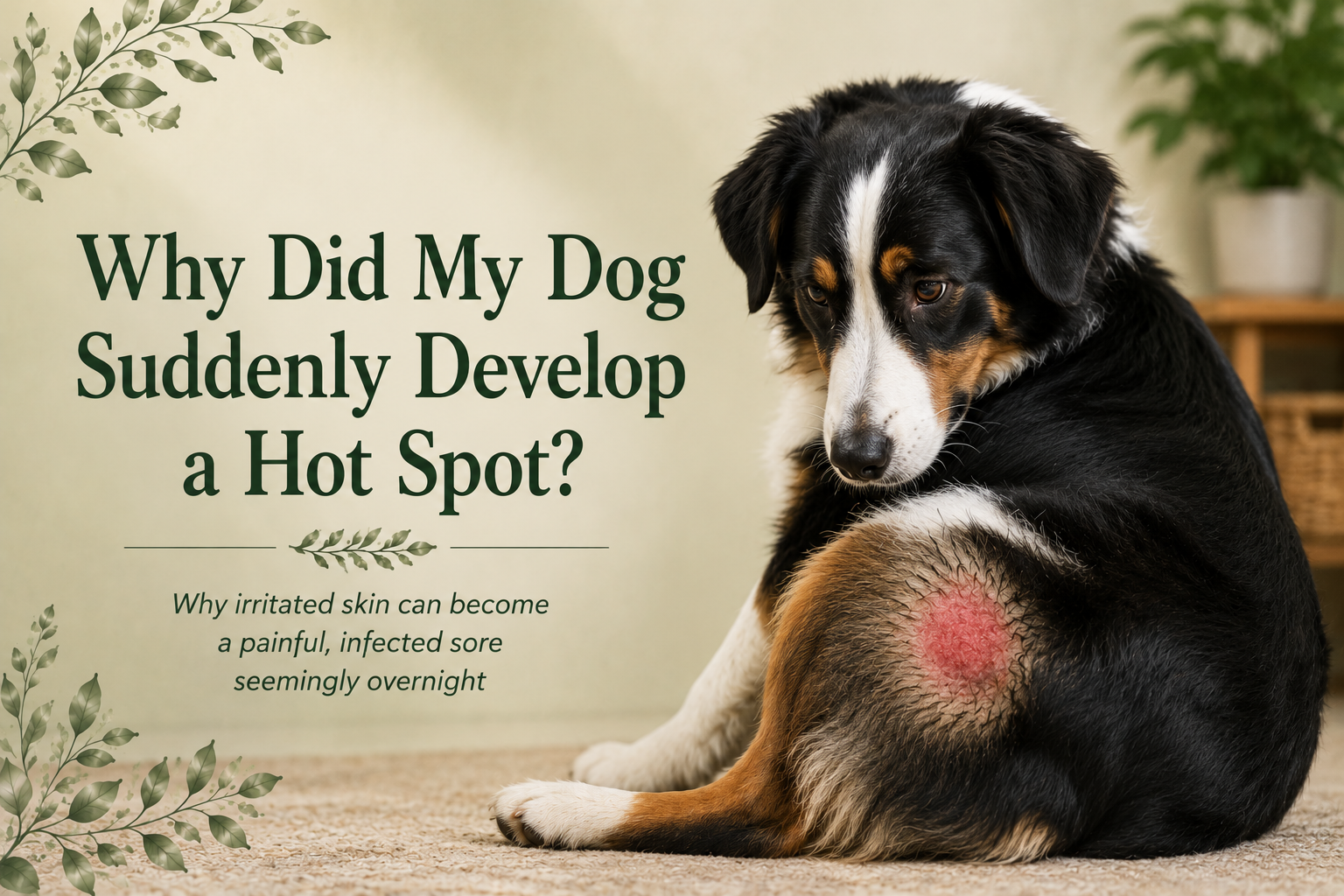
Hot spots can seem to appear overnight. Learn what causes them, why they spread so quickly, and how prompt treatment can help your dog heal comfortably.
About a 9 minute read
"It Was Fine Yesterday..."
This is one of the most common things I hear.
"I swear it wasn't there yesterday."
Or...
"This morning there was just a tiny red spot. Now it's huge."
Hot spots are one of the fastest-developing skin problems we see in veterinary medicine.
A lesion that starts as a small, irritated patch of skin can become a large, painful wound within just a day or two.
Fortunately, although they look alarming, most hot spots heal very well when treated promptly.
What Is a Hot Spot?
The medical term is acute moist dermatitis.
A hot spot is a rapidly developing area of inflamed, infected skin that forms when a dog repeatedly scratches, chews, or licks the same location.
The skin becomes:
- Red
- Moist
- Painful
- Inflamed
- Oozing
As bacteria multiply and inflammation worsens, the lesion often enlarges dramatically.
Why Do Dogs Get Hot Spots?
Hot spots don't usually appear for no reason.
They almost always begin with something that causes irritation.
Common triggers include:
- Environmental allergies
- Flea allergy dermatitis
- Ear infections
- Foot licking
- Insect bites
- Matted hair
- Moisture trapped in the coat
- Swimming
- Grooming irritation
- Small cuts or abrasions
The trigger causes itching.
The scratching damages the skin.
Then bacteria take advantage of the broken skin barrier.
The Itch-Scratch Spiral
Hot spots often develop incredibly fast because they create their own vicious cycle.
It starts like this:
Something itches.
Your dog scratches.
The skin becomes damaged.
Inflammation increases.
The area becomes even itchier.
Your dog scratches even harder.
Bacteria multiply.
The hot spot rapidly grows.
Without treatment, this cycle often continues until something interrupts it.
Why They Grow So Quickly
Many owners are shocked by how fast hot spots enlarge.
There are several reasons.
Every scratch creates additional skin trauma.
Inflammatory chemicals attract more immune cells.
Moisture softens the skin.
Bacteria multiply rapidly.
Dogs continue licking because the area is painful and itchy.
All of those factors combine to make the lesion spread surprisingly quickly.
Where Do Hot Spots Usually Occur?
Hot spots can develop anywhere, but common locations include:
- Hips
- Base of the tail
- Neck
- Face
- Cheeks
- Under the ears
- Chest
- Thighs
The location often provides clues about the underlying cause.
For example:
Tail base
Flea allergy
Under the ear
Ear infection
Neck
Collar irritation or grooming
Hip
Allergies or flea allergy
Why Allergies Cause So Many Hot Spots
Allergies are one of the most common reasons dogs develop hot spots.
Allergic dogs itch.
The more they scratch...
The more they damage the skin.
The more damaged the skin becomes...
The easier it is for bacteria to multiply.
This is why dogs with poorly controlled allergies often experience repeated hot spots.
The Role of Bacteria
Healthy skin naturally contains bacteria.
Normally they live peacefully on the surface.
Once scratching damages the skin barrier...
Those same bacteria begin multiplying rapidly.
The result is infection, pain, and continued inflammation.
The bacteria didn't start the problem.
They simply took advantage of damaged skin.
How Veterinarians Treat Hot Spots
Treatment focuses on several goals at the same time.
Your veterinarian may recommend:
- Clipping the hair around the lesion
- Cleaning the affected skin
- Topical medications
- Oral antibiotics (when appropriate)
- Anti-itch medication
- Pain medication
- Elizabethan collar or recovery collar
- Treating the underlying allergy or flea problem
Many owners are surprised when we shave around the hot spot.
Although it may not look pretty at first, removing the surrounding hair allows air to reach the skin, makes cleaning easier, and helps medications reach the infected tissue.
Can I Treat a Hot Spot at Home?
Small hot spots may improve with early veterinary guidance.
However, many lesions require prescription medication because both itching and infection need to be controlled.
Avoid applying:
- Hydrogen peroxide
- Alcohol
- Essential oils
- Human antibiotic creams without veterinary guidance
Some products delay healing or make the skin even more irritated.
Can Hot Spots Be Prevented?
Often...
Yes.
The best prevention is controlling the condition that caused the itching in the first place.
Depending on your dog, prevention may include:
- Consistent allergy management
- Year-round flea prevention
- Prompt treatment of ear infections
- Drying the coat after swimming
- Regular grooming
- Brushing thick-coated breeds
- Managing underlying skin disease
When the itching is controlled, hot spots become much less likely to develop.
The Bottom Line
Hot spots are painful, rapidly developing skin infections that almost always begin with an underlying source of irritation.
Whether that irritation comes from allergies, fleas, ear infections, moisture, or another skin problem, the result is the same: intense itching, self-trauma, inflammation, and bacterial overgrowth.
Treating the hot spot is important—but preventing future hot spots means identifying and managing the underlying cause.
With prompt veterinary care and a long-term prevention plan, most dogs recover quickly and can avoid repeated episodes.
Key Takeaways
- Hot spots are rapidly developing areas of inflamed, infected skin.
- They usually begin because something makes a dog itch.
- Allergies are one of the most common underlying causes.
- Bacteria worsen the lesion after the skin barrier is damaged.
- Early treatment leads to faster healing and less discomfort.
- Preventing future hot spots means treating the underlying cause—not just the wound itself.
Worried About Your Dog's Skin?
Hot spots heal best when they're treated early and the underlying cause is identified.
Schedule an educational consultation with Dr. Rene'.
Work With Dr. Rene'References & Further Reading
- Miller J, Simpson A, Bloom P, et al. 2023 AAHA Management of Allergic Skin Diseases in Dogs and Cats Guidelines. J Am Anim Hosp Assoc. 2023;59(6):255–284. doi:10.5326/JAAHA-MS-7396
- Loeffler A, Cain CL, Ferrer L, et al. Antimicrobial use guidelines for canine pyoderma by the International Society for Companion Animal Infectious Diseases (ISCAID). Vet Dermatol. 2025;36(3):234–282. PMID: 40338805
- Santoro D, Marsella R, Pucheu-Haston CM, Eisenschenk MNC, Nuttall T, Bizikova P. Review: Pathogenesis of canine atopic dermatitis: skin barrier and host-micro-organism interaction. Vet Dermatol. 2015;26(2):84-e25. PMID: 25683702
Next in this series
Canine Allergy Learning Center · Part 6 of 23
Part 7: Why Does My Dog Keep Getting Skin Infections?
Understanding bacterial and yeast skin infections in dogs — why pyoderma and Malassezia keep coming back, and what skin cytology reveals.
Continue readingContinue Learning
Why Does My Dog Keep Licking Their Feet?
Constant licking of the feet has several causes — allergies are only one of them.
Read articleThe Three Types of Allergies in Dogs
Flea allergies, environmental allergies, and food allergies — how they differ and why it matters.
Read articleWhy Does My Dog Keep Getting Ear Infections?
Recurring ear infections are usually a symptom of an underlying problem — most often allergies.
Read article