
Allergy Learning Center · Part 3
The Three Types of Allergies in Dogs
Understanding Flea Allergies, Environmental Allergies, and Food Allergies
Not all allergies are the same. Understanding which type of allergy your dog has is the first step toward finding the right treatment.
About an 8 minute read
Not All Allergies Are Created Equal
One of the biggest misconceptions I hear is:
"My dog has allergies."
That statement is a little like saying,
"My dog has an infection."
It's true...
But it doesn't tell us what kind.
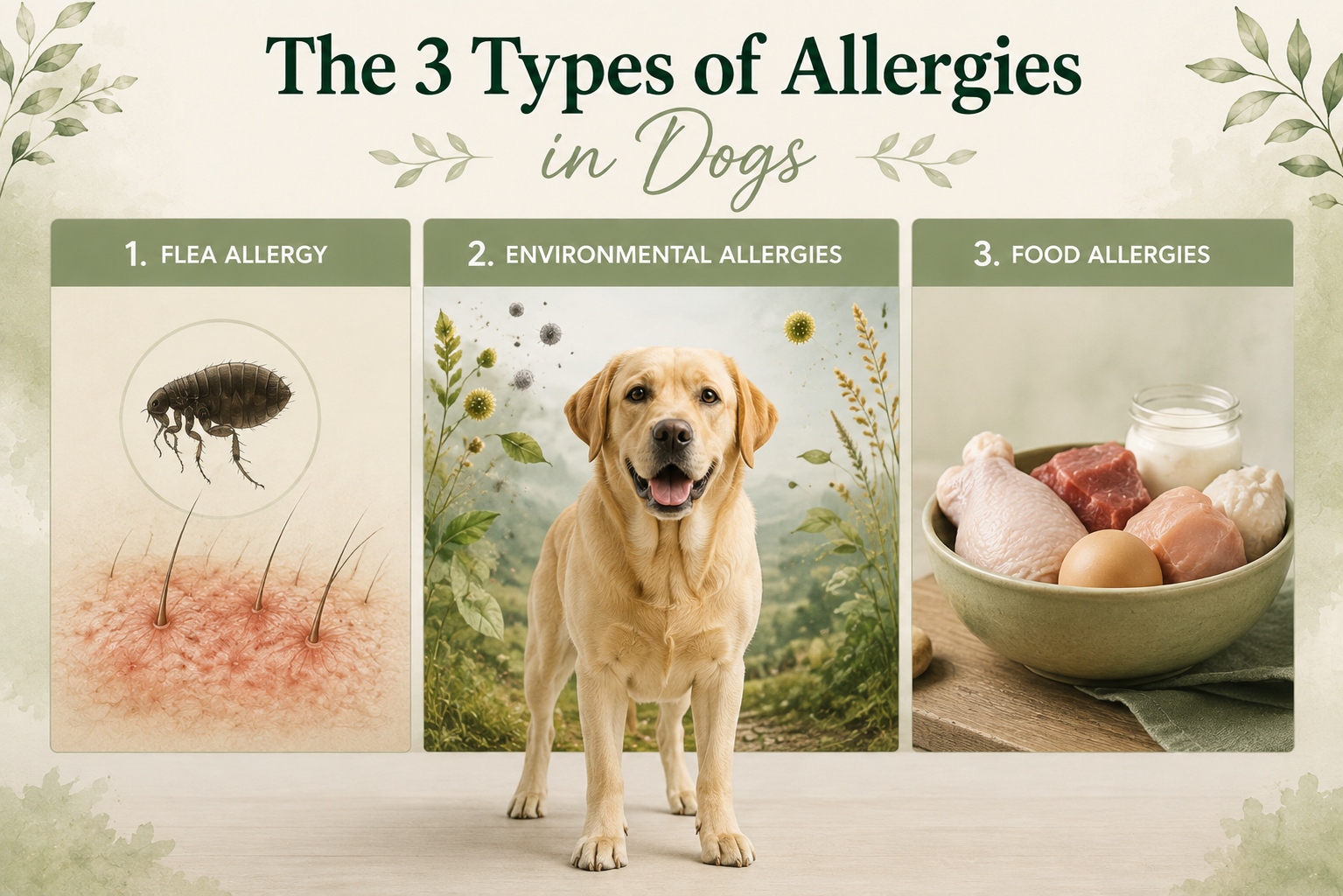
There are three major types of allergic skin disease that veterinarians diagnose most commonly in dogs.
Although they can look very similar on the surface, they develop for different reasons and often require different treatment approaches.
Those three categories are:
- Flea Allergy Dermatitis
- Environmental Allergies (Atopy)
- Food Allergies
Some dogs have only one.
Many have two.
A surprising number have all three.
Understanding the differences is one of the most important parts of diagnosing chronic itching. If you're just joining the series, start with Part 1 – Why Is My Dog Itchy? and Part 2 – Why Is My Dog So Itchy?
Flea Allergy Dermatitis
One Flea Can Cause Weeks of Itching
This is one of the hardest concepts for owners to believe.
A dog with flea allergy dermatitis isn't allergic to the flea itself.
They're allergic to the saliva the flea injects when it bites.
For most dogs, a flea bite is little more than a nuisance.
For an allergic dog, that same bite can trigger an exaggerated immune response that continues long after the flea is gone.
One bite.
Days—or even weeks—of itching.
"But I Never See Fleas."
I hear this almost every day.
And honestly...
You often won't.
Here's why.
Fleas Are Excellent at Hiding
Adult fleas spend surprisingly little time where owners notice them.
Dogs groom themselves.
They scratch.
They chew.
Many fleas are removed before anyone ever sees them.
It Only Takes One
Unlike a flea infestation, flea allergy dermatitis doesn't require dozens of fleas.
One flea can bite...
Leave saliva behind...
Jump off...
And the allergic reaction continues.
By the time your dog starts scratching intensely, the flea may already be gone.
Indoor Dogs Get Fleas Too
Another common myth is:
"My dog never goes outside."
Fleas don't care.
People carry them indoors on shoes.
Cats bring them inside.
Wildlife visits the yard.
Even apartment dogs can develop flea allergy dermatitis.
This is why veterinarians recommend year-round flea prevention—even for many indoor pets.
Common Clues
Dogs with flea allergy dermatitis often itch around:
- Tail base
- Lower back
- Hind legs
- Belly
Many develop:
- Hair loss
- Scabs
- Red skin
- Hot spots
Environmental Allergies (Atopy)
Allergic to the World Around Them
Environmental allergies are the most common allergy we diagnose in dogs.
Instead of reacting to food or fleas, these dogs react to substances they encounter in everyday life.
Common allergens include:
- Grass pollens
- Tree pollens
- Weed pollens
- Dust mites
- Storage mites
- Mold spores
These allergens contact the skin and trigger the immune system, leading to chronic inflammation and itching.
Seasonal vs. Year-Round Allergies
Some dogs itch only during certain seasons.
For example:
- Spring tree pollen
- Summer grasses
- Fall weeds
Others seem itchy all year long.
That often suggests allergens such as:
- Dust mites
- Storage mites
- Indoor molds
Many dogs actually start with seasonal allergies that gradually become year-round as they develop sensitivities to additional allergens.
Where Do These Dogs Usually Itch?
Environmental allergies commonly affect:
- Feet
- Ears
- Face
- Armpits
- Belly
- Groin
Many dogs repeatedly lick their paws or develop chronic ear infections. Long-term control often involves therapies such as Cytopoint, Apoquel, Atopica, or immunotherapy.
Food Allergies
Probably the Most Misunderstood Allergy
Food allergies are real.
They're just much less common than most people think.
In fact, many dogs diagnosed with "food allergies" actually have environmental allergies.
What Food Allergies Are NOT
Let's clear up some of the biggest myths.
Food allergies are not usually caused by:
- Grain
- Artificial colors
- Preservatives
- Cheap dog food
- Corn
- Wheat (in most dogs)
These ingredients are often blamed online without good scientific evidence.
What Dogs Actually Become Allergic To
True food allergies are usually reactions to proteins that the immune system recognizes.
Common food allergens include:
- Beef
- Chicken
- Dairy
- Egg
- Soy
- Lamb (less commonly than many people think)
Remember...
A dog can only become allergic to something they've eaten before.
The immune system has to be exposed to a protein before it can decide to react against it.
Can Dogs Suddenly Become Allergic?
Yes.
One of the biggest surprises for owners is that a dog may eat the same food for years before developing a food allergy.
Just because your dog has eaten chicken their entire life doesn't mean chicken can't eventually become a problem.
How Food Allergies Are Diagnosed
Unfortunately, there isn't a simple blood test that reliably diagnoses food allergies.
The gold standard remains a carefully performed elimination diet using either:
- A hydrolyzed protein diet, or
- A truly novel protein diet selected by your veterinarian.
These diets must be fed exclusively for several weeks.
Can Dogs Have More Than One Type of Allergy?
Absolutely.
This is actually more common than many owners realize.
A dog may have:
- Environmental allergies and flea allergy.
- Environmental allergies and food allergies.
- All three allergy types simultaneously.
That's one reason allergy diagnosis can take time.
We're often sorting through multiple overlapping conditions rather than searching for a single cause.
The Bottom Line
Although flea allergies, environmental allergies, and food allergies all cause itching, they are very different diseases.
Flea allergy dermatitis is an allergic reaction to flea saliva and may occur even when owners never see fleas.
Environmental allergies are reactions to substances like pollen, grasses, dust mites, and molds and are the most common cause of chronic allergic skin disease in dogs.
Food allergies are caused by specific dietary proteins—not by grains, preservatives, or food quality—and require a carefully managed elimination diet to diagnose.
Identifying which type of allergy your dog has is one of the most important steps toward creating an effective long-term treatment plan.
Key Takeaways
- Dogs develop three major types of allergies: flea allergy dermatitis, environmental allergies (atopy), and food allergies.
- Flea allergy dermatitis is caused by an allergy to flea saliva, and a single flea bite can trigger weeks of itching.
- Environmental allergies are the most common type and are often caused by pollen, grasses, dust mites, and molds.
- Food allergies are immune reactions to dietary proteins—not grains, preservatives, or inexpensive food.
- Many dogs have more than one type of allergy at the same time.
References & Further Reading
- Miller J, Simpson A, Bloom P, et al. 2023 AAHA Management of Allergic Skin Diseases in Dogs and Cats Guidelines. J Am Anim Hosp Assoc. 2023;59(6):255–284. doi:10.5326/JAAHA-MS-7396
- Hensel P, Santoro D, Favrot C, Hill P, Griffin C. Canine atopic dermatitis: detailed guidelines for diagnosis and allergen identification. BMC Vet Res. 2015;11:196. PMID: 26260508
- Olivry T, Mueller RS, Prélaud P. Critically appraised topic on adverse food reactions of companion animals (1): duration of elimination diets. BMC Vet Res. 2015;11:225. PMID: 26310322
- Lam A, Yu A. Overview of flea allergy dermatitis. Compend Contin Educ Vet. 2009;31(5):E1–E10. PMID: 19517416
Next in this series
Canine Allergy Learning Center · Part 3 of 23
Part 4: Why Does My Dog Keep Getting Ear Infections?
Recurring ear infections are usually a symptom — not the real problem. Learn how allergies, yeast, bacteria, and ear anatomy drive the cycle, and how to break it.
Continue readingRelated Articles
Why Is My Dog Itchy?
Why itching is a symptom rather than a diagnosis, and how veterinarians work through every possible cause.
Read articleWhy Is My Dog So Itchy?
The science behind allergic skin disease and what happens beneath the surface of your dog's skin.
Read articleEar Infections and Allergies
Recurring ear infections are one of the most common signs of underlying allergic disease.
Read articleContinue Building Your Allergy Knowledge
Knowing which type of allergy your dog has changes the entire treatment plan.
The rest of the Allergy Learning Center explains how veterinarians diagnose allergies, choose treatments, prevent flare-ups, and keep itchy dogs comfortable for the long term.
Explore the Allergy Learning Center