
Allergy Learning Center · Part 10
Cytopoint® for Dogs: Everything Pet Owners Should Know
How It Works, How Long It Lasts, Safety, and When We Recommend It
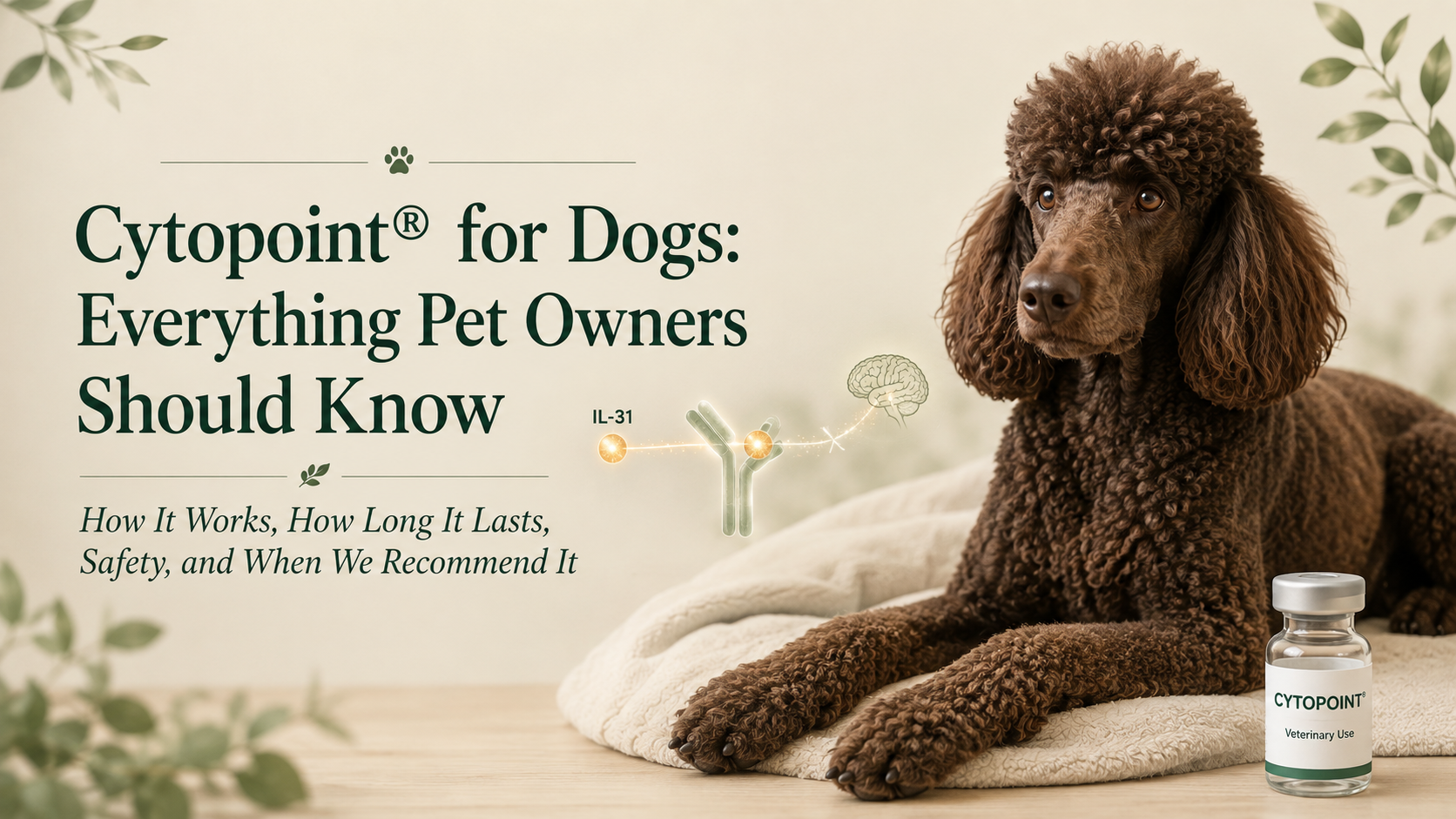
Cytopoint® has changed the way veterinarians treat allergic itch by using antibody technology instead of traditional medications. Learn how it works, why many dogs respond so well, and what to expect if your veterinarian recommends it.
About a 9 minute read
"Is Cytopoint a Steroid?"
This is almost always the first question owners ask.
And the answer is:
No.
Cytopoint isn't a steroid.
It isn't an antihistamine.
It isn't Apoquel.
It isn't even a traditional drug in the way most people think about medications.
Instead...
It's something entirely different.
What Is Cytopoint?
Cytopoint® (lokivetmab) is an injectable medication approved to control allergic itching associated with atopic dermatitis in dogs.
Unlike traditional medications, Cytopoint is a caninized monoclonal antibody.
That sounds incredibly technical.
Fortunately, the idea is actually simple.
Instead of blocking many different parts of the immune system...
It seeks out one specific itch messenger and neutralizes it.
What Is a Monoclonal Antibody?
Think of antibodies as tiny biological "search-and-find" proteins.
Normally, antibodies recognize viruses or bacteria.
A monoclonal antibody is designed to recognize one very specific target.
In the case of Cytopoint...
That target is a protein called interleukin-31 (IL-31).
IL-31 is one of the major chemical messengers responsible for telling your dog's brain:
"I'm itchy."
Cytopoint binds to IL-31 before it can deliver that message.
No message.
Less itching.
An Easy Way to Think About It
Imagine IL-31 is a text message that says:
ITCH!
Cytopoint intercepts that message before it reaches your dog's brain.
The itch signal never gets delivered.
Unlike steroids, Cytopoint doesn't broadly suppress inflammation.
It simply blocks one important itch messenger.
How Quickly Does Cytopoint Work?
Many dogs begin improving within:
- 24 hours
- Sometimes sooner
For others, improvement is more gradual over several days.
Once the itch decreases, the skin finally has a chance to heal.
How Long Does Cytopoint Last?
This is one of the most common questions I receive.
Most injections provide relief for approximately:
4–8 weeks
However...
Every dog is different.
Some dogs consistently receive:
8 weeks of relief.
Others may need another injection after:
4 weeks.
Neither response is "wrong."
Your veterinarian will tailor the schedule based on how your individual dog responds.
Why Didn't It Last as Long This Time?
Owners often worry that Cytopoint has stopped working.
Usually that's not the case.
There are several possibilities.
Your dog may have:
- Developed a skin infection.
- Experienced a heavier pollen season.
- Had increased flea exposure.
- Developed another unrelated skin problem.
- Experienced progression of their allergies.
Sometimes the medication is working exactly as expected—but the disease has changed.
Which Dogs Respond Best?
Cytopoint works best for dogs with:
- Environmental allergies
- Atopic dermatitis
- Moderate to severe itching
- Dogs needing long-term allergy management
Many veterinarians especially like Cytopoint for:
- Dogs that won't take pills.
- Dogs with sensitive stomachs.
- Owners who prefer monthly injections.
- Dogs that cannot safely take certain oral medications.
When Doesn't Cytopoint Work Well?
Although Cytopoint is an excellent medication...
It doesn't solve every itchy dog.
It may not be enough by itself if your dog also has:
- Skin infections
- Ear infections
- Flea infestations
- Food allergies that haven't been addressed
- Contact irritation
- Pain causing licking
- Behavioral licking
Sometimes additional treatments are needed while the underlying problem is addressed.
Is Cytopoint Safe?
One of the reasons Cytopoint has become so popular is its excellent safety profile.
Because it's a monoclonal antibody rather than a traditional drug, it is broken down much like your dog's own natural proteins after it has done its job.
Most dogs tolerate Cytopoint extremely well.
No medication is completely without risk, but serious side effects have been reported infrequently.
As with any injection, individual reactions are possible, and owners should contact their veterinarian if they notice unexpected changes after treatment.
Can Cytopoint Be Used Long-Term?
Yes.
Many dogs receive Cytopoint for months or even years as part of their allergy management plan.
Your veterinarian will continue monitoring your dog's overall health and skin condition over time.
As with any chronic disease, the treatment plan should be reevaluated periodically to ensure it continues meeting your dog's needs.
Cytopoint vs. Apoquel
This is probably the comparison I discuss most often.
Both medications can be excellent choices.
They simply work differently.
Generally speaking:
Apoquel
- Daily tablet
- Acts inside the body to reduce itch signaling
- Rapid onset
- Easy to adjust day by day
Cytopoint
- Injection
- Monoclonal antibody
- Usually lasts several weeks
- Excellent for dogs that dislike pills
Neither medication is universally "better."
The right choice depends on your dog's lifestyle, medical history, and your family's preferences.
Questions I Encourage Every Owner to Ask About Cytopoint
If your veterinarian recommends Cytopoint, consider asking:
- Is my dog's itching caused by environmental allergies?
- How often do you expect my dog will need injections?
- What should I do if the injection seems to wear off sooner than expected?
- Does my dog also have a skin or ear infection?
- Would Cytopoint alone be enough, or should we combine it with other therapies?
Sometimes another problem—not Cytopoint failure—is responsible.
The Bottom Line
Cytopoint represents a completely different approach to allergy treatment.
Instead of broadly suppressing inflammation, it uses monoclonal antibody technology to target one of the key proteins responsible for allergic itch.
For many dogs, this provides weeks of relief with an excellent safety profile.
Like every allergy treatment, Cytopoint works best when it's part of a complete management plan that addresses infections, fleas, and other underlying causes of itching.
The goal isn't simply to stop scratching.
The goal is to help your dog live comfortably every day.
Key Takeaways
- Cytopoint is not a steroid.
- It is a monoclonal antibody that targets IL-31, one of the main itch messengers in dogs.
- Most dogs improve within one to several days.
- Relief commonly lasts 4–8 weeks, although individual responses vary.
- Cytopoint works best for environmental allergies and atopic dermatitis.
- It has an excellent safety profile and is well tolerated by many dogs.
- Cytopoint controls itch but does not cure allergies.
References & Further Reading
- Miller J, Simpson A, Bloom P, et al. 2023 AAHA Management of Allergic Skin Diseases in Dogs and Cats Guidelines. J Am Anim Hosp Assoc. 2023;59(6):255–284. doi:10.5326/JAAHA-MS-7396
- Michels GM, Ramsey DS, Walsh KF, et al. A blinded, randomized, placebo-controlled, dose determination trial of lokivetmab, a caninized anti-canine IL-31 monoclonal antibody in client-owned dogs with atopic dermatitis. Vet Dermatol. 2016;27(6):478-e129. PMID: 27647569
- Michels GM, Walsh KF, Kryda KA, et al. A blinded, randomized, placebo-controlled trial of the safety of lokivetmab, a caninized anti-canine IL-31 monoclonal antibody in client-owned dogs with atopic dermatitis. Vet Dermatol. 2016;27(6):505-e136. PMID: 27647513
- Van Brussel L, Moyaert H, Escalada M, Mahabir SP, Stegemann MR. A masked, randomised clinical trial evaluating the efficacy and safety of lokivetmab compared to saline control in client-owned dogs with allergic dermatitis. Vet Dermatol. 2021;32(5):477-e131. PMID: 34180084
Next in this series
Canine Allergy Learning Center · Part 10 of 23
Part 11: Apoquel® vs. Cytopoint®: Which Allergy Treatment Is Right for My Dog?
Apoquel and Cytopoint both treat allergic itching in dogs, but they work differently. How veterinarians compare them, when each may be preferred, and when they may be used together.
Continue readingContinue Learning
Apoquel®: Everything Pet Owners Should Know
How Apoquel works, how fast it controls itching, side effects, and safety questions owners ask most.
Read articleWhy Do Steroids Work So Well—And Why Don't We Want to Depend on Them?
Prednisone, dexamethasone, and steroid injections — why they work so fast, and why repeated use carries risk.
Read articleThe Three Types of Allergies in Dogs
Flea allergies, environmental allergies, and food allergies — how they differ and why it matters.
Read articleWhy Does My Dog Keep Getting Skin Infections?
Bacterial and yeast infections often flare alongside allergies — and can make medication look like it stopped working.
Read articleWhy Does My Dog Keep Getting Ear Infections?
Recurring ear infections are usually a symptom of an underlying problem — most often allergies.
Read article