
Allergy Learning Center · Part 15
Allergy Shots for Dogs: Can We Actually Change the Disease?
Understanding Allergen-Specific Immunotherapy (ASIT) and Why It's Different from Every Other Allergy Treatment
Unlike medications that simply reduce itching, allergy immunotherapy is designed to retrain your dog's immune system over time. Learn how it works, who it's best for, what success looks like, and why many veterinary dermatologists consider it the closest thing we have to treating the cause—not just the symptoms.
About a 9 minute read
"Will My Dog Need Allergy Medication Forever?"
This is one of the most important questions I hear from owners.
After months—or sometimes years—of itchy skin, ear infections, hot spots, medications, and frustration, many people ask:
"Is there anything that actually fixes the allergies?"
The honest answer is...
Not exactly.
But there is one treatment that's fundamentally different from everything else we've discussed.
It's called allergen-specific immunotherapy, often referred to as:
- Allergy shots
- Allergy vaccines
- Allergy desensitization
- Allergy drops (oral immunotherapy)
Unlike Apoquel®, Cytopoint®, or steroids, immunotherapy isn't designed to simply suppress itching.
Its goal is to teach the immune system to stop overreacting in the first place.
That's what makes it unique.
What Is Allergy Immunotherapy?
Allergy immunotherapy begins after:
- Your veterinarian has diagnosed environmental allergies (atopic dermatitis).
- Allergy testing has identified the environmental allergens most likely affecting your dog.
Those allergens are then used to create a customized vaccine specifically for your dog. If you haven't read it yet, Allergy Testing for Dogs: What It Can—and Can't—Tell You explains where those results come from and why testing follows a clinical diagnosis rather than making one.
Small amounts of those allergens are introduced repeatedly over time.
The goal is to gradually teach the immune system:
"This pollen isn't dangerous."
Instead of reacting with inflammation and itch every time exposure occurs, the immune system slowly becomes more tolerant.
An Easy Way to Think About It
Imagine your dog's immune system is an overly sensitive smoke alarm.
Every little bit of pollen causes it to scream.
Most allergy medications work by muffling the alarm after it starts ringing.
Immunotherapy works differently.
It's trying to recalibrate the smoke alarm so it doesn't go off every time someone burns toast.
Why Is Immunotherapy So Different?
Nearly every other allergy medication works after the immune system has already overreacted.
For example:
- Steroids suppress inflammation.
- Apoquel reduces itch signaling.
- Cytopoint blocks IL-31 before the itch message reaches the brain.
- Antihistamines block histamine in some dogs.
Those medications can be incredibly effective.
But once they wear off...
The underlying allergy is still there.
Immunotherapy is different because it aims to change how the immune system responds over time.
How Are Allergy Shots Given?
There are two common forms of immunotherapy.
Injectable Immunotherapy
Small injections are given under the skin according to a carefully designed schedule.
Many owners learn to give these injections at home.
The needles are tiny, and most dogs tolerate them remarkably well.
Oral Immunotherapy
Some formulations are given as liquid drops inside the mouth.
The goal is the same:
Gradually expose the immune system to carefully selected allergens so it becomes less reactive.
Not every patient is a candidate for every protocol, and recommendations vary depending on your veterinarian or veterinary dermatologist.
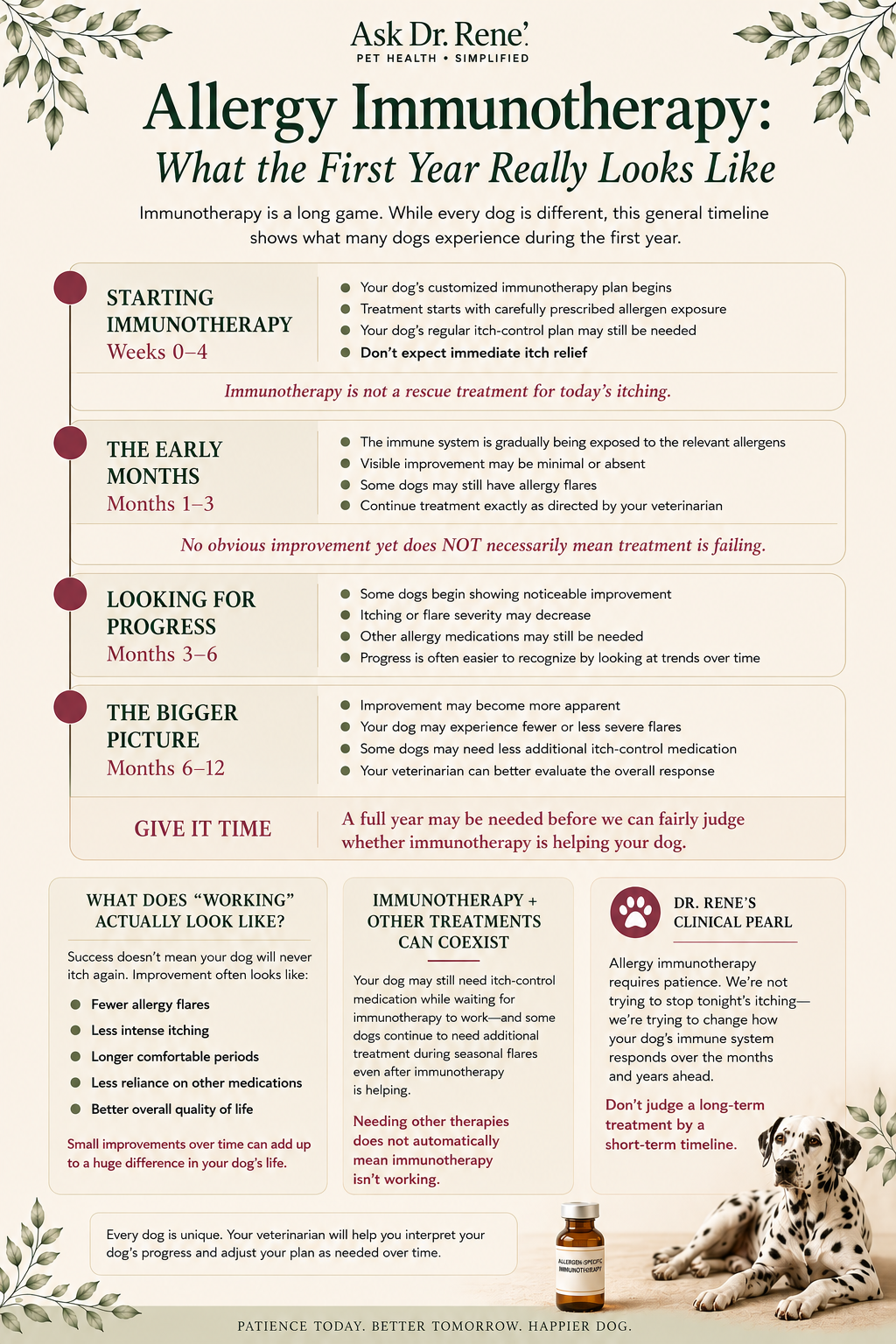
How Long Does It Take to Work?
This is probably the hardest part.
Immunotherapy is slow.
Many owners are used to medications that work within:
- Hours
- Days
Immunotherapy doesn't work that way.
Some dogs begin improving after:
- 3–4 months
Many require:
- 6–12 months
Occasionally even longer.
This isn't because the treatment is failing.
It's because changing an immune system takes time.
Success Rates
One of the most encouraging aspects of immunotherapy is that it works for many dogs.
Studies generally report that about 60–80% of dogs experience meaningful improvement with allergen-specific immunotherapy.
Success doesn't always mean the allergies disappear completely.
Instead, many dogs experience:
- Less itching.
- Fewer ear infections.
- Fewer skin infections.
- Reduced reliance on medications.
- Better quality of life.
For some dogs, the improvement is dramatic.
For others, it's more modest.
Even a partial response can make managing allergies much easier.
Does It Cure Allergies?
No.
At least, not in the way owners usually imagine.
Immunotherapy doesn't erase the immune system's memory.
Instead, it gradually teaches the immune system to become less reactive.
Many dogs still need:
- Medicated shampoos
- Occasional Apoquel or Cytopoint
- Good flea control
- Ear care during flare-ups
The goal isn't perfection.
The goal is better control with less medication over time.
Who Is a Good Candidate?
I usually discuss immunotherapy for dogs that:
- Have confirmed environmental allergies.
- Need medication year after year.
- Have repeated ear or skin infections.
- Experience side effects from other medications.
- Need better long-term control.
- Have owners committed to a long-term treatment plan.
The younger we start appropriate candidates, the more years they have to benefit.
Who May Not Be a Good Candidate?
Immunotherapy may not be the best choice if:
- The diagnosis of environmental allergies is uncertain.
- Fleas or food allergies haven't been addressed.
- Owners are looking for immediate relief.
- Long-term follow-up isn't realistic.
This isn't because immunotherapy doesn't work.
It's because success depends on selecting the right patient.
The Commitment
One of the most important conversations I have is about expectations.
Immunotherapy requires commitment.
It involves:
- Allergy testing.
- Customized formulation.
- Regular administration.
- Patience.
- Follow-up visits.
This isn't a one-time injection.
It's a long-term investment in changing how your dog's immune system behaves.
What About Cost?
Owners often assume immunotherapy is too expensive.
The upfront cost is certainly higher than filling a prescription for a few weeks of medication.
However...
When you consider years of:
- Office visits
- Ear infection treatments
- Skin infection treatments
- Steroids
- Apoquel
- Cytopoint
- Medicated shampoos
Immunotherapy may actually be cost-effective for some dogs over the long term.
The right choice depends on each dog's individual situation and your family's goals.
Questions I Encourage Every Owner to Ask
If you're considering allergy immunotherapy, ask your veterinarian:
- Is my dog a good candidate?
- Would you recommend injections or oral drops?
- How long before we evaluate whether it's helping?
- What other treatments will my dog still need during the transition?
- What does long-term success usually look like?
What Does Success Actually Look Like?
One of the biggest misconceptions about allergy treatment—especially allergy immunotherapy—is believing that success means your dog will never itch again.
That's usually not our goal.
Instead, I ask owners to look for something much more meaningful:
Is your dog's quality of life improving?
For many dogs, success looks like this:
- Sleeping peacefully through the night instead of waking up to scratch every few minutes.
- One ear infection a year instead of six.
- Healthy skin instead of constant redness and irritation.
- Fewer hot spots and skin infections.
- Less chewing and licking of the feet.
- Needing fewer courses of antibiotics or steroids.
- Longer periods between allergy flare-ups.
- Playing, exercising, and enjoying life again instead of constantly focusing on the itch.
- Reducing the amount of medication needed to stay comfortable.
- Giving your dog—and your family—a better quality of life.
My Goal Isn't a Perfect Dog
As veterinarians, we're rarely chasing perfection.
We're chasing comfort.
If I can help your dog go from:
- scratching all day,
- developing monthly ear infections,
- needing repeated antibiotics,
- and keeping everyone awake at night...
to a dog that occasionally scratches during pollen season but otherwise enjoys life...
I consider that a tremendous success.
Sometimes we can achieve even better control than that.
Sometimes we can't.
But almost every allergy patient can have a better quality of life than they had before treatment.
The Bottom Line
Allergen-specific immunotherapy is unlike any other allergy treatment available for dogs.
Rather than simply suppressing itch or inflammation, it's designed to retrain the immune system to become less reactive to environmental allergens over time.
Although it isn't a cure, many dogs experience meaningful long-term improvement, reduced medication needs, and a better quality of life.
For owners willing to commit to the process, allergy immunotherapy can be one of the most rewarding investments they make in their dog's long-term health.
Key Takeaways
- Allergy immunotherapy is the only treatment designed to modify the underlying allergic immune response.
- It is customized using the results of allergy testing.
- Improvement usually takes months—not days.
- Approximately 60–80% of dogs experience meaningful improvement.
- Many dogs require fewer medications over time.
- Success depends on patience, consistency, and choosing the right patients.
References & Further Reading
- Miller J, Simpson A, Bloom P, et al. 2023 AAHA Management of Allergic Skin Diseases in Dogs and Cats Guidelines. J Am Anim Hosp Assoc. 2023;59(6):255–284. doi:10.5326/JAAHA-MS-7396
- Olivry T, DeBoer DJ, Favrot C, Jackson HA, Mueller RS, Nuttall T, Prélaud P; International Committee on Allergic Diseases of Animals. Treatment of canine atopic dermatitis: 2015 updated guidelines from the International Committee on Allergic Diseases of Animals (ICADA). BMC Vet Res. 2015;11:210. PMID: 26276051
- Mueller RS. A systematic review of allergen immunotherapy, a successful therapy for canine atopic dermatitis and feline atopic skin syndrome. J Am Vet Med Assoc. 2023;261(S1):S30–S35. PMID: 36940185
- DeBoer DJ. The future of immunotherapy for canine atopic dermatitis: a review. Vet Dermatol. 2017;28(1):25-e6. PMID: 28133873
Next in this series
Canine Allergy Learning Center · Part 15 of 23
Part 16: Elimination Diet Trials in Dogs: The Only Proven Way to Diagnose a Food Allergy
Food allergy can't be diagnosed from blood, saliva, or hair tests. Here's how a properly performed elimination diet trial works, why strict feeding matters, and why the food challenge confirms the diagnosis.
Continue readingContinue Learning
Allergy Testing: What It Can—and Can't—Tell You
How environmental allergy testing identifies the allergens used to formulate immunotherapy.
Read articleApoquel® vs. Cytopoint®: Which Is Right for My Dog?
How the two most common itch-control treatments compare while a long-term plan is built.
Read articleThe Three Types of Allergies in Dogs
Flea allergy, food allergy, and environmental allergy — how veterinarians tell them apart.
Read articleWhy Does My Dog Keep Getting Skin Infections?
Secondary bacterial and yeast infections that still need care during long-term management.
Read article