
Allergy Learning Center · Part 14
Allergy Testing for Dogs: What It Can—and Can't—Tell You
Understanding Blood Testing, Skin Testing, and How Allergy Immunotherapy Is Created

Allergy testing is one of the most misunderstood topics in veterinary medicine. Learn when it's helpful, when it isn't, and why most veterinarians don't use allergy testing to diagnose allergies.
About an 8 minute read
"Should My Dog Be Allergy Tested?"
This is one of the first questions many owners ask after their dog is diagnosed with allergies.
It seems logical.
If your dog has allergies...
Wouldn't you want to know exactly what they're allergic to?
The answer is:
Yes—but not in the way most people think.
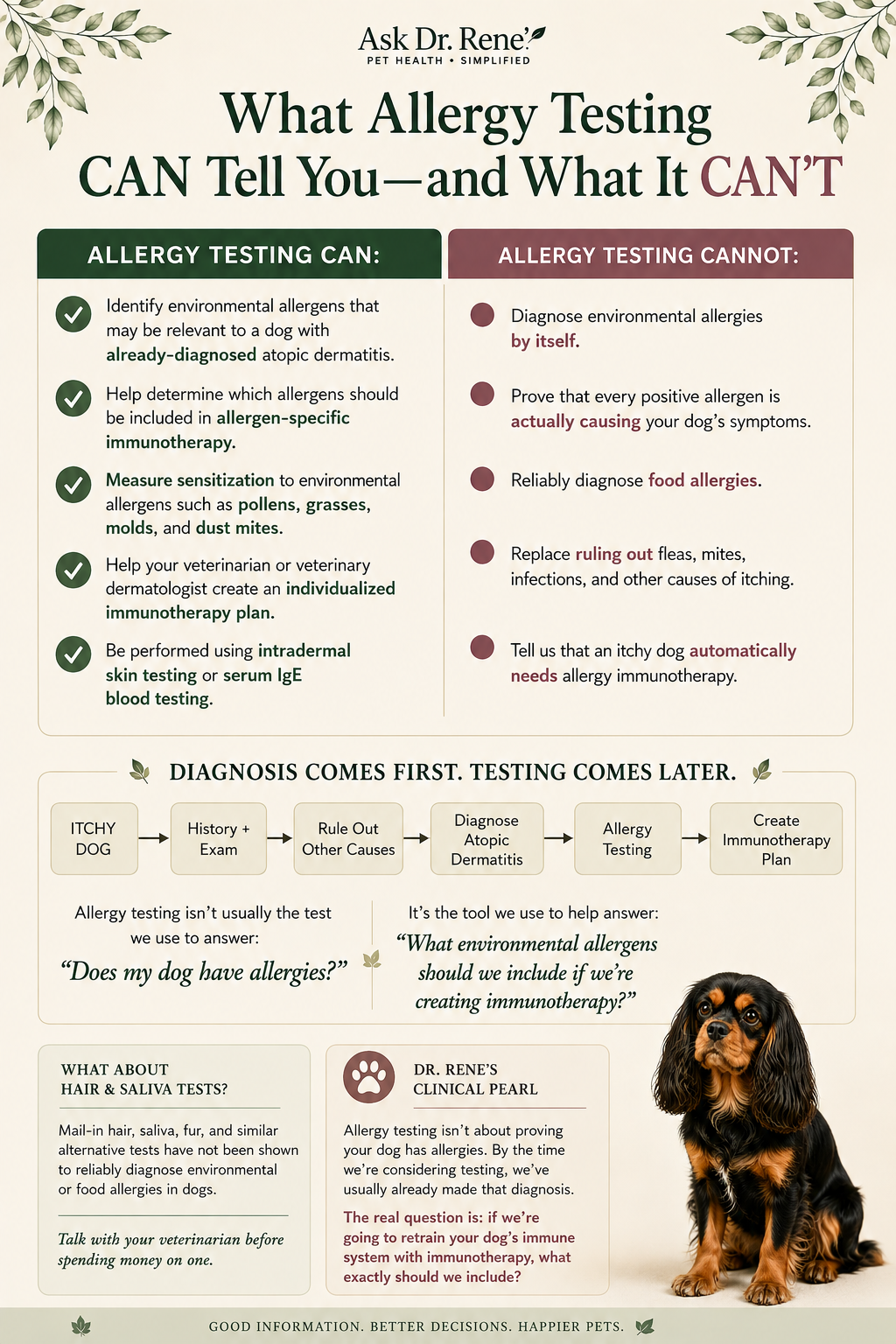
The biggest misunderstanding about allergy testing is believing that it tells us whether your dog has allergies.
It doesn't.
Instead, allergy testing is primarily used to determine which environmental allergens should be included in allergy immunotherapy ("allergy shots" or oral allergy drops).
The Biggest Myth About Allergy Testing
One of the most common misconceptions is:
"Let's do an allergy test and see if my dog has allergies."
Unfortunately...
That's not what allergy testing is designed to do.
There is no blood test or skin test that can diagnose environmental allergies by itself.
Dogs without clinical allergies can sometimes have positive allergy test results.
Dogs with significant allergies may react differently depending on the season, medications, and other factors.
This is why veterinarians diagnose allergies clinically—not by test results alone.
Before We Even Think About Allergy Testing
Before recommending allergy testing, your veterinarian should first rule out other causes of itching, including:
- Fleas
- Mites (mange)
- Skin infections
- Ear infections
- Food allergy
- Hormonal diseases
- Contact irritation
- Pain
- Behavioral licking
If these problems haven't been addressed first—including recurring skin infections and ear infections—allergy testing is unlikely to provide useful answers.
The Two Types of Allergy Testing
There are two primary methods used to identify environmental allergens.
Intradermal Skin Testing
This is considered the gold standard by many veterinary dermatologists.
Small amounts of common environmental allergens are injected just beneath the skin after a small area has been clipped.
The dermatologist then observes which allergens produce a localized reaction.
Skin testing directly evaluates how the skin responds to individual allergens and has been used successfully for decades.
Advantages
- Excellent clinical experience behind it.
- Considered the reference standard by many dermatologists.
- Helps develop individualized allergy immunotherapy.
Limitations
- Requires referral to a veterinary dermatologist.
- Sedation is often needed.
- Hair clipping is required.
- Some medications must be stopped beforehand because they can interfere with results.
Blood Allergy Testing (Serum IgE Testing)
Blood testing measures antibodies against environmental allergens.
A blood sample is collected and sent to a specialized laboratory.
Results help identify which environmental allergens may be contributing to your dog's atopic dermatitis.
Advantages
- Simple blood draw.
- No sedation.
- Convenient for many patients.
- Can often be performed by your primary care veterinarian.
Limitations
- Results must always be interpreted alongside your dog's clinical history.
- Different laboratories may produce somewhat different results.
- Positive results do not automatically mean an allergen is clinically important.
What About Mail-In Hair Tests?
You may have seen advertisements claiming they can identify your dog's allergies using:
- Hair
- Saliva
- Fur
- Specialized scanning devices
These tests can be appealing because they're convenient.
However, they have not been shown to accurately diagnose environmental or food allergies in dogs, and they are not recommended by veterinary dermatologists.
If you're considering one of these tests, talk with your veterinarian first so you understand what the results can—and cannot—tell you.
So Why Do We Test?
If allergy testing doesn't diagnose allergies...
Why do we do it?
The answer is simple.
To create allergen-specific immunotherapy.
In other words...
To build a customized allergy vaccine.
How Is Allergy Immunotherapy Developed?
Once your veterinarian or veterinary dermatologist has diagnosed environmental allergies and allergy testing has identified relevant environmental allergens, those results are used to formulate a customized immunotherapy treatment.
Depending on the program, this may be given as:
- Allergy injections
- Oral allergy drops
The goal isn't simply to control symptoms.
The goal is to gradually teach the immune system to become less reactive to those allergens over time.
Unlike medications that suppress itch, immunotherapy attempts to change the disease itself.
An Easy Way to Think About It
Imagine your dog's immune system has become overly suspicious.
Every time it sees pollen, it sounds the alarm.
Immunotherapy is like patiently retraining that immune system.
Instead of shouting,
"Danger!"
it gradually learns,
"This isn't something I need to overreact to."
That process takes time—but for many dogs, it can make a meaningful difference.
When Is Allergy Testing Most Helpful?
I usually recommend discussing allergy testing when:
- Environmental allergies have been diagnosed.
- Symptoms occur year after year.
- Long-term treatment is expected.
- Owners are interested in allergy immunotherapy.
- Itching remains difficult to control despite appropriate management.
When Is Allergy Testing Usually Not Helpful?
Testing is generally not my first recommendation when:
- Fleas haven't been controlled.
- Skin infections are still present.
- A food allergy hasn't been ruled out when appropriate.
- The diagnosis of atopic dermatitis is still uncertain.
- Owners are hoping the test will identify a specific food to avoid.
Questions I Encourage Every Owner to Ask
If your veterinarian recommends allergy testing, consider asking:
- What are we hoping to learn from this test?
- Will the results change my dog's treatment plan?
- Are we considering allergy immunotherapy?
- Have we ruled out other causes of itching?
- Should we see a veterinary dermatologist?
The Bottom Line
Allergy testing is an important tool, but it's often misunderstood.
It is not used to diagnose environmental allergies or food allergies.
Instead, it helps identify environmental allergens so a customized allergy immunotherapy plan can be developed for dogs with confirmed atopic dermatitis.
When used for the right patient at the right time, allergy testing can be an important step toward long-term allergy management.
Key Takeaways
- Allergy testing does not diagnose environmental allergies.
- Dogs are diagnosed with atopic dermatitis based on history, examination, and ruling out other causes of itching.
- Intradermal skin testing and blood testing are primarily used to develop allergy immunotherapy.
- Blood and skin tests should not be used to diagnose food allergies.
- Hair, saliva, and other alternative allergy tests are not supported by current veterinary evidence.
- Allergy testing is most valuable when it will help guide a long-term immunotherapy plan.
References & Further Reading
- Hensel P, Santoro D, Favrot C, Hill P, Griffin C. Canine atopic dermatitis: detailed guidelines for diagnosis and allergen identification. BMC Vet Res. 2015;11:196. PMID: 26260508
- Morales-Romero R, Gonzalez-Dominguez MS, Sánchez J, Correa-Valencia NM, Maldonado-Estrada JG. Efficacy of diagnostic testing for allergen sensitization in canine atopic dermatitis: a systematic review. Front Vet Sci. 2025;12:1551207. PMID: 40470278
- Hillier A, DeBoer DJ. The ACVD task force on canine atopic dermatitis (XVII): intradermal testing. Vet Immunol Immunopathol. 2001;81(3–4):289–304. PMID: 11553391
- DeBoer DJ, Hillier A. The ACVD task force on canine atopic dermatitis (XVI): laboratory evaluation of dogs with atopic dermatitis with serum-based “allergy” tests. Vet Immunol Immunopathol. 2001;81(3–4):277–287. PMID: 11553390
Next in this series
Canine Allergy Learning Center · Part 14 of 23
Part 15: Allergy Shots for Dogs: Can We Actually Change the Disease?
Allergen-specific immunotherapy is the one allergy treatment designed to change the immune response itself rather than control today's itch — how it works, who it helps, and why it takes months.
Continue readingContinue Learning
The Three Types of Allergies in Dogs
Flea allergy, food allergy, and environmental allergy — how veterinarians tell them apart.
Read articleWhy Is My Dog So Itchy?
The science behind the itch, and how veterinarians work through an itchy dog step by step.
Read articleWhy Does My Dog Keep Getting Skin Infections?
Bacterial and yeast infections that must be addressed before testing is useful.
Read articleApoquel® vs. Cytopoint®: Which Is Right for My Dog?
How the two most common allergy treatments compare while a long-term plan is built.
Read article