
Allergy Learning Center · Part 18
Why Does My Dog Still Have Fleas Even Though They're on Flea Prevention?
Understanding How Modern Flea Products Work—and Why You May Still See Fleas
Modern flea preventives are highly effective, but they're often misunderstood. Learn why you may still see fleas, why your dog may still itch, and how veterinarians determine whether flea prevention is truly working.
About an 8 minute read
"But He's on Flea Prevention...So How Did I Find a Flea?"
Few things frustrate owners more than finding a flea after faithfully giving monthly flea prevention.
The first thought is usually:
"The medication isn't working."
Sometimes that's true.
But much more often...
The product is doing exactly what it was designed to do.
The problem is that many people expect flea prevention to work differently than it actually does.
How Do Most Flea Products Actually Work?
Many owners imagine flea prevention as an invisible shield that keeps fleas from ever touching their dog.
That's not how most veterinary flea preventives work.
Instead:
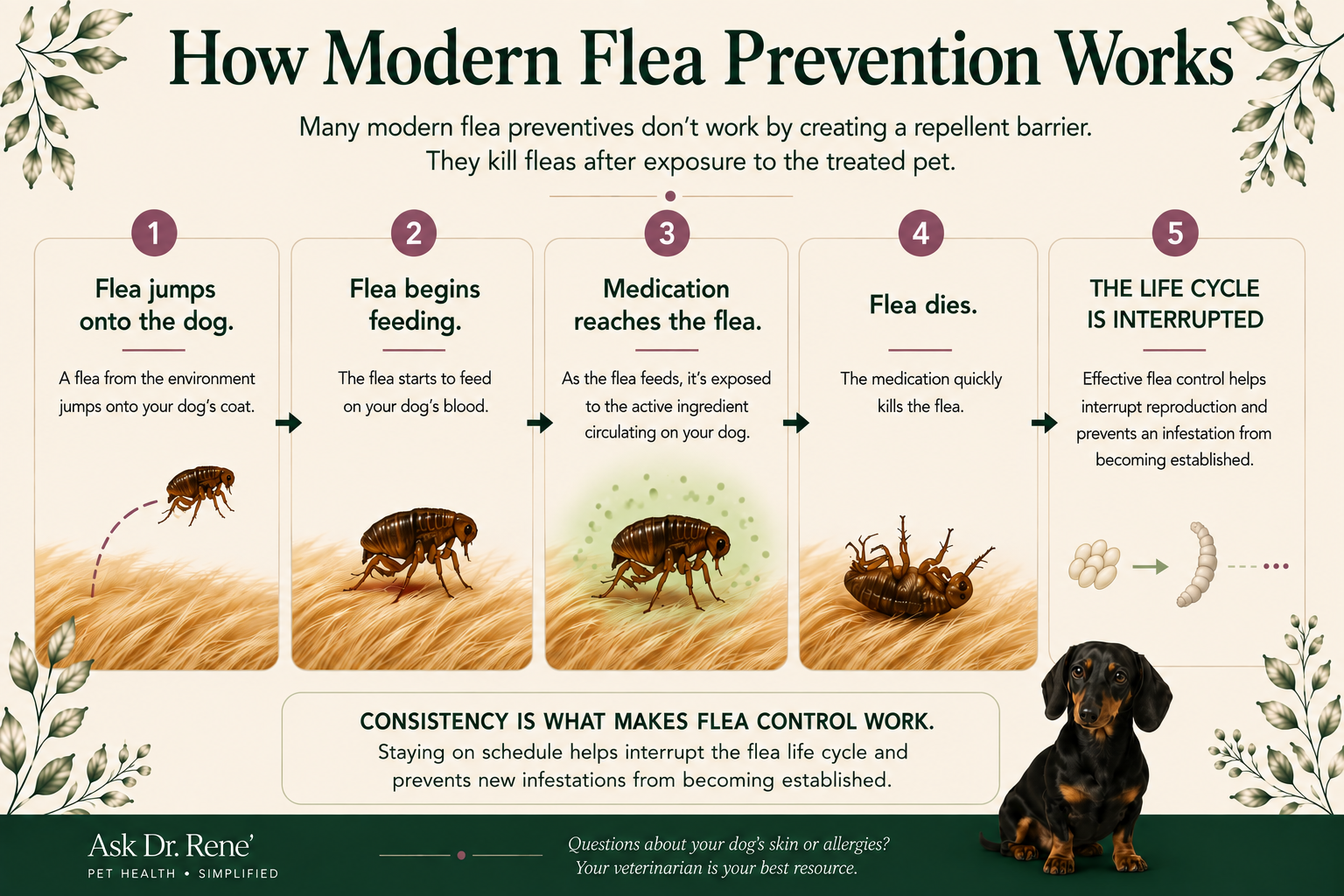
- A flea jumps onto your dog.
- The flea begins feeding.
- The medication enters the flea.
- The flea dies before it can continue feeding, reproduce, or establish an infestation.
This process happens much faster than it would without protection, but it doesn't always happen instantly.
An Easy Way to Think About It
Imagine a burglar walking into a building with an excellent security system.
The security system doesn't prevent the burglar from opening the front door.
It detects the intruder almost immediately and removes them before they can do much damage.
Modern flea preventives work in a similar way.
The flea may arrive.
But it doesn't stay long.
Does That Mean My Dog Can Still Be Bitten?
Sometimes, yes.
Because many flea products require the flea to begin feeding before it is exposed to the medication, a bite may occur before the flea dies.
For most dogs, that isn't a significant problem.
For a dog with flea allergy dermatitis, however, even a single bite may trigger days or weeks of itching.
That's one reason flea-allergic dogs can continue to flare despite excellent flea control.
The medication hasn't failed.
The allergy is simply that sensitive.
Veterinarians look at the whole picture:
- Are fleas reproducing?
- Are you finding large numbers of fleas?
- Are doses being given consistently?
- Is every pet in the home protected?
- Is the environment heavily contaminated?
One flea and hundreds of fleas tell very different stories.
Why Might I Still Be Seeing Fleas?
There are several common reasons.
1. You're Winning the Battle—But Not the War
Adult fleas make up only a small percentage of the total flea population.
Most flea infestations consist of:
- Eggs
- Larvae
- Pupae
These immature stages are already present in your home or yard before treatment even begins.
As they continue to hatch, new adult fleas may appear for several weeks.
That doesn't necessarily mean the medication isn't working.
It means you're seeing the last stages of an existing infestation.
2. A Dose Was Missed
Even missing one monthly dose—or giving it late—can allow flea populations to rebound.
Fleas reproduce incredibly quickly.
Small gaps in protection can have a big impact.
3. Not Every Pet Is Being Treated
This is one of the most common problems I see.
If one dog receives flea prevention but:
- the cat doesn't,
- another dog isn't treated,
- or a new pet enters the home,
fleas can continue cycling through the household.
Successful flea control almost always means treating every dog and every cat in the home.
4. Wildlife Is Visiting Your Yard
Even if your own pets are protected, wildlife can introduce fleas into the environment.
Common visitors include:
- Raccoons
- Opossums
- Foxes
- Feral cats
- Rodents
Your dog may continue encountering new fleas outdoors.
5. Your Home Is Still Recovering
Flea eggs can continue hatching for weeks.
During this time you may continue seeing occasional fleas despite excellent flea prevention.
Regular vacuuming and washing pet bedding help speed this process.
Patience is important.
What About Flea Resistance?
Owners often worry that fleas have become "immune" to flea products.
True resistance is far less common than internet discussions often suggest.
Much more frequently, apparent treatment failures are caused by:
- Missed doses
- Heavy environmental infestations
- Untreated household pets
- Incorrect administration
- Flea allergy causing continued itching after fleas have already been killed
If flea control truly appears inadequate, your veterinarian can help determine whether changing products or addressing another factor is appropriate.
Why Is My Dog Still Itching If the Fleas Are Gone?
This is probably the biggest source of confusion.
Remember...
The fleas and the itching aren't always happening at the same time.
If your dog has flea allergy dermatitis:
- The flea bites today.
- The immune system reacts.
- The flea dies.
- The itching continues.
Sometimes the allergic reaction lasts much longer than the flea itself.
That's why your dog may still scratch even after flea prevention has successfully eliminated the fleas. It's also why flea prevention is especially important for dogs with flea allergy dermatitis.
Before changing medications, ask your veterinarian to evaluate product selection, dosing schedule, household treatment, environmental control, and whether flea allergy is contributing to the itch.
Questions I Encourage Every Owner to Ask
If flea prevention doesn't seem to be working, ask your veterinarian:
- Am I giving the medication correctly?
- Is every pet in my household protected?
- Could this still be flea allergy dermatitis?
- Should I treat my home as well?
- Would you recommend changing flea products?
What Does Success Actually Look Like?
Successful flea prevention doesn't always mean you never see another flea.
Instead, success looks like:
- Fleas die quickly.
- They don't establish an infestation.
- They don't reproduce successfully.
- Your dog's skin becomes healthier.
- Allergy flare-ups become less frequent.
- Hot spots and skin infections become less common.
For flea-allergic dogs, success isn't measured by zero flea sightings.
It's measured by better skin and a more comfortable dog.
The Bottom Line
Modern flea preventives are designed to kill fleas rapidly, but most are not repellents.
That means it's possible to occasionally see a flea even when the medication is working exactly as intended.
When flea prevention appears to fail, the explanation is often related to flea biology, environmental contamination, missed doses, untreated pets, or flea allergy dermatitis—not a defective medication.
Understanding how flea products work helps you partner with your veterinarian to keep your dog comfortable and your home flea-free.
Key Takeaways
- Most flea preventives kill fleas after they jump onto your dog—they do not repel them.
- Seeing an occasional flea does not automatically mean the product has failed.
- Flea allergy dermatitis can cause prolonged itching from a single bite.
- Heavy environmental infestations may take weeks to fully eliminate.
- Every pet in the household should usually be protected.
- Talk with your veterinarian before assuming your flea product isn't working.
Still Fighting Fleas or a Chronic Itch?
Understanding how flea products work makes the conversation with your veterinarian far more productive.
Schedule an educational consultation with Dr. Rene'.
Work With Dr. Rene'References & Further Reading
- Rust MK. The Biology and Ecology of Cat Fleas and Advancements in Their Pest Management: A Review. Insects. 2017;8(4):118. PMID: 29077073
- Carlotti DN, Jacobs DE. Therapy, control and prevention of flea allergy dermatitis in dogs and cats. Vet Dermatol. 2000;11(2):83–98. doi:10.1046/j.1365-3164.2000.00204.x
- Miller J, Simpson A, Bloom P, et al. 2023 AAHA Management of Allergic Skin Diseases in Dogs and Cats Guidelines. J Am Anim Hosp Assoc. 2023;59(6):255–284. doi:10.5326/JAAHA-MS-7396
Next in this series
Canine Allergy Learning Center · Part 18 of 23
Part 19: Bathing an Allergy Dog: One of the Most Overlooked Allergy Treatments
How often should you bathe a dog with allergies? Here's how bathing removes environmental allergens, why shampoo contact time matters, and how conditioners, wipes, and paw care fit in.
Continue readingContinue Learning
Why Flea Prevention Is One of the Most Important Allergy Treatments Your Dog Will Ever Receive
Why one flea bite can cause weeks of itching in a flea-allergic dog.
Read articleThe Three Types of Allergies in Dogs
Flea allergy, food allergy, and environmental allergy — how veterinarians tell them apart.
Read articleHot Spots: Everything You Need to Know
Why acute moist dermatitis appears so suddenly — and why flea allergy is a common trigger.
Read articleSkin Infections: Pyoderma vs. Yeast
Secondary bacterial and yeast infections that often follow allergic flare-ups.
Read article