
Allergy Learning Center · Part 12
Why Benadryl® Usually Doesn't Work for Itchy Dogs
The Truth About Antihistamines for Dogs with Allergies
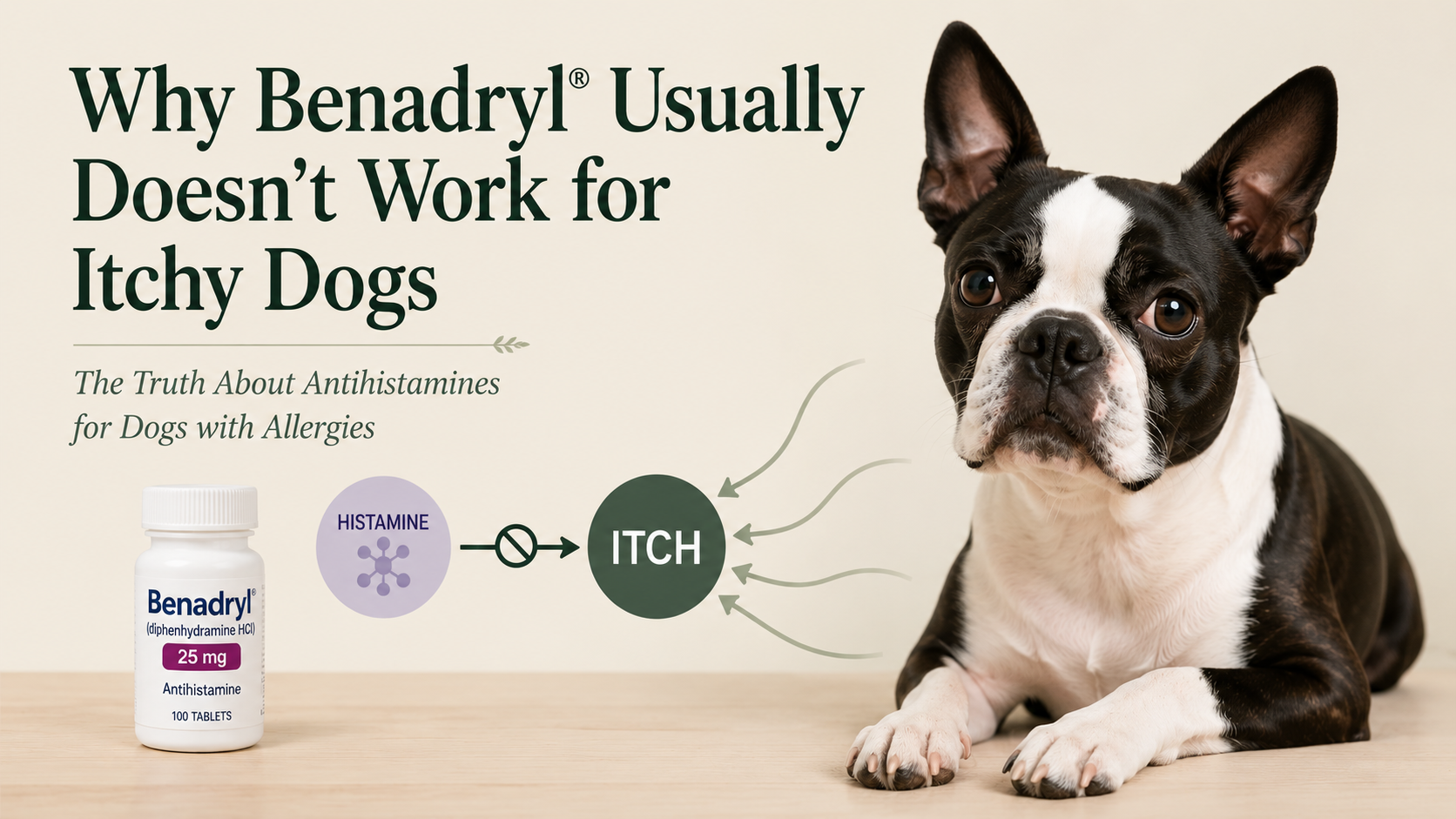
Benadryl®, Zyrtec®, Claritin®, and other antihistamines still have an important place in veterinary medicine—but they're usually not the answer for dogs with chronic environmental allergies. Here's why.
About an 8 minute read
"I've Been Giving Benadryl...Why Is My Dog Still Itching?"
This is one of the most common conversations I have with owners.
They've been doing exactly what they thought they were supposed to do.
Someone recommended Benadryl.
A friend suggested Zyrtec.
The internet said to try an antihistamine first.
They've faithfully given the medication...
And their dog is still scratching.
Still chewing their feet.
Still getting ear infections.
Still miserable.
Naturally, owners begin wondering:
"Am I doing something wrong?"
The answer is...
Probably not.
The reality is that most dogs with chronic environmental allergies simply don't respond very well to antihistamines.
What Are Antihistamines?
Antihistamines are medications that block the effects of histamine, one of the chemicals released during allergic reactions.
Common examples include:
- Benadryl® (diphenhydramine)
- Zyrtec® (cetirizine)
- Claritin® (loratadine)
- Allegra® (fexofenadine)
These medications have been used safely for many years in both human and veterinary medicine.
Why Do They Work So Well for People?
Many people experience allergies that are largely driven by histamine.
Think about symptoms like:
- Sneezing
- Runny nose
- Itchy eyes
- Hives
Histamine plays a major role in those reactions.
Blocking histamine often provides noticeable relief.
Why Don't They Work Well for Most Dogs?
This is one of the biggest differences between human and canine allergies.
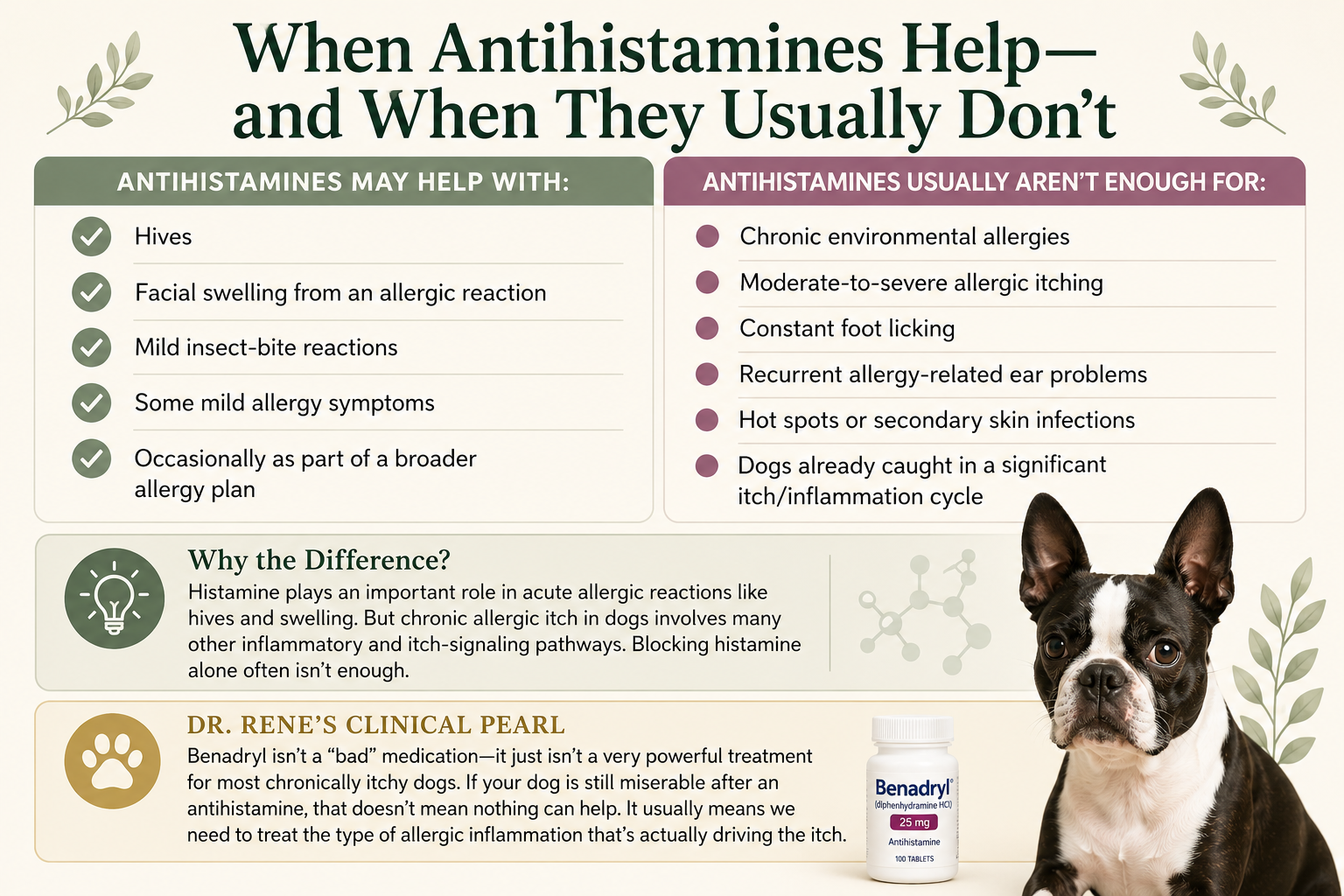
Dogs with atopic dermatitis don't itch because of histamine alone.
Instead, their itch is driven by a complex network of inflammatory chemicals, nerve signals, cytokines, and skin barrier dysfunction.
One of the most important itch messengers is interleukin-31 (IL-31)—not histamine.
By the time a dog has chronic allergic skin disease, blocking histamine is a little like trying to stop a flood by plugging one very small leak.
Histamine matters.
It just isn't the main driver.
An Easy Way to Think About It
Imagine your dog's itch is coming from an orchestra.
Histamine is one violin.
The orchestra also includes:
- IL-31
- Other cytokines
- Nerve pathways
- Inflammatory cells
- Skin barrier damage
Antihistamines quiet one violin.
Modern allergy medications like Apoquel® and Cytopoint® target much more important parts of the orchestra.
That's why they often provide dramatically better itch control.
Does Benadryl Ever Help?
Absolutely.
Benadryl still has an important place in veterinary medicine.
Depending on the situation, your veterinarian may recommend it for:
- Mild allergic reactions
- Insect stings
- Vaccine reactions
- Hives
- Motion sickness (in some dogs)
- Mild sedation before travel or stressful events (in selected situations)
It simply isn't one of our most effective medications for chronic environmental allergies.
What About Zyrtec®, Claritin®, and Allegra®?
Owners often wonder if newer antihistamines work better than Benadryl.
The honest answer is...
Sometimes.
Some individual dogs appear to respond better to cetirizine (Zyrtec®) than diphenhydramine (Benadryl®).
Others show little response to any antihistamine.
Unfortunately, we can't reliably predict which dogs will respond.
That's one reason antihistamines are often considered a reasonable trial in mild cases—but not something we depend on for moderate to severe allergy disease.
Why Did Veterinarians Recommend Benadryl So Often?
This is an important question.
Years ago, veterinarians had far fewer options for treating chronic allergic skin disease.
Before medications like Apoquel® and Cytopoint® were available, antihistamines were one of the safest and least expensive tools we had.
Some dogs improved.
Many didn't.
As veterinary medicine has advanced, we've learned much more about the biology of canine allergies.
We now understand that chronic itch involves many pathways beyond histamine, which has led to the development of newer medications that target the disease much more effectively.
This doesn't mean Benadryl was a "bad" recommendation years ago.
It means veterinary medicine has evolved as we've learned more.
Are Antihistamines Safe?
For most healthy dogs, antihistamines are generally very safe when used appropriately under veterinary guidance.
Possible side effects include:
- Sleepiness
- Dry mouth
- Occasional excitement instead of sedation
- Mild stomach upset
Before Reaching for an Over-the-Counter Product
However, not every human antihistamine product is safe for dogs.
Some combination products contain ingredients such as decongestants or xylitol that can be dangerous.
Always ask your veterinarian before giving any over-the-counter medication.
Can Antihistamines Be Combined with Other Allergy Treatments?
Yes.
In some situations, antihistamines can be one small piece of a larger allergy management plan.
Depending on the individual dog, they may be used alongside:
- Apoquel®
- Cytopoint®
- Allergy immunotherapy
- Omega-3 fatty acid supplements
- Medicated shampoos
- Topical therapies
They rarely control moderate to severe atopic dermatitis by themselves, but they may provide additional benefit for some patients when combined with other treatments.
Questions I Encourage Every Owner to Ask
If you're considering an antihistamine, ask your veterinarian:
- Does my dog truly have allergies?
- Could fleas, infections, or another disease be contributing?
- Is an antihistamine likely to help in my dog's specific situation?
- Which antihistamine would you recommend?
- If this doesn't work, what's our next step?
These conversations often lead to a much more effective long-term treatment plan.
These are signs that your dog likely needs more than an antihistamine alone.
The Bottom Line
Antihistamines remain valuable medications in veterinary medicine, particularly for hives, insect stings, vaccine reactions, and some mild allergic conditions.
However, chronic environmental allergies in dogs are driven by much more than histamine alone.
That's why only a minority of dogs experience meaningful improvement with antihistamines, while many require treatments specifically developed for canine allergic skin disease.
If Benadryl hasn't helped your dog, don't lose hope.
It doesn't mean your dog can't be treated.
It simply means it's time to discuss a more comprehensive allergy management plan with your veterinarian.
Key Takeaways
- Benadryl®, Zyrtec®, Claritin®, and Allegra® are antihistamines—not allergy cures.
- Only about 7% to 30% of dogs with allergic skin disease experience meaningful improvement from antihistamines alone.
- Most canine environmental allergies involve many inflammatory pathways beyond histamine.
- Benadryl still has important uses for hives, insect stings, vaccine reactions, and some acute allergic conditions.
- Chronic allergy dogs usually benefit from medications specifically designed for canine atopic dermatitis.
- If antihistamines aren't helping, it doesn't mean your dog is untreatable—it means they likely need a different approach.
References & Further Reading
- Miller J, Simpson A, Bloom P, et al. 2023 AAHA Management of Allergic Skin Diseases in Dogs and Cats Guidelines. J Am Anim Hosp Assoc. 2023;59(6):255–284. doi:10.5326/JAAHA-MS-7396
- Olivry T, DeBoer DJ, Favrot C, Jackson HA, Mueller RS, Nuttall T, Prélaud P; International Committee on Allergic Diseases of Animals. Treatment of canine atopic dermatitis: 2015 updated guidelines from the International Committee on Allergic Diseases of Animals (ICADA). BMC Vet Res. 2015;11:210. PMID: 26276051
- Olivry T, Foster AP, Mueller RS, McEwan NA, Chesney C, Williams HC. Interventions for atopic dermatitis in dogs: a systematic review of randomized controlled trials. Vet Dermatol. 2010;21(1):4–22. PMID: 20187910
- DeBoer DJ, Griffin CE. The ACVD task force on canine atopic dermatitis (XXI): antihistamine pharmacotherapy. Vet Immunol Immunopathol. 2001;81(3–4):323–329. PMID: 11553395
Next in this series
Canine Allergy Learning Center · Part 12 of 23
Part 13: Do Omega-3 Fatty Acids Really Help Dogs with Allergies?
Fish oil won't cure allergies or stop itching overnight, but it can support a healthier skin barrier over time. How EPA and DHA work, how long they take, and why dosing matters.
Continue readingContinue Learning
Why Do Steroids Work So Well—And Why Don't We Want to Depend on Them?
Prednisone, dexamethasone, and steroid injections — why they work so fast, and why repeated use carries risk.
Read articleApoquel®: Everything Pet Owners Should Know
How Apoquel works, how fast it controls itching, side effects, and safety questions owners ask most.
Read articleCytopoint®: Everything Pet Owners Should Know
How Cytopoint works, how long it lasts, its safety profile, and when veterinarians recommend it.
Read articleApoquel® vs. Cytopoint®: Which Allergy Treatment Is Right for My Dog?
How veterinarians compare the two most common allergy treatments — and when they may be used together.
Read article