
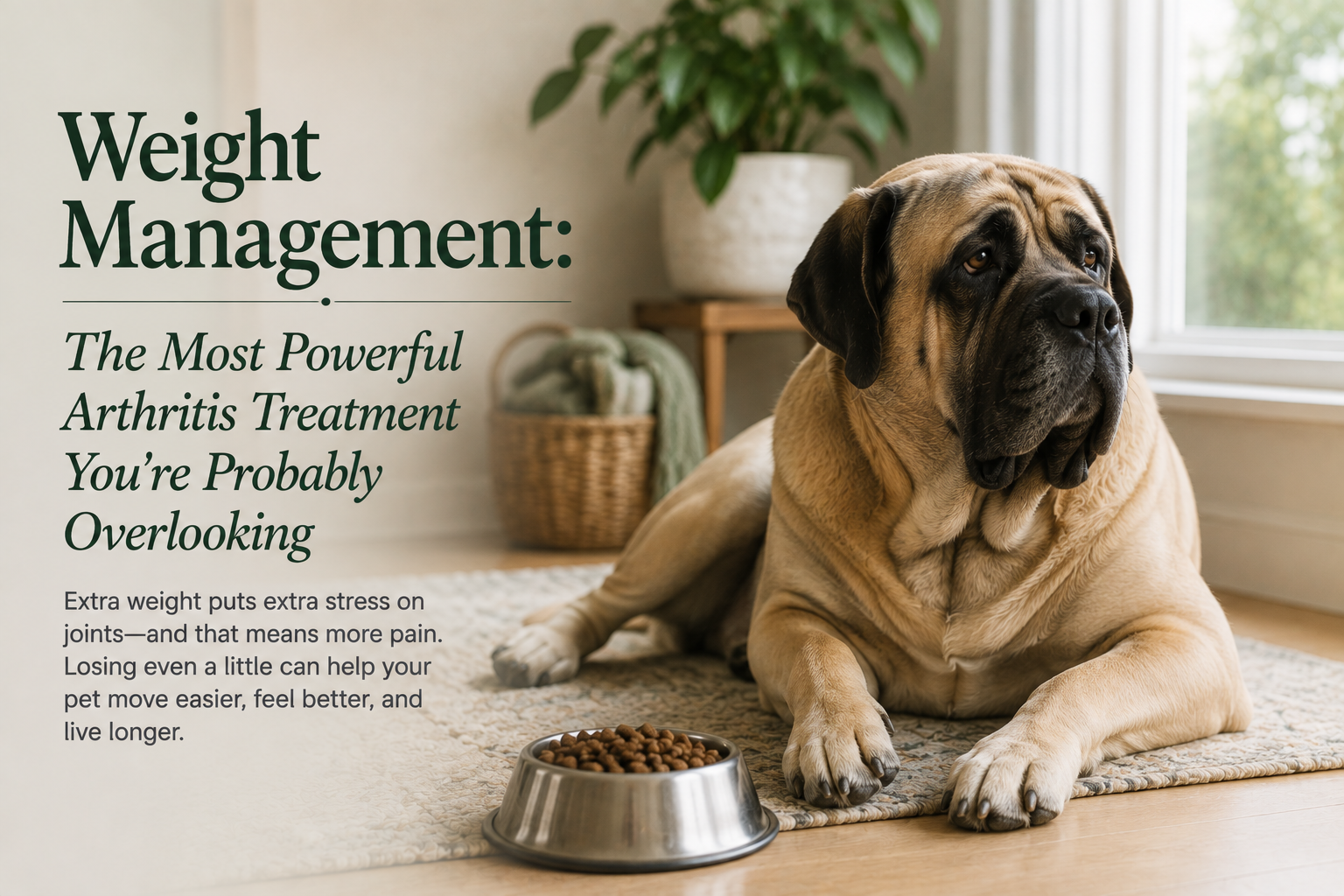
Weight Management: The Most Powerful Arthritis Treatment You're Probably Overlooking
Every extra pound places additional stress on painful joints. Learn why healthy body condition may be the single most powerful arthritis treatment available.
Medications matter, but if I could recommend only one thing for an overweight pet with arthritis, it would be helping them reach a healthy body weight. Learn why fat is inflammatory, why every pound matters, and how to lose weight safely without losing muscle.
Quick answer
In this article you'll learn
- Why extra weight makes arthritis pain worse with every step
- Why fat is an active, inflammatory tissue and not just padding
- How even a few pounds of weight loss can improve mobility
- How to recognize healthy body condition in your pet
- Why preserving muscle matters as much as losing fat
- Why cats need weight management too
- Why safe weight loss is gradual—and why crash diets are dangerous
When most people think about treating arthritis, they think about medications.
Librela.
NSAIDs.
Joint supplements.
Physical therapy.
Those treatments can all play an incredibly important role in helping pets feel better.
But if I could only recommend one thing for an overweight pet with arthritis, it would be helping them achieve a healthy body weight.
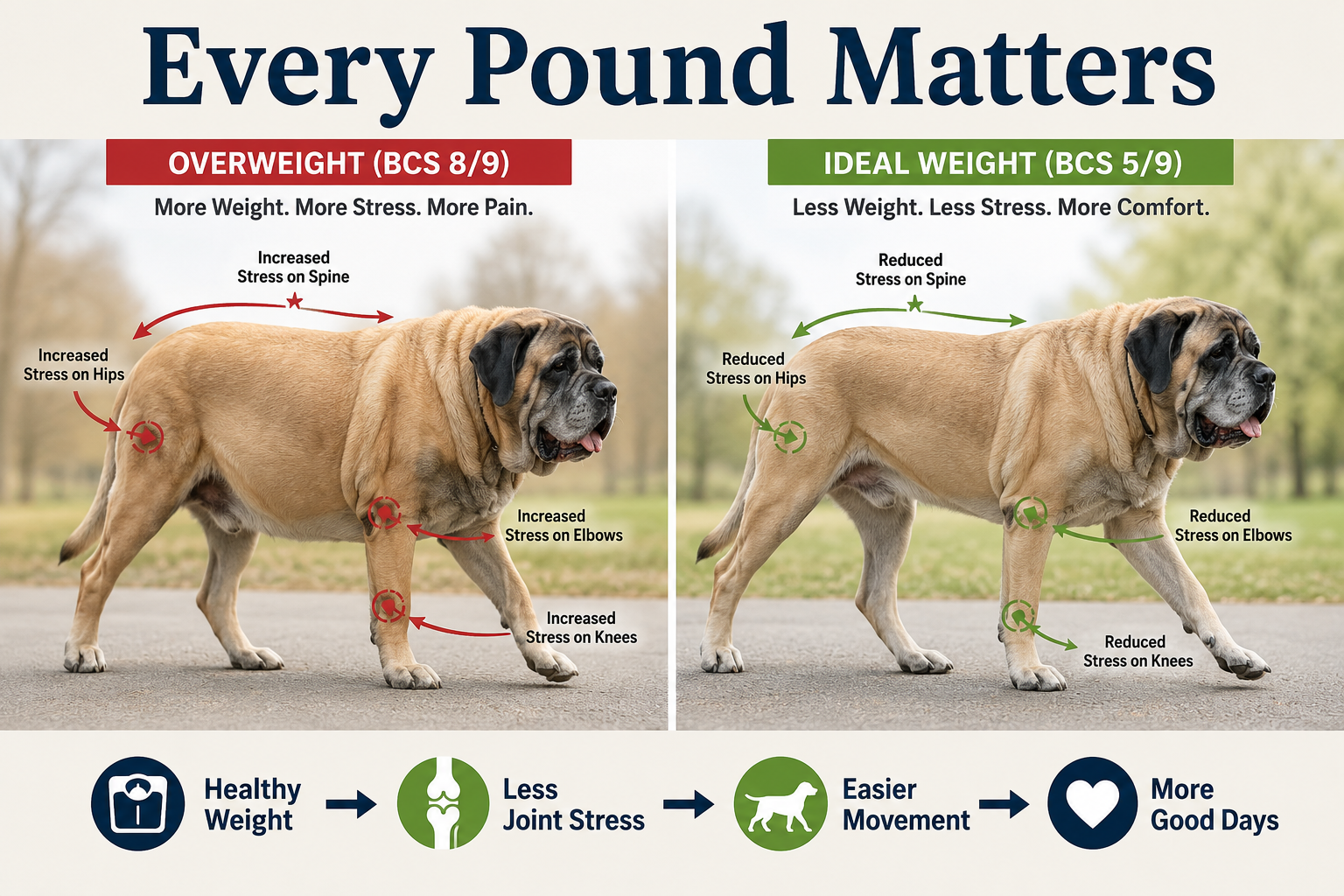
That's because every extra pound your pet carries places additional stress on joints that are already painful and inflamed.
The good news?
Even modest weight loss can make a remarkable difference in comfort, mobility, and quality of life.
Every Pound Matters: Why Healthy Weight Is Arthritis Medicine
Why Weight Matters
Imagine carrying a heavy backpack every hour of every day.
Now imagine that your knees, hips, or elbows already hurt.
Every extra step becomes just a little harder.
That's exactly what happens in overweight dogs and cats.
Extra body weight increases the force placed on every joint every time your pet stands, walks, runs, climbs stairs, or jumps.
Over months and years, that additional stress accelerates wear and tear on already damaged joints.
The result is more inflammation.
More pain.
Less movement.
More weight gain.
A cycle that's difficult to break unless we intervene.
Fat Isn't Just Extra Weight
One of the biggest misconceptions about obesity is that fat is simply "extra padding."
It isn't.
Fat is actually a very active tissue.
It produces inflammatory chemicals that circulate throughout the body.
That means excess body fat doesn't just increase the physical load on the joints—it can also contribute to the inflammation occurring inside those joints.
For pets with arthritis, maintaining a healthy body condition helps in two important ways:
It reduces the amount of weight the joints must support.
It helps decrease inflammation associated with excess body fat.
That's why weight management is considered one of the cornerstones of arthritis treatment.
Every Pound Matters
Many owners feel discouraged because their pet needs to lose 20 or 30 pounds.
The encouraging news is that your pet doesn't have to reach their ideal weight overnight before they start feeling better.
Even losing a small amount of weight can improve mobility.
Many owners begin noticing positive changes after their pet loses just a few pounds.
Their dog seems happier on walks.
Their cat starts jumping onto furniture again.
They get up more easily after resting.
Small changes add up.
The Goal Isn't a Skinny Pet
When I recommend weight loss, I'm not trying to make your pet thin.
I'm trying to make them comfortable.
There's a big difference.
Healthy body condition means your pet has enough muscle to stay strong while carrying only the amount of body fat they truly need.
For most pets, you should be able to:
- Feel the ribs without pressing hard
- See a waist when viewed from above
- Notice a tuck-up behind the rib cage when viewed from the side
If you have to push through a thick layer of fat to feel your pet's ribs, they may be carrying more weight than is healthy.
Weight Loss Should Never Mean Muscle Loss
One mistake I occasionally see is rapid weight loss.
For pets with arthritis, preserving muscle is just as important as reducing excess fat.
Muscles act like natural shock absorbers around painful joints.
The stronger those muscles are, the better they can support the body during movement.
That's why healthy weight loss should always include:
- A balanced, calorie-controlled diet
- Appropriate exercise
- Adequate protein
- Regular weight checks
- Guidance from your veterinarian
The goal isn't simply to make the number on the scale smaller.
The goal is to create a healthier, stronger pet.
Cats Need Weight Management Too
When people think about arthritis, they often picture an overweight Labrador.
But excess weight affects cats just as much.
Because cats naturally jump dozens of times every day, carrying extra weight places tremendous stress on the hips, knees, elbows, and spine.
Many overweight cats gradually stop jumping, climbing, and playing—not because they're lazy, but because movement has become uncomfortable.
Helping an overweight cat lose weight safely can often improve both mobility and quality of life.
Weight Loss Takes Time
If your pet didn't become overweight in a month, they won't safely lose it in a month.
Healthy weight loss is gradual.
Crash diets can be dangerous—especially for cats, where rapid weight loss can lead to hepatic lipidosis (fatty liver disease), a potentially life-threatening condition.
Your veterinarian can help determine a safe calorie goal and a realistic rate of weight loss based on your pet's age, breed, health, and body condition.
Slow, steady progress is almost always the safest and most successful approach.
Weight Management Works Best as Part of a Team
Weight loss alone won't cure arthritis.
But it can make every other treatment work better.
A dog that reaches a healthier weight may respond better to medications.
Physical rehabilitation often becomes easier.
Exercise is more comfortable.
Daily activities require less effort.
Think of weight management as the foundation of your pet's arthritis treatment plan.
Once that foundation is in place, everything built on top of it becomes stronger.
Frequently asked questions
Educational only. This article is not a substitute for veterinary care. If your pet is unwell, please contact your veterinarian.
Next in this series
Arthritis Learning Series · Part 4 of 16
Part 5: Exercise & Physical Rehabilitation: Motion Is Medicine
For most pets with arthritis, the goal isn't less movement—it's better movement. Learn which activities help, how physical rehabilitation and laser therapy fit in, how to exercise a cat, and when to stop.
Continue readingKeep reading
Adequan®, Librela®, and NSAIDs: Which Arthritis Treatment Does My Dog Need?
NSAIDs, Adequan®, and Librela® each treat arthritis in a completely different way. Learn what each one does, how they compare, and why combining them is often the most effective approach.
Read DiseasesExercise & Physical Rehabilitation: Motion Is Medicine
For most pets with arthritis, the goal isn't less movement—it's better movement. Learn which activities help, how physical rehabilitation and laser therapy fit in, how to exercise a cat, and when to stop.
Read DiseasesArthritis in Dogs and Cats: What Every Pet Owner Should Know
Arthritis is one of the most common causes of chronic pain in dogs and cats, yet the earliest signs are often mistaken for normal aging. Learn what happens inside an arthritic joint, which pets are at risk, and how early treatment can protect comfort and mobility.
ReadKeep learning with Dr. Rene'
Browse the library, search another topic, or ask a question of your own.
Continue your journey
Loved this? Here's what to do next.
Every visit is a chance to understand your pet a little better. Pick your next step.
Explore the Learning Center
Browse evidence-based articles about symptoms, diseases, medications, treatments, preventive care, and more.
Explore ArticlesWatch Dr. Rene'
Prefer to watch instead of read? Explore practical veterinary education videos from Dr. Rene'.
Watch VideosGet Free Resources
Explore practical veterinary guides, checklists, and tools designed to help pet owners feel more informed and prepared.
Browse Free ResourcesProducts I Recommend
Browse pet products, supplies, and everyday essentials selected and recommended by Dr. Rene'.
See My RecommendationsEducational consultation
Want help understanding a diagnosis, test results, medications, or treatment options? Book educational guidance with Dr. Rene'. This does not replace veterinary care.
Learn more