
How Is Arthritis Diagnosed?
Arthritis isn't diagnosed by a single test. Learn how your observations at home, a thorough orthopedic examination, and imaging fit together.
How do veterinarians know it's really arthritis? Diagnosis comes from putting the pieces together: your story, the physical examination, gait evaluation, and—when appropriate—X-rays. Learn what each step reveals and why early diagnosis matters.

Quick answer
In this article you'll learn
- Why your observations at home are one of the most valuable diagnostic clues
- What your veterinarian is looking for during an orthopedic examination
- Why home videos can reveal what an office visit cannot
- Whether every pet needs X-rays, and what radiographs can and cannot show
- When additional testing such as bloodwork or advanced imaging is helpful
- Why early diagnosis changes what we can do for your pet
By now, you may be wondering:
"My pet is showing several of these signs...so how do veterinarians know it's really arthritis?"
The answer is that diagnosing arthritis isn't based on a single test.
Instead, your veterinarian puts together several important pieces of information—including what you've noticed at home, your pet's physical examination, and, when appropriate, diagnostic imaging—to determine whether arthritis is causing your pet's discomfort.
In many cases, you are the first person to notice something has changed.
The small details you share during your appointment often provide some of the most valuable clues.
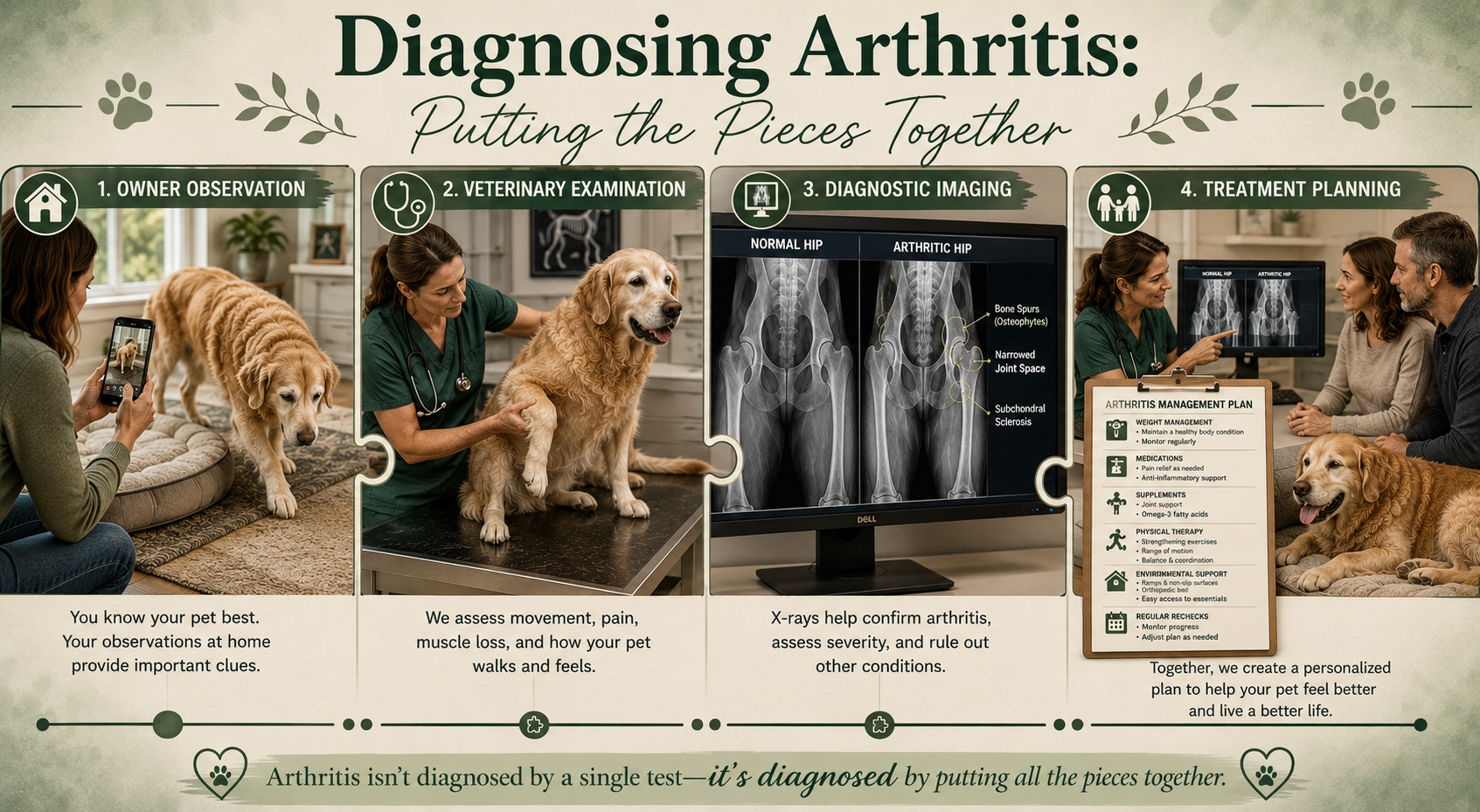
It Starts With Your Story
Before your veterinarian even begins the physical examination, they'll want to hear about the changes you've noticed at home.
Questions may include:
- When did you first notice a change?
- Is your pet stiff after resting?
- Does the stiffness improve after walking?
- Has your dog stopped jumping into the car?
- Has your cat stopped climbing the cat tree?
- Are stairs becoming more difficult?
- Have you noticed limping?
- Has your pet become less playful?
- Have there been any previous injuries or surgeries?
These answers help us understand not only whether your pet is painful, but also how that pain is affecting their daily life.
Your Veterinarian's Physical Examination
The physical examination is one of the most important parts of diagnosing arthritis.
Your veterinarian isn't simply feeling your pet's legs.
They're looking for subtle changes throughout the body that often accompany chronic joint pain.
During the examination, your veterinarian may evaluate:
Joint Range of Motion
Healthy joints move smoothly through their normal range of motion.
Arthritic joints often become stiff, painful, or resistant to movement.
Pain
Your veterinarian will gently manipulate the joints to identify areas of discomfort.
Some pets may tense their muscles.
Others may pull the leg away, turn their head, or show subtle signs of discomfort.
Many pets never cry out, even when a joint is painful.
Muscle Loss
One of the biggest clues to chronic arthritis is muscle atrophy.
When a joint hurts, pets naturally use that limb less.
Over time, the surrounding muscles begin to shrink.
Sometimes the muscle loss is much easier to appreciate than the lameness itself.
Joint Thickening
Long-standing arthritis often causes joints to become enlarged.
This happens because of inflammation and new bone formation around the joint.
Walking and Gait
Watching your pet walk is incredibly valuable.
Your veterinarian may observe your pet:
- Walking
- Trotting
- Turning
- Sitting
- Standing
- Climbing a small step
- Rising after lying down
Many arthritic pets move differently than their owners realize because those changes developed gradually over months or years.
Videos Can Be One of Your Best Tools
One of the biggest advantages pet owners have is that you see your pet every day.
Many dogs become nervous during veterinary visits and temporarily hide their stiffness because of adrenaline.
Cats may move very differently in the clinic than they do at home.
That's why I often encourage owners to bring videos.
A short phone video showing your pet:
- Getting up after a nap
- Walking through the house
- Climbing stairs
- Jumping into the car
- Trying to jump onto furniture
- Using the litter box
...can be incredibly helpful and often provides information we can't see during a brief office visit.
Do All Pets Need X-Rays?
Not necessarily.
Many pets with arthritis can be strongly suspected of having joint disease based on their history and physical examination alone.
However, radiographs (X-rays) are often recommended because they help:
- Confirm arthritis
- Evaluate how severely the joint has changed
- Identify previous injuries
- Detect bone spurs
- Rule out fractures, bone tumors, or other conditions that can mimic arthritis
- Help guide long-term treatment decisions
What Can X-Rays Show?
Radiographs allow veterinarians to see changes in the bones surrounding the joint.
Common findings include:
- Bone spurs (osteophytes)
- Narrowing of the joint space
- Thickening of the bone beneath the cartilage
- Joint remodeling
- Evidence of previous injuries
- Joint instability
These changes help confirm that arthritis is present.
What X-Rays Can't Tell Us
This surprises many owners.
The severity of arthritis on an X-ray doesn't always match how painful a pet feels.
Some pets have dramatic arthritic changes and remain surprisingly comfortable.
Others have only mild changes but experience significant pain.
That's because pain comes from inflammation, the joint capsule, surrounding tissues, and changes in how the joint functions—not just what appears on the X-ray.
Your veterinarian treats the patient, not the radiograph.
Are Other Tests Ever Needed?
Sometimes.
If your veterinarian suspects another condition may be causing your pet's lameness or discomfort, additional testing may be recommended.
Depending on your pet's history, this could include:
- Bloodwork
- Joint fluid analysis
- Advanced imaging such as CT or MRI
- Referral to a veterinary orthopedic specialist
- Referral for rehabilitation evaluation
Most pets with typical osteoarthritis never need these tests, but they can be very helpful in more complicated cases.
Why Early Diagnosis Matters
Arthritis is a progressive disease.
The earlier it's recognized, the sooner we can begin breaking the cycle of pain, inflammation, muscle loss, and reduced mobility.
Early treatment doesn't just improve comfort today.
It helps preserve strength, mobility, and quality of life for years to come.
Frequently asked questions
Educational only. This article is not a substitute for veterinary care. If your pet is unwell, please contact your veterinarian.
Next in this series
Arthritis Learning Series · Part 3 of 16
Part 4: Weight Management: The Most Powerful Arthritis Treatment You're Probably Overlooking
Medications matter, but if I could recommend only one thing for an overweight pet with arthritis, it would be helping them reach a healthy body weight. Learn why fat is inflammatory, why every pound matters, and how to lose weight safely without losing muscle.
Continue readingKeep reading
Arthritis in Dogs and Cats: What Every Pet Owner Should Know
Arthritis is one of the most common causes of chronic pain in dogs and cats, yet the earliest signs are often mistaken for normal aging. Learn what happens inside an arthritic joint, which pets are at risk, and how early treatment can protect comfort and mobility.
Read DiseasesRecognizing Arthritis: The Signs Your Pet May Be Trying to Tell You
Most pets with arthritis never cry or limp dramatically. They simply stop doing the things they love. Learn the subtle signs of joint pain in dogs and cats, why pets hide discomfort, and when it is time to schedule a veterinary examination.
Read DiseasesLibrela® for Dogs: A New Way to Treat Arthritis Pain
Librela® is a monthly injection that blocks Nerve Growth Factor to reduce arthritis pain in dogs. Learn how it works, who it helps, what to expect, and the reported side effects to discuss with your veterinarian.
ReadKeep learning with Dr. Rene'
Browse the library, search another topic, or ask a question of your own.
Continue your journey
Loved this? Here's what to do next.
Every visit is a chance to understand your pet a little better. Pick your next step.
Explore the Learning Center
Browse evidence-based articles about symptoms, diseases, medications, treatments, preventive care, and more.
Explore ArticlesWatch Dr. Rene'
Prefer to watch instead of read? Explore practical veterinary education videos from Dr. Rene'.
Watch VideosGet Free Resources
Explore practical veterinary guides, checklists, and tools designed to help pet owners feel more informed and prepared.
Browse Free ResourcesProducts I Recommend
Browse pet products, supplies, and everyday essentials selected and recommended by Dr. Rene'.
See My RecommendationsEducational consultation
Want help understanding a diagnosis, test results, medications, or treatment options? Book educational guidance with Dr. Rene'. This does not replace veterinary care.
Learn more