
Femoral Head Ostectomy (FHO) in Dogs & Cats: A Different Approach to Hip Pain
Why removing part of the hip can create a comfortable, functional 'false joint.'
An FHO removes the painful ball of the hip joint so a fibrous false joint can form. A veterinarian explains which dogs and cats are good candidates, why rehabilitation determines success, and how FHO compares to total hip replacement.
Quick answer
In this article you'll learn
- What an FHO removes and why that relieves pain
- Which dogs and cats are the best candidates
- Why cats often do exceptionally well
- How rehabilitation determines the outcome
- How FHO compares with total hip replacement
- The risks and realistic expectations
When owners hear that their dog has severe hip arthritis, many assume the only surgical option is a total hip replacement.
In reality, there is another procedure that has helped countless dogs regain comfort and mobility: the Femoral Head Ostectomy (FHO).
Unlike a total hip replacement, an FHO doesn't replace the damaged joint.
Instead, it removes the painful part of the joint altogether.
While that may sound surprising, many dogs can function remarkably well afterward.
What Is an FHO?
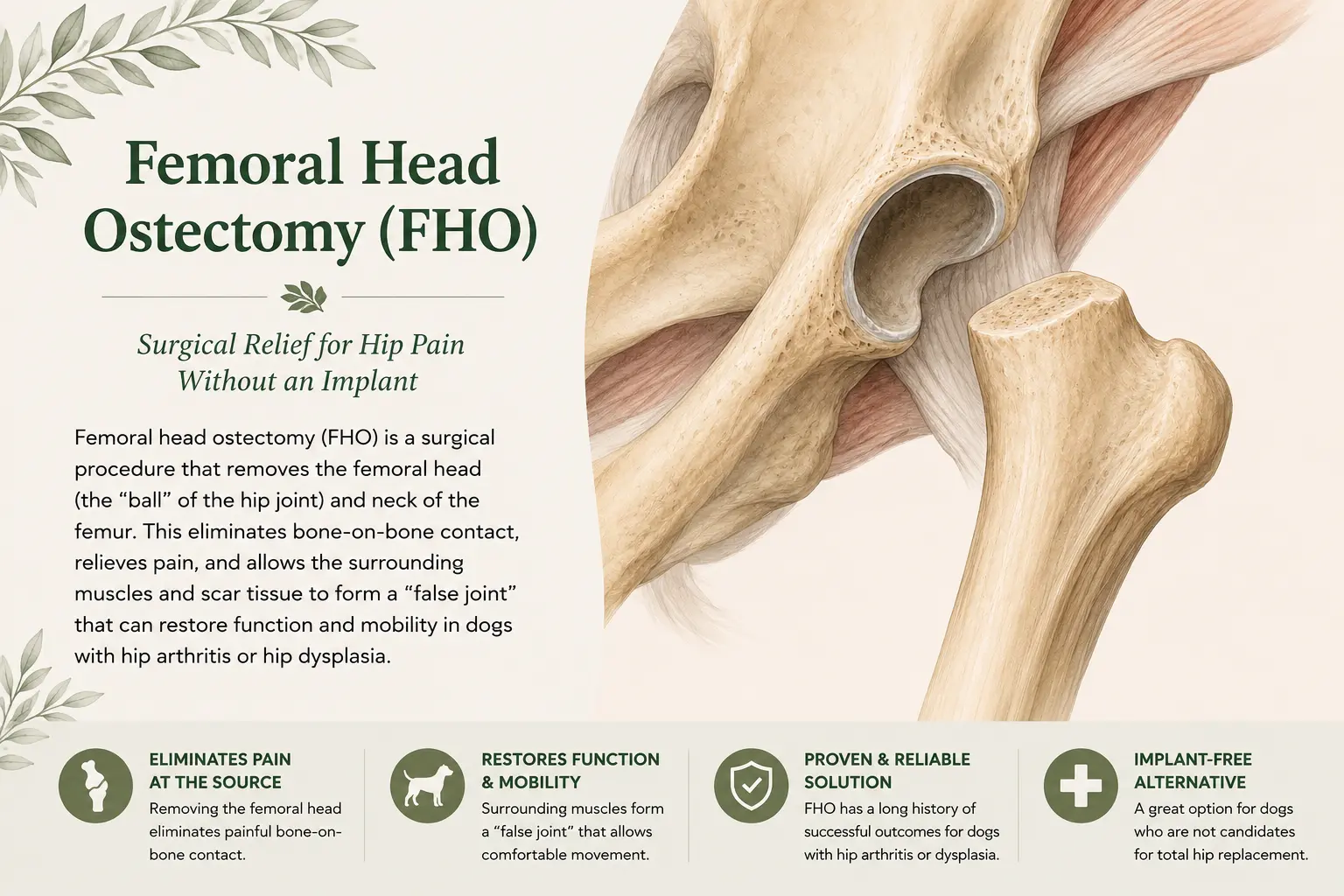
The hip is a ball-and-socket joint.
The "ball" is the femoral head—the top portion of the thigh bone.
During an FHO, the surgeon removes the femoral head and neck, eliminating the painful bone-on-bone contact caused by arthritis or injury.
Over time, the surrounding muscles and connective tissues form a "false joint" (fibrous pseudoarthrosis) that allows the leg to move comfortably.
Although this false joint isn't identical to a normal hip, it can provide excellent pain relief and functional mobility.
Which Dogs Are Good Candidates?
An FHO may be recommended for dogs with:
- Severe hip arthritis.
- Hip dysplasia with chronic pain.
- Femoral head fractures.
- Hip luxation (dislocation) that cannot be successfully repaired.
- Avascular necrosis (Legg-Calvé-Perthes disease).
- Failed previous hip surgery.
Historically, FHOs were recommended primarily for small and medium-sized dogs.
However, with dedicated rehabilitation, many larger dogs can also achieve very good outcomes.
The key is choosing the right patient and committing to postoperative rehabilitation.
What About Cats?
Cats are often excellent candidates for an FHO.
Because they are lighter, more agile, and naturally adapt their movement, many cats regain outstanding function after surgery.
For feline patients with severe hip injuries or arthritis, an FHO is often the preferred surgical option.
Recovery Is Everything
One of the biggest predictors of success isn't the surgery itself—it's the recovery afterward.
After surgery, pets need:
- Strict pain management.
- Controlled activity.
- Gradual return to movement.
- Physical rehabilitation.
- Muscle-strengthening exercises.
Unlike many orthopedic surgeries, early controlled use of the leg is encouraged once your veterinarian determines it's safe.
Building muscle helps the new fibrous joint function more effectively.
Dogs that remain inactive for long periods after surgery often have poorer outcomes than those participating in a structured rehabilitation program.
What Does the Research Say?
FHO has been performed successfully for decades.
Numerous studies have shown:
- Excellent pain relief.
- Improved mobility.
- High owner satisfaction.
- Good long-term quality of life.
While gait may not return completely to normal—particularly in larger dogs—most pets become far more comfortable than they were before surgery.
The procedure is especially successful in cats and smaller dogs.
FHO vs. Total Hip Replacement
Owners often ask which surgery is "better."
The answer depends on the patient.
Total Hip Replacement
- Replaces the normal joint.
- Usually restores more normal biomechanics.
- Often provides the best long-term function.
- More expensive.
- Requires specialized surgical training and implants.
Femoral Head Ostectomy
- Removes the painful joint.
- Creates a comfortable false joint.
- Less expensive.
- More widely available.
- Functional outcome depends heavily on rehabilitation and muscle development.
Neither surgery is universally better.
The best choice depends on:
- Your pet's size.
- Age.
- Activity level.
- Overall health.
- Financial considerations.
- Availability of a board-certified surgeon.
- Your veterinarian's recommendations.
Are There Risks?
Like any surgery, FHO carries potential risks, including:
- Infection.
- Delayed healing.
- Persistent muscle loss.
- Reduced range of motion.
- Continued lameness.
- Need for prolonged rehabilitation.
Fortunately, serious complications are relatively uncommon.
My Perspective
Continue learning
- Total hip replacement — the surgical alternative to an FHO.
- Exercise and physical rehabilitation — the single biggest predictor of FHO success.
- Arthritis medications for dogs and cats — pain control before and after surgery.
- Advanced arthritis treatments overview — compare every option side by side.
Femoral Head Ostectomy (FHO) at a Glance
How it works
Removes the painful ball portion of the hip joint, allowing a comfortable fibrous "false joint" to develop over time.
Best candidates
Small and medium-sized dogs with severe hip disease, many cats with hip injuries or arthritis, and selected larger dogs committed to rehabilitation.
Evidence
⭐⭐⭐⭐☆ (Strong evidence for pain relief and improved quality of life, particularly in cats and smaller dogs. Success in larger dogs depends heavily on rehabilitation.)
Typical cost
$$$–$$$$ (Generally less expensive than a total hip replacement because specialized implants are not required.)
Invasiveness
High (Major orthopedic surgery requiring general anesthesia and postoperative rehabilitation.)
Dr. Rene's recommendation
FHO is an excellent procedure for the right patient. While it doesn't recreate a normal hip, it can provide outstanding pain relief and restore a happy, active life—especially when paired with a dedicated rehabilitation program.
Frequently asked questions
Educational only. This article is not a substitute for veterinary care. If your pet is unwell, please contact your veterinarian.
Next in this series
Advanced Arthritis Treatments · Part 7 of 9
Part 8: Total Hip Replacement for Dogs: When Replacing the Joint Is the Best Option
Total hip replacement removes the arthritic hip and replaces it with an artificial joint. A veterinarian explains which dogs are candidates, what recovery involves, the risks, and why THR has some of the strongest evidence in veterinary orthopedics.
Continue readingKeep reading
Total Hip Replacement for Dogs: When Replacing the Joint Is the Best Option
Total hip replacement removes the arthritic hip and replaces it with an artificial joint. A veterinarian explains which dogs are candidates, what recovery involves, the risks, and why THR has some of the strongest evidence in veterinary orthopedics.
Read DiseasesAcupuncture for Arthritis in Dogs & Cats: Can Tiny Needles Make a Big Difference?
Is veterinary acupuncture real medicine or placebo? A veterinarian explains how acupuncture may reduce arthritis pain in dogs and cats, which pets are good candidates, what a session is like, and what the evidence shows.
Read DiseasesShockwave Therapy (ESWT) for Arthritis in Dogs: Using Sound Waves to Reduce Pain
Shockwave therapy uses high-energy sound waves — not electricity — to reduce pain and support healing in arthritic joints and injured tendons. A veterinarian explains how ESWT works, which dogs benefit, and what the research shows.
Read DiseasesStem Cell Therapy for Arthritis in Dogs: Can Regenerative Medicine Help?
Stem cell therapy is one of the most talked-about — and most overpromised — arthritis treatments. A veterinarian explains what stem cells do, how treatment works, what it costs, and what the evidence really shows.
Read DiseasesChoosing the Right Arthritis Treatment: How Veterinarians Build a Plan
With medications, supplements, rehabilitation, regenerative medicine, injections, and surgery all on the table, how do veterinarians decide? A veterinarian explains how an individualized, layered arthritis plan is built — including how budget fits in.
Read DiseasesAdvanced Arthritis Treatments for Dogs & Cats: When Traditional Care Isn't Enough
When weight management, exercise, and pain medication are no longer enough, advanced arthritis treatments may help. A veterinarian explains each option, what the evidence actually shows, and which pets are most likely to benefit.
ReadKeep learning with Dr. Rene'
Browse the library, search another topic, or ask a question of your own.
Continue your journey
Loved this? Here's what to do next.
Every visit is a chance to understand your pet a little better. Pick your next step.
Explore the Learning Center
Browse evidence-based articles about symptoms, diseases, medications, treatments, preventive care, and more.
Explore ArticlesWatch Dr. Rene'
Prefer to watch instead of read? Explore practical veterinary education videos from Dr. Rene'.
Watch VideosGet Free Resources
Explore practical veterinary guides, checklists, and tools designed to help pet owners feel more informed and prepared.
Browse Free ResourcesProducts I Recommend
Browse pet products, supplies, and everyday essentials selected and recommended by Dr. Rene'.
See My RecommendationsEducational consultation
Want help understanding a diagnosis, test results, medications, or treatment options? Book educational guidance with Dr. Rene'. This does not replace veterinary care.
Learn more