
Stem Cell Therapy for Arthritis in Dogs: Can Regenerative Medicine Help?
Separating the promise of regenerative medicine from what the research actually supports.
Stem cell therapy is one of the most talked-about — and most overpromised — arthritis treatments. A veterinarian explains what stem cells do, how treatment works, what it costs, and what the evidence really shows.
Quick answer
In this article you'll learn
- What stem cells are and how they may help joints
- Where the cells come from and how they're collected
- Which pets have been studied — and which haven't
- How stem cell therapy compares with PRP
- The realistic risks, costs, and expectations
- What the current evidence supports
Stem cell therapy is one of the most talked-about treatments in veterinary orthopedics.
Depending on where you look online, you'll find claims ranging from "it's the future of arthritis treatment" to "it completely regenerates damaged joints."
The truth is more nuanced.
Stem cell therapy is one of the most exciting areas of veterinary medicine, but it's also one of the areas where research is still evolving.
While some patients appear to benefit, it's important to understand what we know—and what we don't know.
What Are Stem Cells?
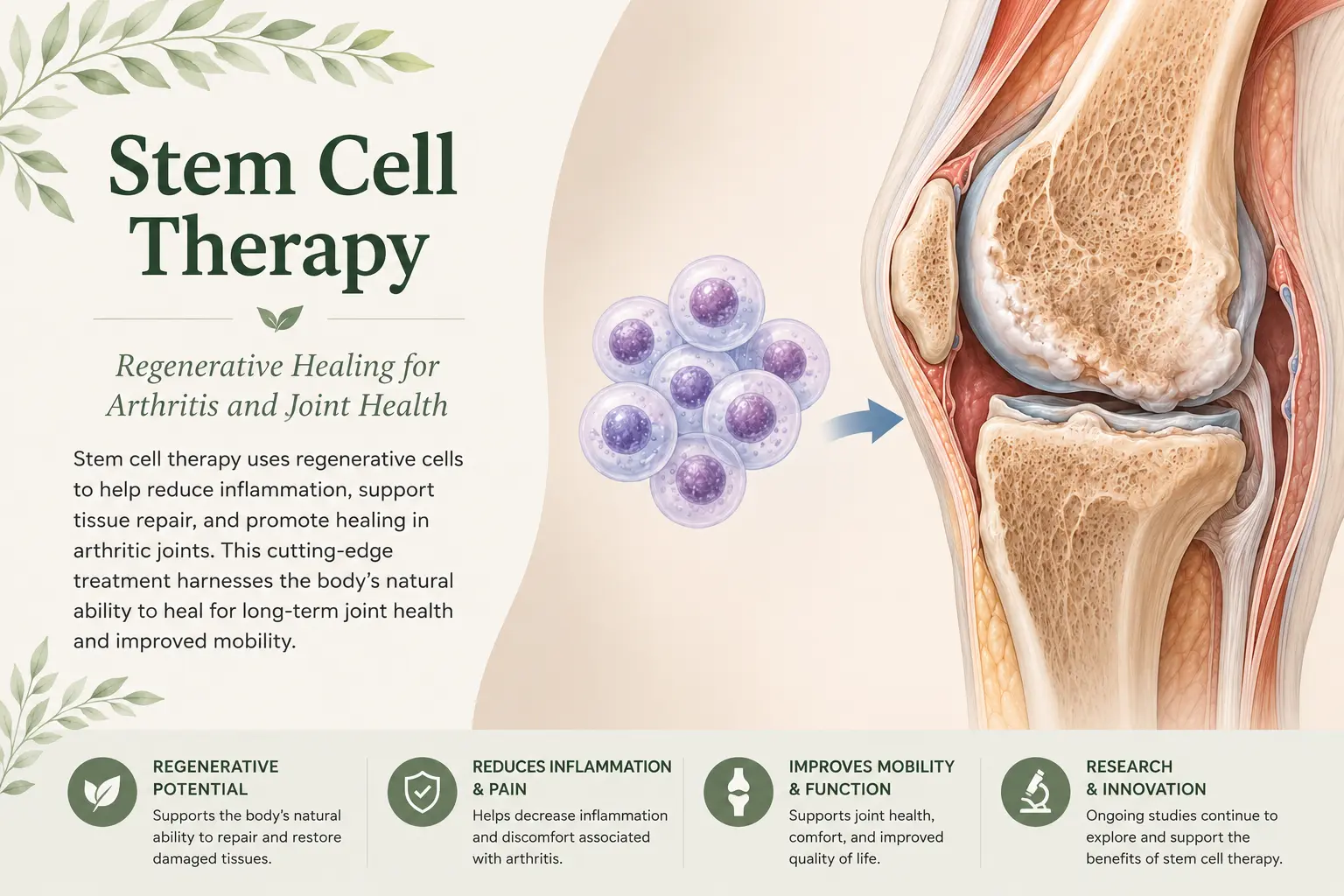
Stem cells are unique because they have the ability to develop into different types of cells and release substances that help regulate inflammation and healing.
In veterinary medicine, the goal isn't necessarily for stem cells to replace damaged cartilage.
Instead, researchers believe much of their benefit comes from the signaling molecules they release, which may:
- Reduce inflammation.
- Influence the joint environment.
- Support tissue repair.
- Improve comfort.
- Improve mobility.
Think of stem cells less as "replacement parts" and more as tiny messengers that encourage the body to heal more effectively.
Where Do the Stem Cells Come From?
Most stem cell treatments in dogs use cells collected from the pet's own fat tissue (adipose tissue).
This usually requires:
- Sedation or general anesthesia.
- A small surgical procedure to collect fat.
- Processing of the sample.
- Injection of the concentrated cells into the affected joint.
Some newer products use donor-derived (allogeneic) stem cells, but availability and protocols vary widely depending on the clinic and country.
Which Pets May Benefit?
Stem cell therapy has been used for:
- Osteoarthritis.
- Hip dysplasia.
- Elbow dysplasia.
- Tendon injuries.
- Ligament injuries.
- Some orthopedic surgery patients.
Most of the available research has focused on dogs.
Studies in cats remain much more limited.
What Does the Research Say?
This is where honest expectations are especially important.
Several studies suggest stem cell therapy may improve comfort and mobility in some dogs with osteoarthritis.
Owners often report:
- Easier rising.
- Increased activity.
- Longer walks.
- Better overall quality of life.
However, the scientific literature is mixed.
Different studies use different stem cell sources, processing techniques, injection methods, and outcome measurements, making comparisons difficult.
At this time, we still don't have strong evidence that stem cell therapy consistently regenerates cartilage or permanently reverses arthritis.
While the results are encouraging, larger, well-designed clinical trials are still needed.
What Is the Procedure Like?
If your pet is receiving stem cells collected from their own body, the procedure generally involves:
- Sedation or anesthesia.
- Collection of a small amount of fat tissue.
- Laboratory processing.
- Injection into the affected joint.
- Recovery and restricted activity for a short period.
Most pets return home the same day.
Improvement, if it occurs, is often gradual over several weeks.
Are There Risks?
Fortunately, complications are generally uncommon.
Possible risks include:
- Temporary soreness.
- Mild swelling.
- Bruising.
- Infection (rare).
- Risks associated with sedation or anesthesia.
- No noticeable improvement.
Because many treatments use the pet's own cells, rejection reactions are uncommon.
Stem Cells vs. PRP
Owners often ask whether stem cell therapy is "better" than PRP.
The honest answer is:
We don't know.
Both therapies are considered regenerative medicine.
Both aim to improve the environment within the joint rather than simply masking pain.
Some specialists even combine PRP and stem cell therapy in selected patients.
At this point, there isn't enough evidence to confidently say that one is universally superior to the other.
The right choice depends on the individual patient, the experience of the treating veterinarian, and the goals of treatment.
My Perspective
Continue learning
- Platelet-rich plasma (PRP) — the regenerative therapy stem cells are most often compared with.
- Joint injections — how regenerative products reach the joint.
- Weight management for arthritis — the foundation no therapy replaces.
- Advanced arthritis treatments overview — compare every option side by side.
Stem Cell Therapy at a Glance
How it works
Uses stem cells—most commonly collected from your pet's own fat tissue—to release signaling molecules that may reduce inflammation and improve the joint environment.
Best candidates
Dogs with mild to moderate osteoarthritis, hip or elbow dysplasia, selected tendon or ligament injuries, and some orthopedic surgery patients.
Evidence
⭐⭐⭐☆☆ (Promising but still evolving. Research supports potential benefits in some patients, but results are variable and more high-quality studies are needed.)
Typical cost
$$$$–$$$$$ (Often one of the more expensive arthritis treatments because of tissue collection, processing, and anesthesia.)
Invasiveness
Moderate to High (Requires tissue collection, processing, and joint injection, usually under sedation or anesthesia.)
Dr. Rene's recommendation
An exciting area of regenerative medicine with real potential, but not a miracle cure. I think it's best considered for carefully selected patients after discussing the expected benefits, limitations, and costs with your veterinarian or a veterinary orthopedic specialist.
Frequently asked questions
Educational only. This article is not a substitute for veterinary care. If your pet is unwell, please contact your veterinarian.
Next in this series
Advanced Arthritis Treatments · Part 5 of 9
Part 6: Joint Injections for Arthritis in Dogs: Treating the Joint from the Inside
Joint injections place medication or biologic products directly inside an arthritic joint. A veterinarian explains hyaluronic acid, corticosteroid injections, what the procedure involves, and which pets are good candidates.
Continue readingKeep reading
Shockwave Therapy (ESWT) for Arthritis in Dogs: Using Sound Waves to Reduce Pain
Shockwave therapy uses high-energy sound waves — not electricity — to reduce pain and support healing in arthritic joints and injured tendons. A veterinarian explains how ESWT works, which dogs benefit, and what the research shows.
Read DiseasesAdvanced Arthritis Treatments for Dogs & Cats: When Traditional Care Isn't Enough
When weight management, exercise, and pain medication are no longer enough, advanced arthritis treatments may help. A veterinarian explains each option, what the evidence actually shows, and which pets are most likely to benefit.
Read DiseasesPlatelet-Rich Plasma (PRP) for Dogs with Arthritis: Can Your Pet's Own Blood Help Their Joints?
Platelet-rich plasma uses your dog's own concentrated platelets to deliver growth factors into an arthritic joint. A veterinarian explains how PRP works, which patients may benefit, what the procedure involves, and what the evidence shows.
Read DiseasesAcupuncture for Arthritis in Dogs & Cats: Can Tiny Needles Make a Big Difference?
Is veterinary acupuncture real medicine or placebo? A veterinarian explains how acupuncture may reduce arthritis pain in dogs and cats, which pets are good candidates, what a session is like, and what the evidence shows.
Read DiseasesJoint Injections for Arthritis in Dogs: Treating the Joint from the Inside
Joint injections place medication or biologic products directly inside an arthritic joint. A veterinarian explains hyaluronic acid, corticosteroid injections, what the procedure involves, and which pets are good candidates.
Read DiseasesFemoral Head Ostectomy (FHO) in Dogs & Cats: A Different Approach to Hip Pain
An FHO removes the painful ball of the hip joint so a fibrous false joint can form. A veterinarian explains which dogs and cats are good candidates, why rehabilitation determines success, and how FHO compares to total hip replacement.
ReadKeep learning with Dr. Rene'
Browse the library, search another topic, or ask a question of your own.
Continue your journey
Loved this? Here's what to do next.
Every visit is a chance to understand your pet a little better. Pick your next step.
Explore the Learning Center
Browse evidence-based articles about symptoms, diseases, medications, treatments, preventive care, and more.
Explore ArticlesWatch Dr. Rene'
Prefer to watch instead of read? Explore practical veterinary education videos from Dr. Rene'.
Watch VideosGet Free Resources
Explore practical veterinary guides, checklists, and tools designed to help pet owners feel more informed and prepared.
Browse Free ResourcesProducts I Recommend
Browse pet products, supplies, and everyday essentials selected and recommended by Dr. Rene'.
See My RecommendationsEducational consultation
Want help understanding a diagnosis, test results, medications, or treatment options? Book educational guidance with Dr. Rene'. This does not replace veterinary care.
Learn more