
My Dog Chewed a Vape Pen (Part 4): The Hidden Danger of Swallowed Batteries and Broken Vape Devices
Nicotine isn't the only danger when a dog chews a vape pen. Learn why swallowed lithium-ion batteries, plastic, and metal pieces can cause life-threatening injuries, how veterinarians diagnose battery ingestion, and when endoscopy or surgery may be needed.
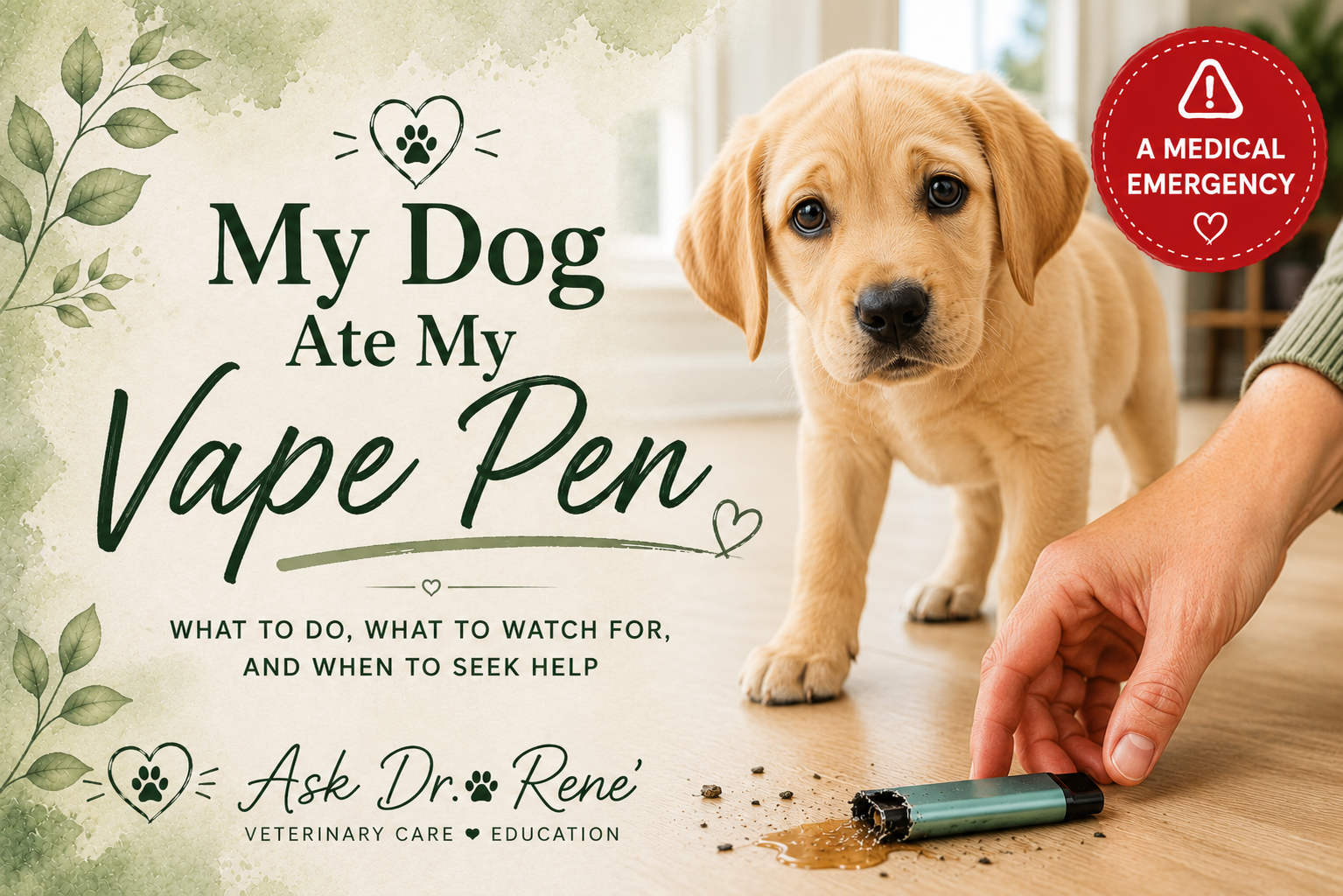
The Other Emergency: What If My Dog Swallowed the Battery?
When most owners think about a dog chewing a vape pen, they immediately worry about the nicotine.
And they're right to.
But there's another danger that can be just as serious—and in some cases, even more urgent.
The battery.
Many disposable vape pens and rechargeable vaping devices contain lithium-ion batteries. If your dog swallows one, we're no longer dealing with just nicotine poisoning. We're now facing a completely different type of emergency that can cause severe burns, tissue damage, or even perforation of the digestive tract.
This is why one of the first questions I'll ask is:
"Do you think the battery is still inside the vape pen?"
If the answer is "I'm not sure," we have to assume it may have been swallowed until we can prove otherwise.
Why Are Batteries So Dangerous?
Most people imagine that a swallowed battery is dangerous because it leaks acid.
While leaking chemicals can certainly cause injury if a battery is damaged, that's not usually what worries us first.
The biggest concern is that a battery can create an electrical current when it comes into contact with moist tissues like the tongue, esophagus, or stomach.
That electrical current can rapidly damage nearby cells, leading to painful burns and tissue death.
Think of it like a tiny heating element sitting against the lining of the digestive tract.
The longer it remains in one place, the greater the potential for injury.
Does It Matter What Kind of Battery It Is?
Yes.
Different batteries pose different risks.
Lithium-Ion Rechargeable Batteries
These are commonly found in vape pens and disposable vaping devices.
If swallowed, they can cause:
- Pressure injury if they become lodged
- Electrical burns
- Leakage of irritating chemicals if the casing is damaged
- Gastrointestinal obstruction
- Button Batteries
Although they're less common in vape devices, button batteries deserve special mention because they can cause severe burns in as little as a couple of hours if they become stuck in the esophagus.
Fortunately, most vape pens contain rechargeable lithium-ion batteries rather than button batteries, but either type should be treated as an emergency.
What Happens If the Battery Gets Stuck?
The esophagus is the muscular tube connecting the mouth to the stomach.
Unlike the stomach, it doesn't have much extra room.
If a battery becomes lodged there, it may continue pressing against the same area of tissue while electrical injury occurs.
This can lead to:
- Deep ulcers
- Tissue death (necrosis)
- Perforation
- Scarring
- Narrowing of the esophagus during healing (a stricture)
These injuries can make swallowing difficult long after the battery has been removed.
Because of this, time matters.
The faster we identify and remove a lodged battery, the better the chance of preventing permanent damage.
What If the Battery Makes It Into the Stomach?
This is where treatment becomes more individualized.
Some batteries pass through the digestive tract without causing major problems.
Others become damaged by chewing before they're swallowed, increasing the risk of chemical leakage.
In some cases, your veterinarian may recommend monitoring the battery's movement with repeat X-rays.
In other situations—particularly if the battery is damaged, your dog is showing symptoms, or the battery isn't moving normally—removal by endoscopy or surgery may be recommended.
Every case is different.
What Signs Might I See?
Some dogs with swallowed batteries don't show symptoms immediately.
Others develop signs within hours.
Watch for:
- Drooling
- Difficulty swallowing
- Repeated swallowing motions
- Gagging
- Vomiting
- Loss of appetite
- Pain when swallowing
- Pawing at the mouth
- Lethargy
These signs don't necessarily mean a battery has caused injury, but they do tell us your dog needs prompt veterinary evaluation.
How Do Veterinarians Diagnose a Swallowed Battery?
One of the first diagnostic tests we often recommend is radiographs (X-rays).
Fortunately, batteries are usually easy to identify because they're made of metal and show up clearly on X-rays.
The images help us answer several critical questions:
Is a battery actually present?
Where is it located?
Has it moved into the stomach or intestines?
Are there multiple pieces?
Could there also be swallowed plastic or metal fragments?
Knowing the battery's location helps us decide whether emergency removal is needed.
When Is Endoscopy Recommended?
If a battery is lodged in the esophagus, endoscopic removal is often the preferred treatment because it allows us to retrieve the battery without making an incision into the chest.
An endoscope is a flexible camera that is passed through the mouth into the esophagus and stomach while your dog is under general anesthesia.
Using specialized instruments, the battery can often be grasped and removed safely.
The earlier this is performed, the less opportunity there is for tissue damage.
Will My Dog Need Surgery?
Sometimes.
Surgery may be necessary if:
The battery cannot be reached with an endoscope.
It has moved into the intestines and become lodged.
It has caused a perforation.
Plastic or metal fragments have created an intestinal blockage.
There are signs of severe damage that cannot be managed medically.
While surgery sounds frightening, it may be the safest option in complicated cases.
What About the Plastic and Metal Pieces?
Even if the battery isn't swallowed, dogs often chew the rest of the vape pen into dozens of small pieces.
Depending on their size and shape, these fragments may:
Pass harmlessly through the digestive tract.
Become lodged in the stomach.
Cause an intestinal obstruction.
Irritate or puncture the digestive tract.
This is another reason we sometimes recommend X-rays, even if we're not convinced a battery was swallowed.
We're looking for everything your dog may have ingested—not just the nicotine.
Bring the Vape Pen With You
If it's safe to do so, bring every piece of the damaged vape device to the veterinary hospital.
Even a partially destroyed vape pen can provide valuable information.
We're looking for clues such as:
Is the nicotine reservoir empty or still intact?
Is the battery missing?
Are pieces of the casing gone?
Was this a nicotine vape, THC vape, or CBD vape?
Can we identify the nicotine concentration?
The more information we have, the more accurately we can assess your dog's risk and recommend the most appropriate treatment.
From My Exam Room
One of the questions I ask almost automatically is:
"Can you account for every piece of the vape pen?"
Owners are often surprised by that question.
They're understandably focused on the nicotine.
I'm thinking about the entire device.
If the battery is missing, that changes our plan.
If half the plastic casing is gone, that changes our plan.
If the nicotine reservoir was punctured, that changes our plan.
That's one of the reasons I encourage owners to bring the damaged vape pen with them. Sometimes the device tells us almost as much as the patient does, and those details help us decide how aggressively we need to act.
Educational only. This article is not a substitute for veterinary care. If your pet is unwell, please contact your veterinarian.
Next in this series
Nicotine & Vape Toxicity Learning Series · Part 4 of 5
Part 5: My Dog Chewed a Vape Pen (Part 5): What Happens at the Veterinary Hospital? Treatment, Recovery, and Going Home After Nicotine Poisoning
Wondering what happens after your dog chews a vape pen? Learn how veterinarians diagnose nicotine poisoning, when blood work and X-rays are needed, how nicotine toxicity is treated, what happens if a battery was swallowed, and what to expect during recovery at home.
Continue readingKeep reading
My Dog Chewed a Vape Pen (Part 5): What Happens at the Veterinary Hospital? Treatment, Recovery, and Going Home After Nicotine Poisoning
Wondering what happens after your dog chews a vape pen? Learn how veterinarians diagnose nicotine poisoning, when blood work and X-rays are needed, how nicotine toxicity is treated, what happens if a battery was swallowed, and what to expect during recovery at home.
Read ToxicitiesMy Dog Chewed a Vape Pen: The Complete Veterinarian's Guide to Nicotine Poisoning, Batteries, and Vape Device Injuries
Did your dog chew a vape pen or nicotine vape? Learn why vape devices are veterinary emergencies, how nicotine poisoning develops, the dangers of lithium batteries and swallowed plastic, and why immediate treatment is so important.
Read ToxicitiesMy Dog Chewed a Vape Pen (Part 2): The Timeline of Nicotine Poisoning and When Symptoms Begin
How quickly does nicotine poisoning develop after a dog chews a vape pen? Learn the minute-by-minute timeline of nicotine toxicity, why symptoms can worsen rapidly, what affects severity, and why waiting to "see what happens" can be dangerous.
ReadKeep learning with Dr. Rene'
Browse the library, search another topic, or ask a question of your own.
Continue your journey
Loved this? Here's what to do next.
Every visit is a chance to understand your pet a little better. Pick your next step.
Explore the Learning Center
Browse evidence-based articles about symptoms, diseases, medications, treatments, preventive care, and more.
Explore ArticlesWatch Dr. Rene'
Prefer to watch instead of read? Explore practical veterinary education videos from Dr. Rene'.
Watch VideosGet Free Resources
Explore practical veterinary guides, checklists, and tools designed to help pet owners feel more informed and prepared.
Browse Free ResourcesProducts I Recommend
Browse pet products, supplies, and everyday essentials selected and recommended by Dr. Rene'.
See My Recommendations