My Dog Chewed a Vape Pen (Part 5): What Happens at the Veterinary Hospital? Treatment, Recovery, and Going Home After Nicotine Poisoning
Wondering what happens after your dog chews a vape pen? Learn how veterinarians diagnose nicotine poisoning, when blood work and X-rays are needed, how nicotine toxicity is treated, what happens if a battery was swallowed, and what to expect during recovery at home.
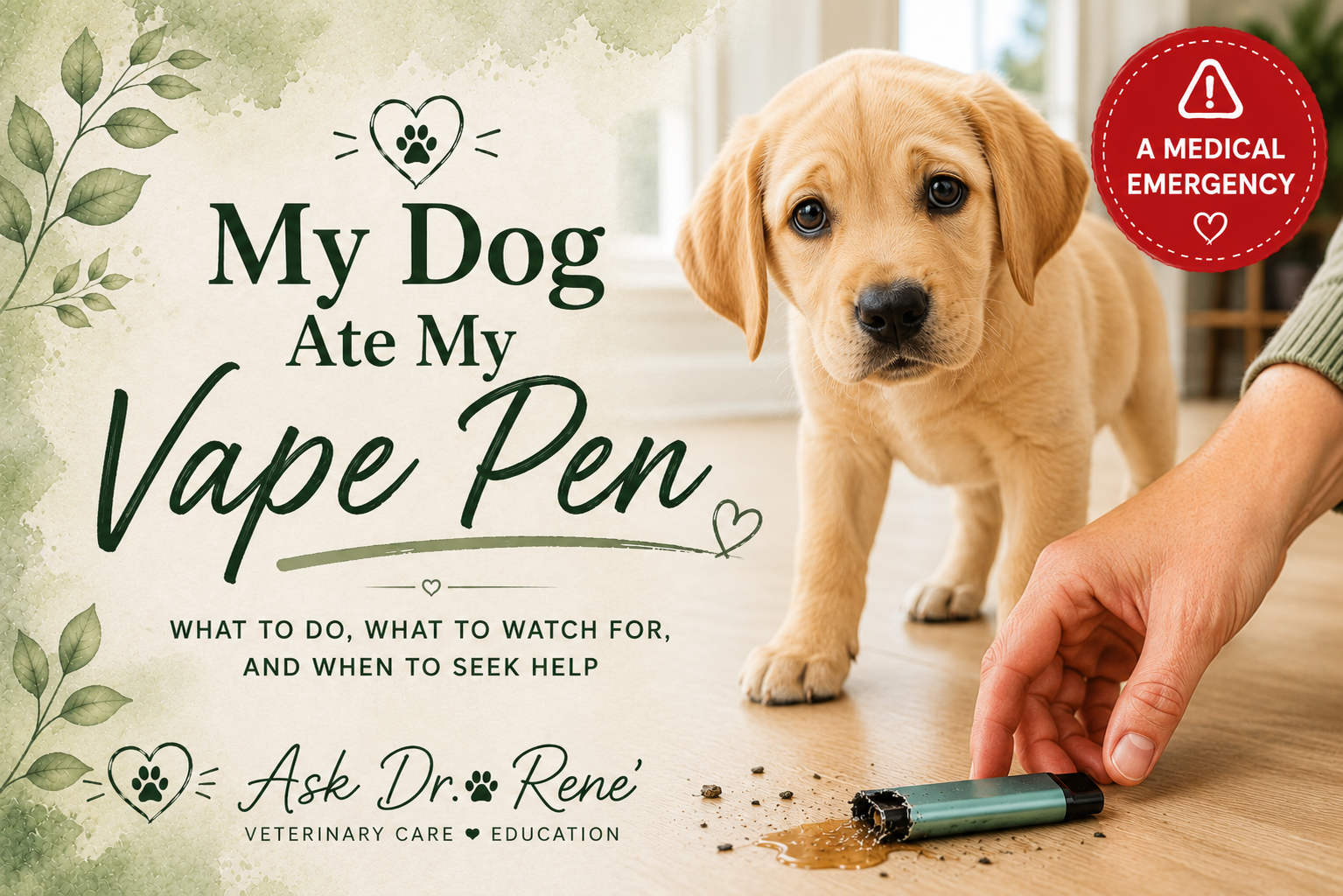
What Happens at the Veterinary Hospital? Treatment, Recovery, and Going Home After Nicotine Poisoning
One of the first questions owners ask me is:
"Can you do anything for nicotine poisoning?"
Fortunately, the answer is yes.
There isn't a medication that instantly neutralizes nicotine, but there are many treatments we can provide to support your dog's body while the nicotine is metabolized and eliminated.
Most dogs that receive prompt veterinary care recover completely.
The exact treatment plan depends on several important factors:
- How much nicotine was consumed
- What type of vape product was involved
- Whether the nicotine reservoir was punctured
- Whether a battery or pieces of the vape were swallowed
- How long ago the exposure occurred
- Whether your dog is already showing symptoms
Every patient is different, which is why treatment plans are individualized.
What Happens When We First See Your Dog?
When your dog arrives at the veterinary hospital, our first priority is determining two things:
How sick are they right now?
and
What problems are we dealing with?
Remember, a vape pen exposure may involve:
- Nicotine poisoning
- Battery ingestion
- Foreign body obstruction
- THC exposure
- Multiple toxins at once
We'll begin by asking questions such as:
- What kind of vape was it?
- Was it nicotine, THC, or CBD?
What nicotine concentration did it contain?
When did the exposure happen?
Has your dog vomited?
Do you think the battery is missing?
Can you account for all the pieces?
If possible, bring the damaged vape pen and its packaging with you.
Those details often influence our treatment decisions.
The Physical Examination
Nicotine poisoning often produces a recognizable pattern of findings.
During your dog's examination we'll evaluate:
- Heart rate
- Respiratory rate
- Body temperature
- Blood pressure
- Hydration
- Gum color
- Neurologic function
- Ability to stand and walk
- Muscle tremors
- Level of consciousness
We'll also look carefully inside the mouth for burns or irritation if your dog chewed through the vape.
Will My Dog Need Blood Work?
Usually, yes.
Blood work cannot tell us whether nicotine is present.
Instead, it tells us how your dog's body is responding.
Blood work allows us to evaluate:
- Blood sugar
- Kidney function
- Liver function
- Electrolytes
- Hydration
- Acid-base balance
- Other illnesses that could mimic nicotine poisoning
It also helps us establish a baseline before treatment begins.
Will My Dog Need X-rays?
Often.
Not because nicotine appears on X-rays—it doesn't.
Instead, radiographs help answer important questions such as:
- Was the battery swallowed?
- Are pieces of plastic present?
- Is metal lodged in the stomach?
Could there be an intestinal obstruction?
Has the battery moved?
Sometimes X-rays completely change our treatment plan.
Should My Dog Vomit?
It depends entirely on timing.
If the exposure occurred very recently and your dog is still bright, alert, and neurologically normal, your veterinarian may recommend inducing vomiting before more nicotine is absorbed.
However, once tremors, weakness, or neurologic signs develop, making a dog vomit can become dangerous.
Dogs that cannot swallow normally may inhale vomit into their lungs, leading to aspiration pneumonia.
That is why you should never induce vomiting at home unless your veterinarian specifically recommends it.
Intravenous Fluids
One of the most common treatments we provide is IV fluid therapy.
Owners often ask:
"Will the fluids flush the nicotine out?"
Not exactly.
IV fluids support the body while it clears the nicotine naturally.
They help us:
- Maintain blood pressure
- Support circulation
- Replace fluids lost from vomiting
- Correct electrolyte abnormalities
- Provide immediate access for emergency medications
- Medications We May Use
Treatment focuses on controlling symptoms while the nicotine wears off.
Depending on your dog's condition, your veterinarian may administer medications to:
- Control tremors
- Stop seizures
- Reduce nausea
- Stabilize abnormal heart rhythms
- Support blood pressure
- Treat pain if mouth or esophageal burns are present
Every medication is selected based on your dog's specific symptoms.
Monitoring Is One of the Most Important Treatments
Sometimes owners are surprised that their dog spends hours in the hospital with "just monitoring."
Monitoring isn't passive.
It's active medical care.
Throughout hospitalization we'll repeatedly evaluate:
- Heart rate
- Blood pressure
- Respiratory rate
- Oxygen levels
- Temperature
- Neurologic status
- Ability to walk
- Comfort level
Nicotine poisoning can change rapidly.
Frequent reassessments allow us to respond immediately if complications develop.
What If My Dog Swallowed the Battery?
If imaging confirms battery ingestion, treatment depends on where the battery is located.
A battery lodged in the esophagus often requires emergency endoscopic removal.
Batteries in the stomach may sometimes be monitored, while others require removal depending on their size, condition, and your dog's symptoms.
If a battery or fragments have caused an intestinal obstruction or perforation, surgery may become necessary.
This is why we evaluate both the poisoning and the physical device.
When Does My Dog Need to Stay Overnight?
Not every patient requires hospitalization.
Dogs with mild exposures that remain neurologically normal may sometimes go home after a period of observation.
Hospitalization is more likely if your dog has:
- Tremors
- Weakness
- Difficulty walking
- Seizures
- Abnormal heart rhythms
- Significant vomiting
- Swallowed the battery
- Swallowed multiple pieces of the device
- Needed IV medications
Hospitalization allows us to respond quickly if symptoms worsen.
Going Home
Before discharge we want to see that your dog is:
- Walking normally
- Eating willingly
- Drinking appropriately
- Maintaining normal body temperature
- Comfortable
- Stable without injectable medications
Some dogs are still tired for the remainder of the day.
This is usually expected.
Most continue improving steadily over the next 24 to 48 hours.
Preventing Another Vape Emergency
Fortunately, nearly every vape exposure is preventable.
Store vape devices:
- Inside closed cabinets
- Out of reach of pets
- In purses or backpacks that pets cannot access
- Away from countertops and bedside tables
Remember that dogs are often attracted to vape pens because they smell like the people they love—not because they're interested in nicotine itself.
If friends or family visit your home, remind them to keep vape devices securely stored as well.
Dr. Rene's Clinical Pearls
💨 Most dogs recover very well when treatment begins early. The biggest advantage we can give your dog is seeing them before severe symptoms develop.
💨 A vape pen is rarely just a nicotine exposure. I'm always thinking about the nicotine, the battery, the plastic pieces, and any other ingredients that may have been inside the device.
💨 Don't throw away the damaged vape. Bringing it with you often answers important questions that help us make faster medical decisions.
💨 Never feel embarrassed to tell us exactly what your dog got into. Honest information allows us to provide safer, more effective care.
💨 If you're debating whether this is an emergency, call your veterinarian. I'd much rather reassure you that everything is okay than have you wait until your dog becomes critically ill.
The Bottom Line
A dog chewing a vape pen is never a simple accident. Depending on the device, your pet may be at risk for nicotine poisoning, battery burns, swallowed plastic or metal fragments, or exposure to other toxic ingredients. Because nicotine can begin affecting the body within minutes, early veterinary evaluation gives your dog the best chance for a smooth recovery.
The encouraging news is that most dogs recover completely with prompt treatment. If your dog chews a vape pen or any nicotine-containing product, don't wait for symptoms to appear. Contact your veterinarian or the nearest emergency veterinary hospital immediately, bring the damaged device if you can, and let your veterinary team guide the next steps. We're here to help you and your dog through the entire process.
Educational only. This article is not a substitute for veterinary care. If your pet is unwell, please contact your veterinarian.
You've reached the end
Nicotine & Vape Toxicity Learning Series · Part 5 of 5
That's the final part of this series. Head back to the series hub to revisit any chapter.
Keep reading
My Dog Chewed a Vape Pen (Part 4): The Hidden Danger of Swallowed Batteries and Broken Vape Devices
Nicotine isn't the only danger when a dog chews a vape pen. Learn why swallowed lithium-ion batteries, plastic, and metal pieces can cause life-threatening injuries, how veterinarians diagnose battery ingestion, and when endoscopy or surgery may be needed.
Read ToxicitiesMy Dog Chewed a Vape Pen (Part 2): The Timeline of Nicotine Poisoning and When Symptoms Begin
How quickly does nicotine poisoning develop after a dog chews a vape pen? Learn the minute-by-minute timeline of nicotine toxicity, why symptoms can worsen rapidly, what affects severity, and why waiting to "see what happens" can be dangerous.
Read ToxicitiesMy Dog Chewed a Vape Pen (Part 3): Recognizing the Signs of Nicotine Poisoning
What does nicotine poisoning look like in dogs? Learn how nicotine affects the brain, heart, muscles, lungs, digestive system, and behavior, why symptoms change over time, and when emergency veterinary care is needed.
ReadKeep learning with Dr. Rene'
Browse the library, search another topic, or ask a question of your own.
Continue your journey
Loved this? Here's what to do next.
Every visit is a chance to understand your pet a little better. Pick your next step.
Explore the Learning Center
Browse evidence-based articles about symptoms, diseases, medications, treatments, preventive care, and more.
Explore ArticlesWatch Dr. Rene'
Prefer to watch instead of read? Explore practical veterinary education videos from Dr. Rene'.
Watch VideosGet Free Resources
Explore practical veterinary guides, checklists, and tools designed to help pet owners feel more informed and prepared.
Browse Free ResourcesProducts I Recommend
Browse pet products, supplies, and everyday essentials selected and recommended by Dr. Rene'.
See My Recommendations