My Dog Ate a Sock (Part 4): What Happens During Intestinal Surgery?
If your dog needs surgery after swallowing a sock, knowing what to expect can make the experience less overwhelming. Learn how veterinarians stabilize patients, remove intestinal foreign bodies, when part of the intestine must be removed, and what recovery typically looks like.
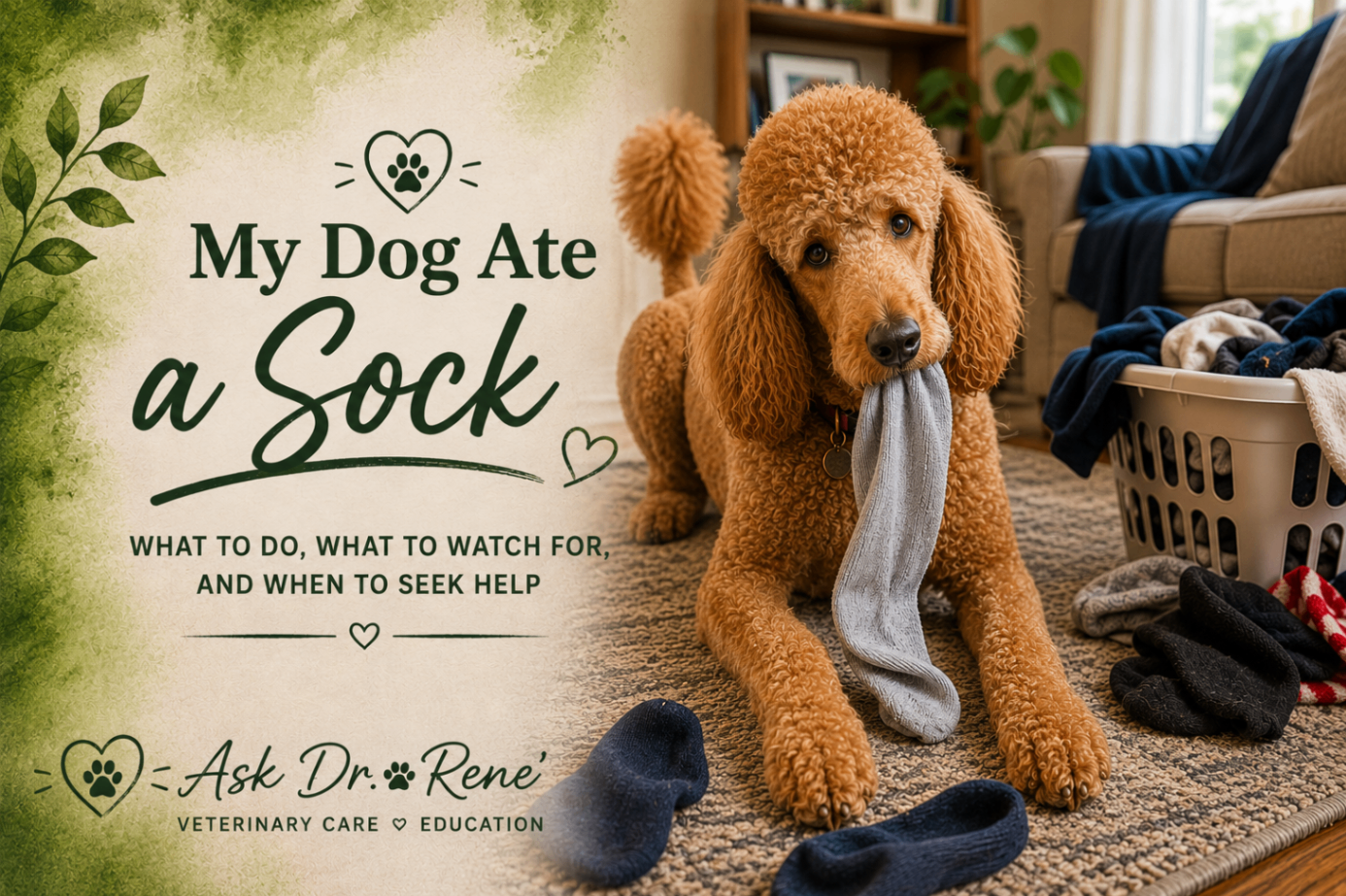
What Happens During Surgery?
Hearing that your dog needs surgery is frightening.
One of the first things many owners ask me is:
"What exactly are you going to do?"
Understanding the procedure can make the experience a little less overwhelming.
While every surgery is unique, here's what typically happens when we remove a sock causing an intestinal obstruction.
Step 1: Stabilizing Your Dog
Before surgery, our first priority is making sure your dog is as stable as possible.
Dogs with intestinal blockages are often:
- Dehydrated
- Vomiting repeatedly
- Experiencing electrolyte imbalances
- Painful
- At risk for shock
Before anesthesia, your veterinarian will often begin:
- Intravenous (IV) fluids
- Pain medication
- Anti-nausea medication
- Antibiotics (if indicated)
Blood work helps us identify any abnormalities that should be corrected before surgery whenever possible.
Sometimes surgery can wait a few hours while we stabilize a patient.
Sometimes it can't.
If the intestine appears to be losing its blood supply or has ruptured, surgery becomes an emergency.
Step 2: General Anesthesia
Your dog will be placed under general anesthesia so they remain completely asleep and pain-free throughout the procedure.
A breathing tube is placed into the trachea to protect the airway and deliver oxygen and anesthetic gas.
During surgery, a dedicated veterinary professional carefully monitors:
- Heart rate
- Blood pressure
- Oxygen levels
- Carbon dioxide levels
- Temperature
- Respiratory rate
- ECG (heart rhythm)
Modern veterinary anesthesia is much safer than many owners realize because patients are continuously monitored from start to finish.
Step 3: Preparing for Surgery
The hair on your dog's abdomen is clipped.
The skin is scrubbed several times with surgical disinfectants to reduce the risk of infection.
Sterile drapes are placed around the surgical site, and everyone involved wears sterile gowns and gloves.
Preventing contamination is incredibly important because surgery involving the gastrointestinal tract carries a higher risk of infection than many other procedures.
Step 4: Exploring the Abdomen
A careful incision is made along the middle of the abdomen.
Rather than immediately removing the sock, your surgeon first performs a systematic exploration of the abdominal cavity.
This allows us to evaluate:
- The stomach
- The entire small intestine
- The large intestine
- The liver
- The spleen
- Other abdominal organs
- Why?
Because dogs that swallow one sock sometimes swallow more than one.
I've removed multiple socks, underwear, washcloths, toys, and other foreign objects from the same patient during a single surgery.
Examining the entire gastrointestinal tract helps ensure we don't miss an additional obstruction.
Step 5: Finding the Sock
Once the obstruction is located, the affected section of intestine is carefully evaluated.
We're asking several important questions:
- Is the intestine still healthy?
- Is blood flow normal?
- Is the tissue bruised?
- Is there evidence of tearing?
- Has the intestine started to die?
Healthy intestine has a pink color, a shiny surface, and a good blood supply.
Dark purple, black, gray, or green tissue is much more concerning and may indicate that part of the intestine is no longer viable.
Step 6: Removing the Sock
The location of the sock determines how it is removed.
If the Sock Is Still in the Stomach
A surgical opening into the stomach, called a gastrotomy, may be performed.
The sock is removed, and the stomach is closed using multiple layers of sutures designed to create a strong, leak-resistant seal.
Because the stomach has an excellent blood supply, it generally heals very well.
If the Sock Is in the Small Intestine
A procedure called an enterotomy is performed.
Your surgeon makes a carefully planned incision directly into the intestine, removes the sock, and then closes the intestine with specialized sutures.
Whenever possible, the incision is made through healthy tissue rather than directly over the damaged area.
What If the Intestine Has Been Badly Damaged?
This is the part owners often worry about most.
If the sock has blocked blood flow for too long, part of the intestine may no longer be healthy enough to save.
When that happens, simply removing the sock isn't enough.
The damaged section must be removed.
This procedure is called an intestinal resection and anastomosis.
The unhealthy portion of intestine is surgically removed, and the two healthy ends are carefully sewn back together.
Although this is a more complex surgery than a simple enterotomy, many dogs recover very well—especially when surgery is performed before infection develops.
Step 7: Checking Everything One More Time
Before closing the abdomen, your surgeon carefully inspects the entire surgical site.
We look for:
- Additional foreign objects
- Areas of leaking
- Bleeding
- Healthy blood supply
- Secure sutures
The abdomen is often flushed with sterile fluid if contamination is suspected.
Only after we're confident everything looks healthy do we close the abdominal incision.
Recovery in the Hospital
Most dogs remain hospitalized after surgery.
During recovery, we closely monitor:
- Pain level
- Appetite
- Vomiting
- Hydration
- Incision healing
- Temperature
- Heart rate
- Ability to walk
- Bowel movements
Many dogs begin eating small meals within 12 to 24 hours after surgery, depending on the type of procedure performed and how they're recovering.
Some patients are ready to go home the following day.
Others—especially those who required intestinal resection or had severe contamination—may need several days of hospitalization.
What Are the Risks of Surgery?
Every surgery carries some degree of risk, but most dogs recover very well following foreign body removal.
Potential complications include:
- Infection
- Bleeding
- Delayed healing
- Vomiting
- Incision complications
- Leakage from the stomach or intestine
- Adhesion formation
- Persistent ileus (temporary slowing of intestinal movement)
Fortunately, these complications are uncommon when surgery is performed before the intestine becomes severely damaged.
Does My Dog Have a Good Prognosis?
In many cases, yes.
Dogs treated early—before the intestine loses its blood supply or ruptures—often recover completely and return to their normal lives.
The prognosis becomes more guarded if:
Surgery is delayed for several days.
The intestine has ruptured.
Septic peritonitis develops.
A large section of intestine must be removed.
Your dog has significant underlying medical problems.
One of the biggest factors affecting outcome is how quickly treatment begins.
Dr. Rene's Clinical Pearls
🧦 One of the questions I hear most is, "Will my dog ever be normal again?" In the vast majority of uncomplicated cases, the answer is yes. Most dogs recover beautifully and go right back to being themselves.
🧦 I always examine the entire intestinal tract during surgery. If a dog swallowed one sock, I never assume there isn't another surprise waiting farther down the intestines.
🧦 The biggest predictor of a smooth recovery is early intervention. The sooner we remove an obstruction, the less likely we are to encounter severely damaged intestine or life-threatening complications.
🧦 Owners often apologize for "not bringing them in sooner." Please don't let guilt keep you from seeking care. If you think your dog may have swallowed a sock, getting them evaluated promptly gives us the best chance to help them.
Educational only. This article is not a substitute for veterinary care. If your pet is unwell, please contact your veterinarian.
Next in this series
Foreign Body Ingestion Learning Series · Part 4 of 5
Part 5: My Dog Ate a Sock (Part 5): Recovery After Intestinal Surgery
Bringing your dog home after intestinal surgery can feel overwhelming. Learn what to expect during recovery, how to care for the incision, manage activity restrictions, recognize warning signs, and help prevent another foreign body emergency.
Continue readingKeep reading
My Dog Ate a Sock (Part 5): Recovery After Intestinal Surgery
Bringing your dog home after intestinal surgery can feel overwhelming. Learn what to expect during recovery, how to care for the incision, manage activity restrictions, recognize warning signs, and help prevent another foreign body emergency.
Read Foreign Body IngestionMy Dog Ate a Sock (Part 2): Symptoms of an Intestinal Blockage and When It's an Emergency
Wondering if your dog will pass a swallowed sock or develop an intestinal blockage? Learn when vomiting may be appropriate, why symptoms don't always appear immediately, the warning signs of an obstruction, and when emergency veterinary care is needed.
Read Foreign Body IngestionMy Dog Ate a Sock: The Complete Veterinarian's Guide to Intestinal Blockages, Surgery, and Recovery
Did your dog swallow a sock? Learn when it may pass on its own, when an intestinal blockage is likely, what symptoms to watch for, whether vomiting should be induced, and when emergency surgery may be needed.
ReadKeep learning with Dr. Rene'
Browse the library, search another topic, or ask a question of your own.
Continue your journey
Loved this? Here's what to do next.
Every visit is a chance to understand your pet a little better. Pick your next step.
Explore the Learning Center
Browse evidence-based articles about symptoms, diseases, medications, treatments, preventive care, and more.
Explore ArticlesWatch Dr. Rene'
Prefer to watch instead of read? Explore practical veterinary education videos from Dr. Rene'.
Watch VideosGet Free Resources
Explore practical veterinary guides, checklists, and tools designed to help pet owners feel more informed and prepared.
Browse Free ResourcesProducts I Recommend
Browse pet products, supplies, and everyday essentials selected and recommended by Dr. Rene'.
See My Recommendations