My Dog Ate a Sock (Part 2): Symptoms of an Intestinal Blockage and When It's an Emergency
Wondering if your dog will pass a swallowed sock or develop an intestinal blockage? Learn when vomiting may be appropriate, why symptoms don't always appear immediately, the warning signs of an obstruction, and when emergency veterinary care is needed.
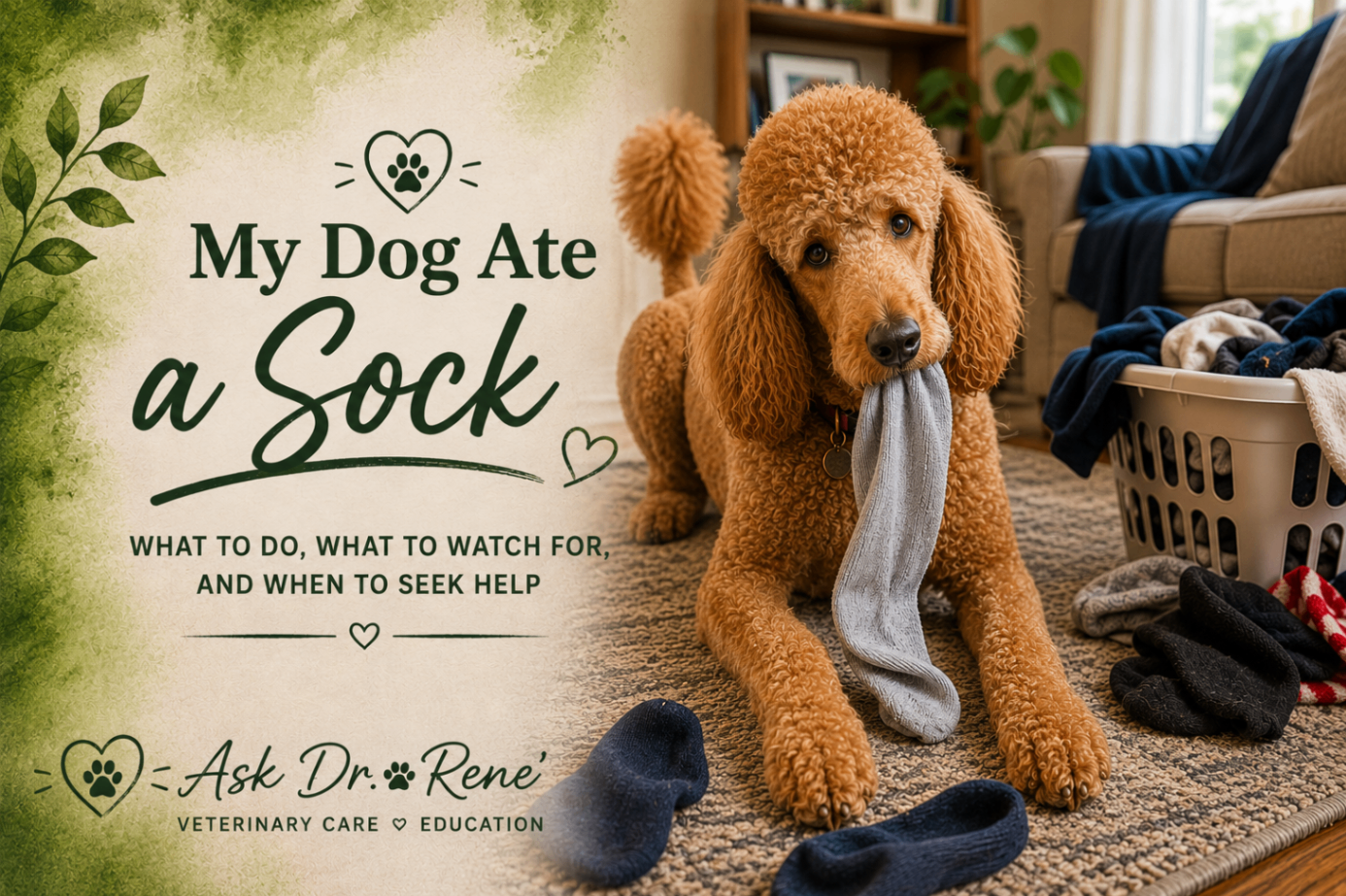
Should I Make My Dog Vomit?
This is often the first question owners ask after realizing their dog swallowed a sock.
The answer is: Maybe—but only under the guidance of a veterinarian.
If the sock was swallowed recently and is still in the stomach, inducing vomiting may allow it to be removed before it ever reaches the intestines. This can completely eliminate the need for surgery.
However, inducing vomiting is not always safe.
Your veterinarian will consider several factors before recommending it, including:
- How long ago the sock was swallowed
- The size of the sock
- Your dog's size and breed
- Your dog's medical history
- Whether your dog is already showing signs of illness
- If the sock has already moved into the intestines, making your dog vomit is unlikely to help
- Likewise, dogs that are already weak, having difficulty breathing, or showing neurological signs may not be safe candidates for vomiting
What About Hydrogen Peroxide?
Many websites recommend giving hydrogen peroxide at home.
While hydrogen peroxide can sometimes induce vomiting in dogs, it is not a harmless home remedy.
Potential complications include:
- Severe stomach irritation
- Ulceration of the esophagus or stomach
- Bloody vomiting
- Aspiration pneumonia if vomit is inhaled into the lungs
- Failure to bring the sock back up despite causing significant irritation
Because of these risks, I recommend speaking with a veterinarian before attempting to induce vomiting. In many cases, it is safer and more effective to have vomiting induced under veterinary supervision.
Why Don't Symptoms Start Right Away?
One of the most confusing things for owners is that many dogs seem perfectly normal immediately after swallowing a sock.
This happens because the sock doesn't instantly block the intestines.
It first has to travel through the stomach and into the intestinal tract. During that time, your dog may continue eating, drinking, playing, and acting completely normal.
As the sock moves through the digestive system, one of three things usually happens:
Scenario 1: The Sock Passes Normally
The sock successfully travels through the intestines and is passed in the stool.
Although this can happen, there is no reliable way to predict whether it will.
Scenario 2: Partial Obstruction
The sock becomes partially lodged.
Food and fluids can still move around it, but not efficiently.
Dogs with partial obstructions often have symptoms that come and go, including:
- Vomiting every few hours or days
- Decreased appetite
- Occasional diarrhea
- Intermittent lethargy
Because these dogs sometimes seem to improve, owners may think the problem has resolved.
Unfortunately, many partial obstructions eventually become complete obstructions.
Scenario 3: Complete Obstruction
The sock completely blocks the intestine.
Nothing can move past the obstruction.
Pressure builds inside the intestines, causing repeated vomiting, dehydration, severe pain, and progressive damage to the intestinal wall.
Without treatment, this can become life-threatening.
Why Dogs Sometimes "Get Better" Before They Get Worse
One of the most dangerous misconceptions is: "He threw up yesterday, but today he's acting much better."
Unfortunately, temporary improvement does not always mean the sock has passed.
Some dogs stop vomiting because their stomach is empty—not because the obstruction is gone.
Others experience temporary decreases in pain before inflammation worsens again.
I've seen many dogs that appeared almost normal in the morning but required emergency surgery later that same day.
If your veterinarian recommends additional diagnostics or monitoring, it's because intestinal obstructions can change quickly.
What Are the Signs of an Intestinal Blockage?
Symptoms vary depending on where the sock becomes lodged and whether the obstruction is partial or complete.
Common signs include:
- Vomiting
Vomiting is usually the first symptom owners notice.
Initially, dogs may vomit food shortly after eating.
As the obstruction progresses, they often begin vomiting water, yellow bile, or foamy fluid.
Repeated vomiting quickly leads to dehydration.
- Loss of Appetite
Many dogs refuse food altogether.
Others may appear interested in food but walk away after sniffing it.
Some dogs will eat small amounts only to vomit shortly afterward.
- Lethargy
As dehydration develops and pain increases, dogs often become quieter than usual.
They may sleep more, avoid playing, hide, or seem depressed.
- Abdominal Pain
Signs of abdominal discomfort include:
- Standing with a hunched back
- Restlessness
- Crying when picked up
- Guarding the abdomen
- Praying position (front legs stretched forward with rear end elevated)
Some dogs show surprisingly little pain despite having severe disease.
- Changes in Bowel Movements
Depending on the location of the obstruction, dogs may have diarrhea, small amounts of stool, straining to defecate, or no stool production at all.
The presence of diarrhea does not rule out an intestinal blockage.
- Weakness or Collapse
As dehydration and electrolyte abnormalities worsen, some dogs become weak or collapse.
This represents a true emergency.
When Is It an Emergency?
Seek immediate veterinary care if your dog:
- Cannot stop vomiting
- Has repeated unsuccessful attempts to vomit
- Has severe abdominal pain
- Becomes weak or collapses
- Has a swollen abdomen
- Stops eating completely
- Becomes unusually quiet after swallowing a sock
- Has pale gums
- Seems to be getting worse instead of better
Even if your dog appears normal, it's still worth calling your veterinarian if you know a sock was swallowed.
Dr. Rene's Clinical Pearls
🧦 The dogs that worry me the most aren't always the ones vomiting the most—they're the ones whose owners tell me, "He just isn't acting like himself." That subtle change is often the first sign something is wrong.
🧦 Vomiting isn't required for an obstruction. I've operated on dogs with intestinal blockages whose primary signs were lethargy and refusing to eat.
🧦 Don't rely on waiting to "see if it passes." By the time many dogs become obviously sick, the intestine may already be significantly damaged.
🧦 If you actually witnessed your dog swallow a sock, tell your veterinarian. Knowing exactly what happened often changes our recommendations and may allow us to intervene before surgery becomes necessary.
Educational only. This article is not a substitute for veterinary care. If your pet is unwell, please contact your veterinarian.
Next in this series
Foreign Body Ingestion Learning Series · Part 2 of 5
Part 3: My Dog Ate a Sock (Part 3): How Veterinarians Diagnose an Intestinal Blockage
How do veterinarians know if a swallowed sock is causing an intestinal blockage? Learn why socks don't always show up on X-rays, when ultrasound is helpful, when endoscopy is an option, and why some dogs need surgery even if they seem to be feeling better.
Continue readingKeep reading
My Dog Ate a Sock: The Complete Veterinarian's Guide to Intestinal Blockages, Surgery, and Recovery
Did your dog swallow a sock? Learn when it may pass on its own, when an intestinal blockage is likely, what symptoms to watch for, whether vomiting should be induced, and when emergency surgery may be needed.
Read Foreign Body IngestionMy Dog Ate a Sock (Part 3): How Veterinarians Diagnose an Intestinal Blockage
How do veterinarians know if a swallowed sock is causing an intestinal blockage? Learn why socks don't always show up on X-rays, when ultrasound is helpful, when endoscopy is an option, and why some dogs need surgery even if they seem to be feeling better.
Read Foreign Body IngestionMy Dog Ate a Sock (Part 4): What Happens During Intestinal Surgery?
If your dog needs surgery after swallowing a sock, knowing what to expect can make the experience less overwhelming. Learn how veterinarians stabilize patients, remove intestinal foreign bodies, when part of the intestine must be removed, and what recovery typically looks like.
ReadKeep learning with Dr. Rene'
Browse the library, search another topic, or ask a question of your own.
Continue your journey
Loved this? Here's what to do next.
Every visit is a chance to understand your pet a little better. Pick your next step.
Explore the Learning Center
Browse evidence-based articles about symptoms, diseases, medications, treatments, preventive care, and more.
Explore ArticlesWatch Dr. Rene'
Prefer to watch instead of read? Explore practical veterinary education videos from Dr. Rene'.
Watch VideosGet Free Resources
Explore practical veterinary guides, checklists, and tools designed to help pet owners feel more informed and prepared.
Browse Free ResourcesProducts I Recommend
Browse pet products, supplies, and everyday essentials selected and recommended by Dr. Rene'.
See My Recommendations