My Dog Ate a Sock: The Complete Veterinarian's Guide to Intestinal Blockages, Surgery, and Recovery
Did your dog swallow a sock? Learn when it may pass on its own, when an intestinal blockage is likely, what symptoms to watch for, whether vomiting should be induced, and when emergency surgery may be needed.
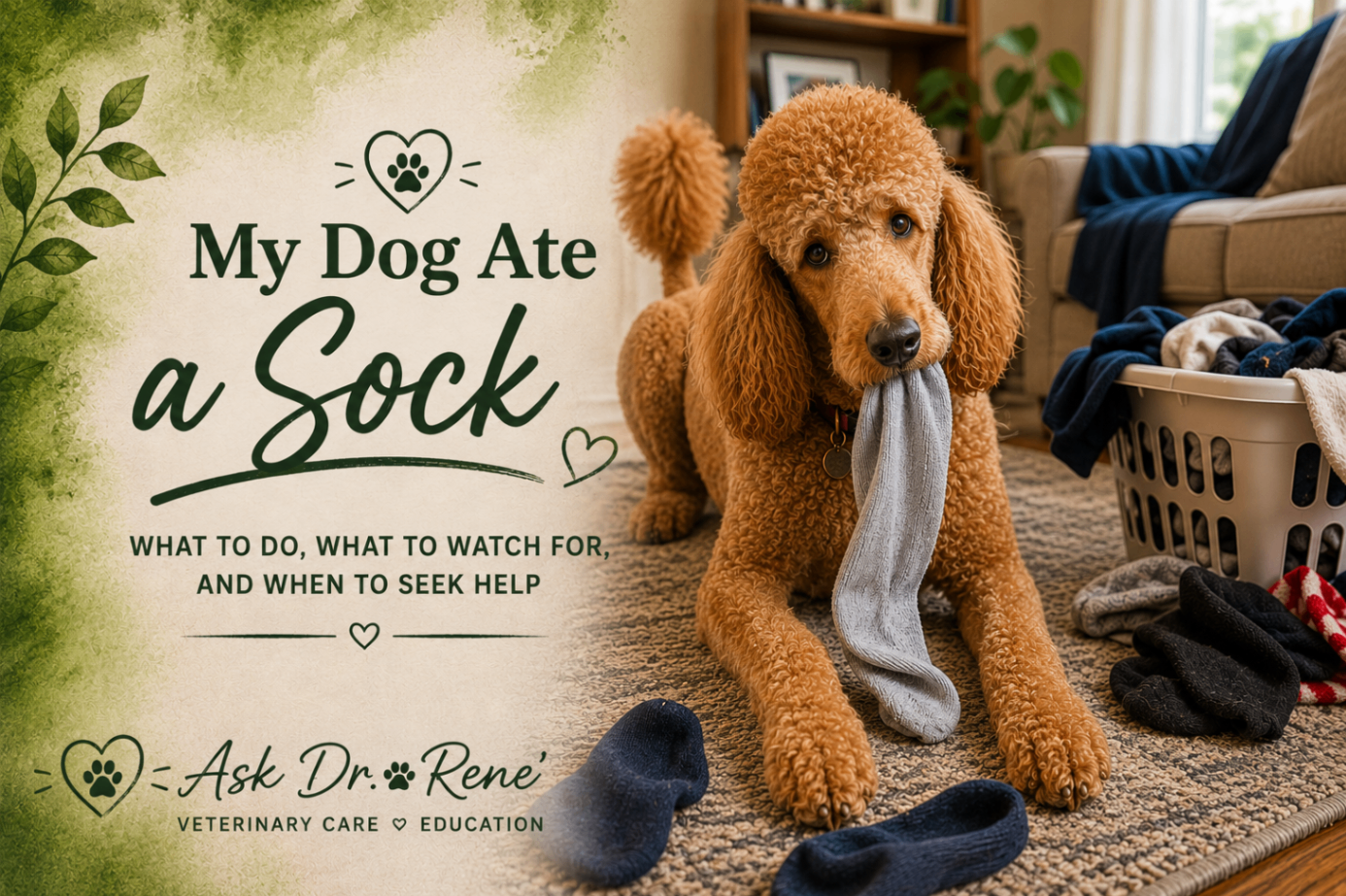
Everything Every Dog Owner Should Know After Their Dog Swallows a Sock
Dr. Rene's Take
"If I had to make a list of the items I've surgically removed from dogs over the years, socks would be near the very top. They're soft, smell like their favorite people, and are just the right size for many dogs to swallow whole. The good news is that many dogs recover completely when treated early. The key is recognizing the problem before a simple foreign body becomes a life-threatening intestinal obstruction."
Introduction
Your dog just swallowed a sock.
Maybe it disappeared while you were folding laundry. Maybe you watched your Labrador gulp it down before you could react. Or maybe you simply noticed that one sock from the dryer never turned up—and now your dog is vomiting.
If you're reading this, you're probably asking one of these questions:
- Will my dog pass the sock?
- Does my dog need surgery?
- Should I make my dog vomit?
- How long before symptoms start?
- Can I just watch and wait?
These are all excellent questions.
As a veterinarian, I can tell you that swallowing a sock is one of the most common reasons dogs require emergency surgery. But it's also important to know that not every dog that swallows a sock will need surgery.
The challenge is that there is no reliable way to predict at home which dogs will safely pass a sock and which will develop a life-threatening obstruction.
This guide will walk you through everything you need to know—from what happens inside your dog's body to how veterinarians diagnose, treat, and help prevent sock-related intestinal blockages.
Why Do Dogs Eat Socks?
One of the first questions owners ask is:
"Why on earth would my dog eat a sock?"
The answer depends on the individual dog.
Some dogs simply enjoy chewing soft objects. Others are attracted to the scent of their favorite person. Socks carry a strong human scent, making them particularly appealing to many dogs.
Puppies often explore the world with their mouths and may accidentally swallow objects while playing. Adult dogs may swallow socks during rough play, while others intentionally seek them out because they enjoy chewing fabric.
In some cases, repeatedly eating non-food objects may be a condition called pica, which can be associated with behavioral issues, boredom, anxiety, or, less commonly, underlying medical conditions.
Regardless of why it happens, once the sock has been swallowed, the focus shifts from why it happened to whether it can safely pass through the digestive tract.
What Happens After a Dog Swallows a Sock?
Many owners imagine that the sock simply travels through the stomach and eventually comes out in the stool.
Sometimes that's exactly what happens.
Unfortunately, it's not always that simple.
After being swallowed, the sock enters the stomach. Smaller objects may leave the stomach and move into the small intestine within hours, although larger objects can remain in the stomach longer.
The intestines are much narrower than the stomach. As the sock travels through these narrow sections, it may become lodged.
Once that happens, food, water, and digestive fluids can no longer move normally through the intestines.
The intestines continue trying to push the sock forward, causing painful contractions and inflammation. Pressure on the intestinal wall may eventually reduce blood flow to that section of intestine.
Without adequate blood supply, the intestinal tissue begins to die.
If left untreated, the intestine can rupture, allowing bacteria and intestinal contents to spill into the abdomen. This causes septic peritonitis, one of the most serious emergencies we treat in veterinary medicine.
Fortunately, most dogs never reach this stage because owners recognize the problem and seek care early.
Which Dogs Are Most at Risk?
While any dog can swallow a sock, some are more likely than others.
Higher-risk dogs include:
- Labrador Retrievers
- Golden Retrievers
- Beagles
- Boxers
- Mixed-breed puppies
- Dogs under two years of age
Small dogs are at greater risk of developing an obstruction because their intestinal diameter is much smaller, meaning even a baby sock can become lodged.
Large dogs may swallow surprisingly large socks, towels, or even multiple socks before developing symptoms.
Can a Dog Pass a Sock Naturally?
This is one of the most common questions I hear in the exam room.
The honest answer is:
Sometimes.
Some dogs pass socks without any complications.
Others develop complete intestinal obstructions that require emergency surgery.
The problem is that there is no way to safely predict which outcome will occur based solely on your dog's size or the size of the sock.
I've seen tiny dogs pass surprisingly large objects and large dogs require surgery for relatively small ones.
That uncertainty is exactly why we recommend veterinary evaluation rather than simply waiting to see what happens.
(**Continued**...)
In the remainder of this guide, we'll cover:
- Should you make your dog vomit?
- Symptoms of an intestinal blockage
- Why symptoms may not appear immediately
- How veterinarians diagnose foreign bodies
- X-rays vs. ultrasound
- Endoscopy vs. surgery
- What happens during intestinal surgery
- Risks and recovery
- Potential complications
- Prognosis
- Prevention
- Frequently asked questions
- Dr. Rene's Clinical Pearls
Educational only. This article is not a substitute for veterinary care. If your pet is unwell, please contact your veterinarian.
Next in this series
Foreign Body Ingestion Learning Series · Part 1 of 5
Part 2: My Dog Ate a Sock (Part 2): Symptoms of an Intestinal Blockage and When It's an Emergency
Wondering if your dog will pass a swallowed sock or develop an intestinal blockage? Learn when vomiting may be appropriate, why symptoms don't always appear immediately, the warning signs of an obstruction, and when emergency veterinary care is needed.
Continue readingKeep reading
My Dog Ate a Sock (Part 2): Symptoms of an Intestinal Blockage and When It's an Emergency
Wondering if your dog will pass a swallowed sock or develop an intestinal blockage? Learn when vomiting may be appropriate, why symptoms don't always appear immediately, the warning signs of an obstruction, and when emergency veterinary care is needed.
Read Foreign Body IngestionMy Dog Ate a Sock (Part 3): How Veterinarians Diagnose an Intestinal Blockage
How do veterinarians know if a swallowed sock is causing an intestinal blockage? Learn why socks don't always show up on X-rays, when ultrasound is helpful, when endoscopy is an option, and why some dogs need surgery even if they seem to be feeling better.
Read Foreign Body IngestionMy Dog Ate a Sock (Part 4): What Happens During Intestinal Surgery?
If your dog needs surgery after swallowing a sock, knowing what to expect can make the experience less overwhelming. Learn how veterinarians stabilize patients, remove intestinal foreign bodies, when part of the intestine must be removed, and what recovery typically looks like.
ReadKeep learning with Dr. Rene'
Browse the library, search another topic, or ask a question of your own.
Continue your journey
Loved this? Here's what to do next.
Every visit is a chance to understand your pet a little better. Pick your next step.
Explore the Learning Center
Browse evidence-based articles about symptoms, diseases, medications, treatments, preventive care, and more.
Explore ArticlesWatch Dr. Rene'
Prefer to watch instead of read? Explore practical veterinary education videos from Dr. Rene'.
Watch VideosGet Free Resources
Explore practical veterinary guides, checklists, and tools designed to help pet owners feel more informed and prepared.
Browse Free ResourcesProducts I Recommend
Browse pet products, supplies, and everyday essentials selected and recommended by Dr. Rene'.
See My Recommendations