My Dog Ate a Sock (Part 3): How Veterinarians Diagnose an Intestinal Blockage
How do veterinarians know if a swallowed sock is causing an intestinal blockage? Learn why socks don't always show up on X-rays, when ultrasound is helpful, when endoscopy is an option, and why some dogs need surgery even if they seem to be feeling better.
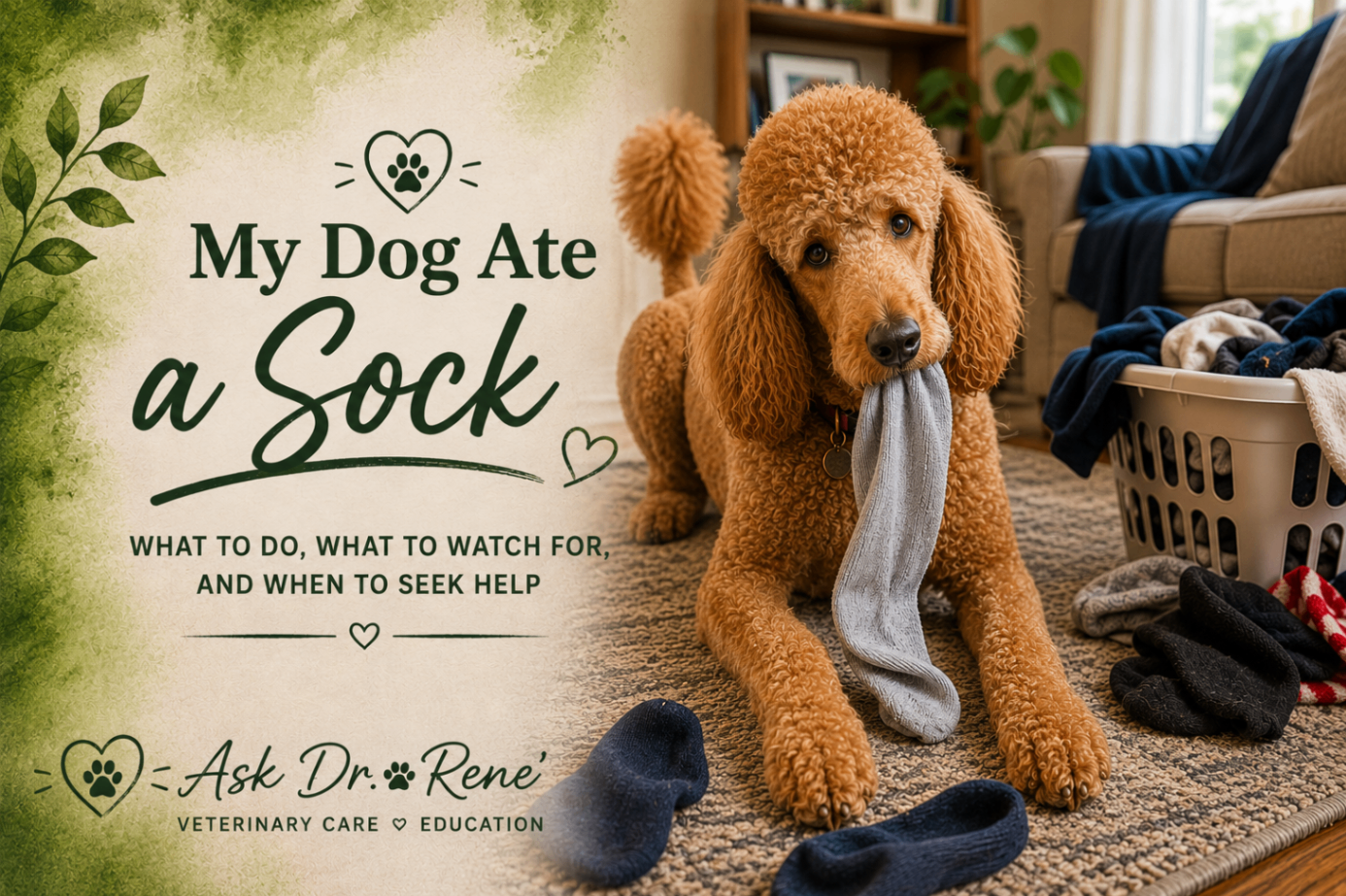
How Veterinarians Diagnose a Sock Obstruction
One of the most common questions I hear is:
"Can't you just take an X-ray and see the sock?"
Sometimes we can.
Often, we can't.
Unlike a metal toy or a swallowed rock, socks are made of fabric. Fabric doesn't block X-rays very well, which means the sock itself is frequently invisible on standard radiographs.
Instead of looking for the sock, we're often looking for the changes the sock causes inside the digestive tract.
This is why diagnosing an intestinal blockage sometimes requires more than one test.
Step 1: A Thorough Physical Examination
Before we ever take an X-ray, your veterinarian gathers important clues from your dog's history and physical exam.
We'll ask questions such as:
- When did your dog swallow the sock?
- Was it a baby sock, ankle sock, or large athletic sock?
- Has your dog vomited?
- Are they still eating and drinking?
- Have they had a bowel movement?
- Have they swallowed foreign objects before?
During the examination, we evaluate:
- Hydration
- Heart rate
- Temperature
- Gum color
- Abdominal pain
- Abdominal distension
- Signs of shock
- Overall attitude and energy level
Occasionally, in very small dogs or puppies, a foreign object may even be felt during abdominal palpation, but this is uncommon.
Step 2: Blood Work
Many owners are surprised when we recommend blood work.
Blood tests don't tell us whether a sock is present.
Instead, they tell us how the rest of the body is handling the obstruction.
Blood work helps us evaluate:
- Hydration status
- Electrolyte abnormalities
- Kidney function
- Liver function
- Blood sugar
- White blood cell count
- Evidence of infection or inflammation
This information is especially important if surgery becomes necessary because it helps us prepare your dog for anesthesia and identify complications that need to be addressed first.
Step 3: Abdominal X-rays
X-rays are usually the first imaging test performed.
Even though the sock itself may not be visible, X-rays can reveal changes that strongly suggest an obstruction.
These include:
- Enlarged, gas-filled loops of intestine
- Fluid-filled stomach
- Abnormal intestinal patterns
- Stacked or "bunched" intestines
- Free air in the abdomen (which may indicate intestinal rupture)
- Other foreign objects that are visible on X-rays
Sometimes the diagnosis is obvious.
Other times, the X-rays appear almost completely normal despite the presence of a sock.
This is one reason why a normal X-ray does not automatically rule out an intestinal obstruction.
Why Don't Socks Show Up on X-rays?
Socks are considered radiolucent, meaning X-rays pass through them easily.
Think of it like trying to find a wet towel in a swimming pool.
You may not see the towel itself, but you can often recognize that something isn't right by watching how the water moves around it.
That's exactly what veterinarians do—we often diagnose the obstruction by recognizing how the intestines respond to the foreign object rather than seeing the object directly.
Step 4: Abdominal Ultrasound
Ultrasound has become one of the most valuable tools for diagnosing intestinal foreign bodies.
Unlike X-rays, ultrasound often allows us to see:
- The sock itself
- Thickened intestinal walls
- Areas where the intestine is blocked
- Normal movement of the intestines
- Areas where movement has stopped
- Free abdominal fluid
- Evidence of intestinal damage
In many cases, ultrasound provides the answer when X-rays are inconclusive.
Because of this, many veterinarians recommend an ultrasound if there's a strong suspicion of a foreign body but the X-rays don't provide a clear diagnosis.
What About Contrast Studies?
Years ago, veterinarians commonly used contrast studies, where a liquid visible on X-rays is given by mouth and a series of radiographs are taken over several hours.
The contrast material outlines the stomach and intestines, allowing us to watch how it moves through the digestive tract.
If the contrast suddenly stops or moves very slowly, it may indicate a blockage.
Today, contrast studies are used less often because ultrasound is frequently faster, more comfortable for the patient, and provides more detailed information.
However, they may still be useful in certain situations when ultrasound is unavailable or additional information is needed.
When Is Endoscopy an Option?
If the sock is still in the stomach, your veterinarian may recommend an endoscopy.
During this procedure:
Your dog is placed under general anesthesia.
A flexible camera is passed through the mouth into the stomach.
Special instruments are used to grasp and remove the sock.
The biggest advantage of endoscopy is that no abdominal incision is required.
Recovery is usually much faster than with surgery.
Unfortunately, once the sock has moved into the small intestine, endoscopy is rarely an option because the scope cannot safely reach most intestinal foreign bodies.
When Is Surgery the Best Choice?
If imaging shows that the sock has moved into the intestines or is causing a blockage, surgery is often the safest and most effective treatment.
Surgery allows us to:
- Locate the obstruction.
- Remove the sock.
- Examine the entire intestinal tract.
- Check for additional foreign objects.
- Assess whether any portion of the intestine has lost its blood supply.
Many dogs recover very well after surgery, especially when the obstruction is treated before the intestine becomes severely damaged.
Why We Sometimes Recommend Surgery Even If Your Dog Seems Better
One of the hardest conversations I have with owners is explaining why I still recommend surgery when their dog suddenly seems to be improving.
If imaging confirms that a sock is lodged in the intestines, the problem doesn't disappear simply because your dog has a good afternoon.
Temporary improvement may occur because:
- The stomach has emptied.
- Pain temporarily decreases.
- Vomiting becomes less frequent.
- Your dog has adjusted to the obstruction.
Unfortunately, the pressure on the intestine continues.
Waiting too long increases the risk that the intestinal wall will lose its blood supply, die, or rupture.
That's why veterinarians often recommend surgery based on the imaging findings—not just on how your dog happens to feel that day.
Dr. Rene's Clinical Pearls
🧦 A normal X-ray doesn't always mean everything is normal. Socks are made of fabric, and many are impossible to see directly on radiographs.
🧦 Ultrasound has changed the way we diagnose intestinal foreign bodies. It's one of the most helpful tools we have when a foreign body is suspected but not obvious on X-rays.
🧦 Don't be discouraged if your veterinarian recommends additional testing. Each diagnostic test provides a different piece of the puzzle, and together they help us make the safest decision for your dog.
🧦 Time matters. The earlier we diagnose an intestinal obstruction, the more treatment options we may have—and the better your dog's chances of a smooth recovery.
Educational only. This article is not a substitute for veterinary care. If your pet is unwell, please contact your veterinarian.
Next in this series
Foreign Body Ingestion Learning Series · Part 3 of 5
Part 4: My Dog Ate a Sock (Part 4): What Happens During Intestinal Surgery?
If your dog needs surgery after swallowing a sock, knowing what to expect can make the experience less overwhelming. Learn how veterinarians stabilize patients, remove intestinal foreign bodies, when part of the intestine must be removed, and what recovery typically looks like.
Continue readingKeep reading
My Dog Ate a Sock (Part 2): Symptoms of an Intestinal Blockage and When It's an Emergency
Wondering if your dog will pass a swallowed sock or develop an intestinal blockage? Learn when vomiting may be appropriate, why symptoms don't always appear immediately, the warning signs of an obstruction, and when emergency veterinary care is needed.
Read Foreign Body IngestionMy Dog Ate a Sock: The Complete Veterinarian's Guide to Intestinal Blockages, Surgery, and Recovery
Did your dog swallow a sock? Learn when it may pass on its own, when an intestinal blockage is likely, what symptoms to watch for, whether vomiting should be induced, and when emergency surgery may be needed.
Read Foreign Body IngestionMy Dog Ate a Sock (Part 4): What Happens During Intestinal Surgery?
If your dog needs surgery after swallowing a sock, knowing what to expect can make the experience less overwhelming. Learn how veterinarians stabilize patients, remove intestinal foreign bodies, when part of the intestine must be removed, and what recovery typically looks like.
ReadKeep learning with Dr. Rene'
Browse the library, search another topic, or ask a question of your own.
Continue your journey
Loved this? Here's what to do next.
Every visit is a chance to understand your pet a little better. Pick your next step.
Explore the Learning Center
Browse evidence-based articles about symptoms, diseases, medications, treatments, preventive care, and more.
Explore ArticlesWatch Dr. Rene'
Prefer to watch instead of read? Explore practical veterinary education videos from Dr. Rene'.
Watch VideosGet Free Resources
Explore practical veterinary guides, checklists, and tools designed to help pet owners feel more informed and prepared.
Browse Free ResourcesProducts I Recommend
Browse pet products, supplies, and everyday essentials selected and recommended by Dr. Rene'.
See My Recommendations