
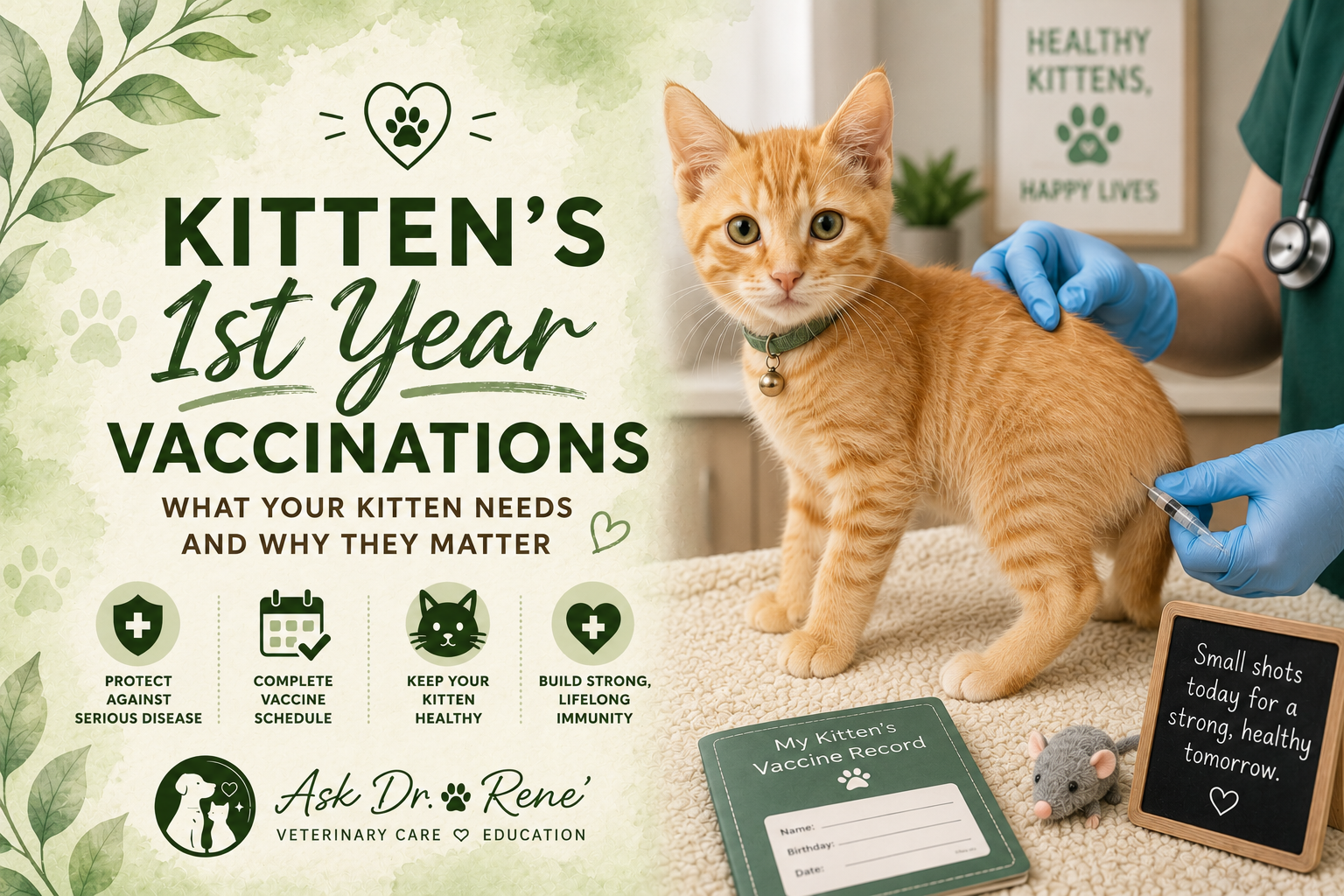
First-Year Kitten Vaccinations: What Your Kitten Needs and Why They Matter
Vaccinating your kitten is one of the most important steps you can take to protect them from serious and potentially life-threatening diseases. Learn which vaccines your kitten needs, why multiple boosters are necessary, and how to keep them safe during their first year of life.
By Dr. Rene' Holt
Bringing home a new kitten is exciting, but it's also one of the most important times to protect their health.
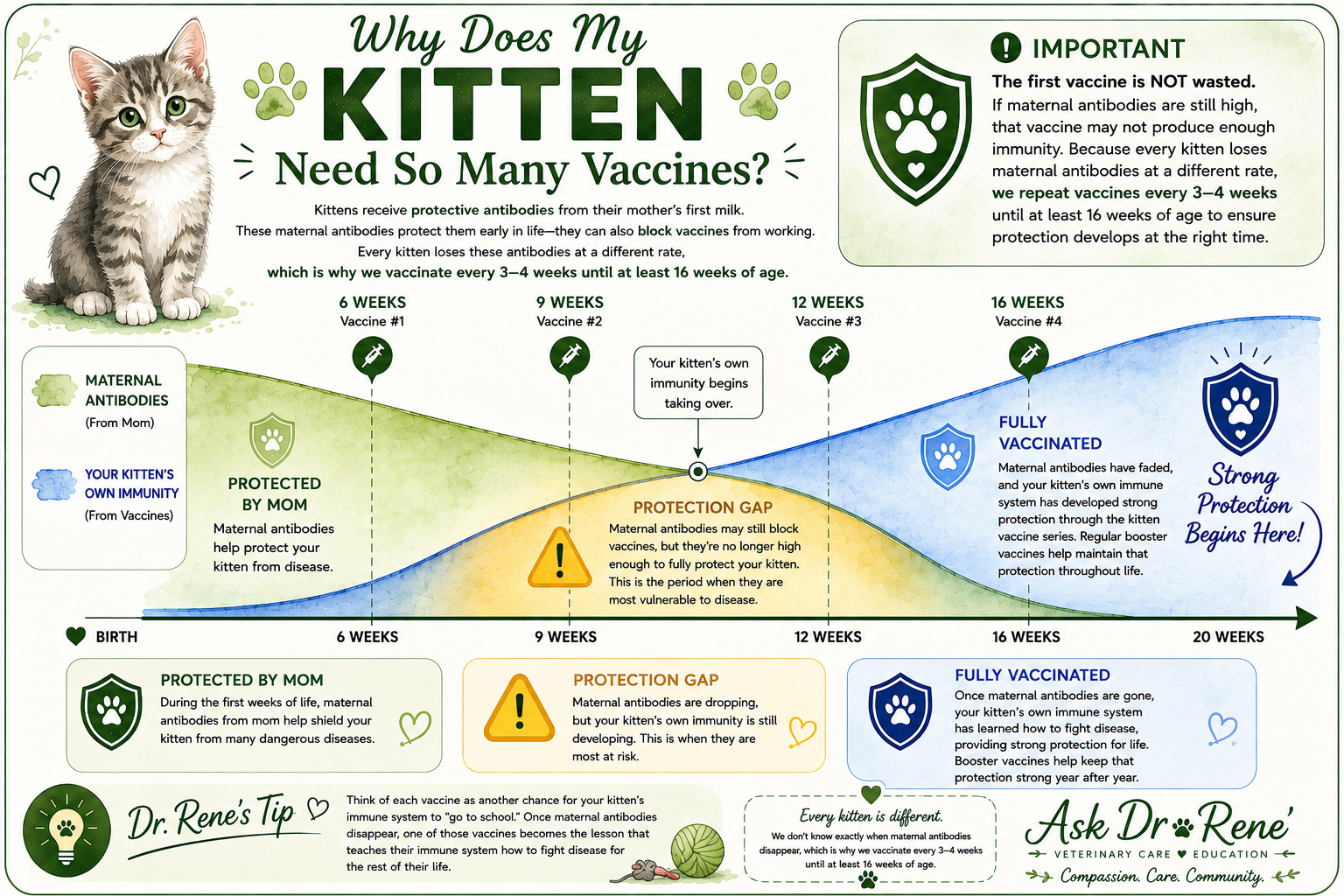
Kittens are born with immature immune systems and rely on antibodies they receive from their mother's first milk (colostrum) for protection during their first weeks of life. While these maternal antibodies help protect kittens early in life, they also interfere with vaccines.
That's why kittens need a series of vaccinations, not just a single shot.
Each vaccine builds upon the last, giving your kitten's immune system multiple opportunities to develop lasting protection against dangerous—and sometimes fatal—diseases.
Vaccines are one of the safest and most effective ways to help your kitten grow into a healthy adult cat.
Why Do Kittens Need Multiple Vaccines?
One of the most common questions I hear is:
"Why can't my kitten just get one vaccine?"
The answer lies in maternal antibodies.
These antibodies gradually disappear over the first few months of life, but every kitten loses them at a different rate. If a vaccine is given while maternal antibodies are still present, they can neutralize the vaccine before your kitten's immune system has a chance to respond.
By vaccinating every 3–4 weeks until at least 16 weeks of age, we dramatically improve the chances that your kitten develops strong, long-lasting immunity.
Think of each vaccine visit as another opportunity to teach your kitten's immune system how to recognize and fight disease.
Core Vaccines I Recommend for Every Kitten
Every kitten deserves protection against diseases that are common, highly contagious, and potentially life-threatening.
In my practice, I recommend these vaccines for every kitten, unless there is a specific medical reason not to vaccinate.
FVRCP Vaccine
This combination vaccine protects against three serious feline diseases.
Feline Viral Rhinotracheitis (Herpesvirus)
Feline herpesvirus is one of the most common causes of upper respiratory disease in cats.
It can cause:
- Sneezing
- Eye discharge
- Nasal congestion
- Corneal ulcers
- Fever
- Chronic respiratory disease
Once infected, many cats become lifelong carriers and may experience flare-ups during times of stress.
Feline Calicivirus
Calicivirus is another highly contagious respiratory virus.
It may cause:
- Sneezing
- Oral ulcers
- Eye discharge
- Fever
- Pneumonia in severe cases
Some strains are particularly aggressive and can become life-threatening.
Feline Panleukopenia
Often called "feline distemper," panleukopenia is one of the deadliest diseases affecting kittens.
It can cause:
- Severe vomiting
- Diarrhea
- Extreme dehydration
- A dangerously low white blood cell count
- Sepsis
- Death
The virus is incredibly hardy and can survive in the environment for months—even years.
Many owners believe indoor kittens aren't at risk, but the virus can easily be carried indoors on shoes, clothing, hands, pet carriers, and other objects.
Vaccination is by far the best protection.
Rabies Vaccine
Rabies is one of the deadliest diseases known.
Once clinical signs develop, it is almost always fatal.
Rabies also infects people, making vaccination essential for protecting both your family and your community.
Many owners assume indoor cats don't need rabies vaccination because they never leave the house.
Unfortunately, accidents happen.
Cats slip through open doors, escape from carriers, or become lost during emergencies. Bats can also enter homes through surprisingly small openings and expose indoor cats without anyone realizing it.
For these reasons, I recommend rabies vaccination for every kitten unless there is a medical reason not to vaccinate.
Most kittens receive their first rabies vaccine between 12 and 16 weeks of age, depending on local laws and your veterinarian's recommendations.
Feline Leukemia (FeLV)
Feline leukemia (FeLV) is one of the most significant infectious diseases affecting cats.
It attacks the immune system and can lead to:
- Cancer (especially lymphoma)
- Severe infections
- Anemia
- Chronic illness
- Premature death
The virus spreads primarily through close contact with infected cats, including:
- Grooming
- Sharing food and water bowls
- Bite wounds
- Prolonged close contact
For many years, FeLV vaccination was recommended primarily for outdoor cats or cats living with infected cats.
While lifestyle certainly influences long-term risk, I believe every kitten deserves the opportunity to develop immunity while their immune system is young.
That's why I recommend the entire FeLV vaccine series for every kitten, followed by a booster at one year of age, regardless of whether they are expected to live indoors or outdoors.
Why?
Because life changes.
An indoor kitten may accidentally escape. A family may adopt another cat whose FeLV status is unknown. A move, divorce, emergency, or rehoming can completely change a cat's lifestyle years later.
We simply cannot predict what a kitten's life will look like when they're only a few months old.
By completing the kitten series and the one-year booster, we provide protection during the time when kittens respond best to vaccination. After that, future FeLV vaccination can be individualized based on your cat's age, lifestyle, and risk factors.
In my opinion, providing that early immunity is one of the best investments we can make in a kitten's long-term health.
Typical First-Year Kitten Vaccine Schedule
| Kitten Age | Vaccines |
|---|---|
| 6–8 weeks | FVRCP |
| 9–12 weeks | FVRCP + FeLV (first vaccine) |
| 12–15 weeks | FVRCP + Rabies + FeLV booster |
| 15–17 weeks | FVRCP |
| Approximately 1 year | FVRCP booster + Rabies booster (as required) + FeLV booster |
Your veterinarian may recommend slight adjustments based on your kitten's age, previous vaccine history, health status, and local disease risks.
Can My Kitten Meet Other Cats Before They're Fully Vaccinated?
Socialization is important, but it should be done carefully.
Avoid:
- Unknown cats
- Stray cats
- Animal shelters
- Pet store adoption areas
- Homes with unvaccinated cats
Safer options include:
- Healthy, vaccinated cats with known medical histories
- Keeping your kitten indoors
- Gradual introductions to vaccinated household pets
Are Vaccines Safe?
For the overwhelming majority of kittens, yes.
Most experience only mild, temporary side effects such as:
- Mild soreness at the injection site
- Sleepiness
- Temporary decrease in appetite
Serious vaccine reactions are uncommon.
Seek veterinary care immediately if your kitten develops:
- Facial swelling
- Hives
- Repeated vomiting
- Difficulty breathing
- Collapse
These reactions are rare but require prompt medical attention.
Why Staying on Schedule Matters
Delaying vaccines leaves your kitten vulnerable during the time they are most susceptible to life-threatening infectious diseases.
Completing the full vaccine series provides the strongest possible protection while your kitten's immune system is still developing.
Vaccination doesn't just protect your kitten—it also helps protect other cats, your family, and your community.
Frequently Asked Questions
Does my indoor kitten really need vaccines?
Absolutely.
Indoor cats are still at risk from escaped doors, bats entering the home, emergency evacuations, veterinary visits, and diseases that can be carried indoors on shoes, clothing, or other objects. We can't predict every situation our cats may encounter over their lifetime, which is why I believe protecting them early is so important.
Will my cat need vaccines after the first year?
Yes.
Most cats receive booster vaccines at approximately one year of age. After that, your veterinarian will recommend an individualized vaccination schedule based on your cat's health, age, lifestyle, and risk factors.
Can my kitten be vaccinated if they're sick?
Minor illnesses may not delay vaccination, but kittens with fever, vomiting, diarrhea, or more significant illness may need to recover first. Your veterinarian will determine the safest timing.
Key Takeaways
- Kittens need multiple vaccines because maternal antibodies gradually disappear over time.
- I recommend FVRCP and Rabies as core vaccines for every kitten.
- I recommend every kitten receive the complete FeLV vaccine series plus a one-year booster, regardless of their expected lifestyle.
- Future FeLV vaccination can then be tailored to your cat's individual lifestyle and risk.
- Even indoor cats need vaccines because exposure can occur in ways many owners don't expect.
- Staying on schedule provides the best protection during your kitten's most vulnerable months.
Dr. Rene's Tip
Help your kitten learn that veterinary visits are positive experiences from the very beginning. Bring a favorite blanket or toy, reward them with treats after each visit, and gently handle their paws, ears, and mouth at home. These small steps help reduce fear and make veterinary care less stressful throughout their lifetime.
It also helps to make the carrier a normal, everyday part of your kitten's environment rather than something that only appears before a stressful trip. Leave the carrier out in your home instead of putting it away, and make it a comfortable, familiar space. You can place soft bedding inside, feed meals or treats in or near it, and occasionally let your kitten explore it on their own terms. When the carrier becomes a safe, predictable place, travel to the veterinary clinic is far less stressful and no longer feels like a battle.
Remember, vaccines are about more than preventing disease today—they're about protecting your kitten for the unexpected moments life may bring tomorrow.
Educational only. This article is not a substitute for veterinary care. If your pet is unwell, please contact your veterinarian.
Keep reading
First-Year Puppy Vaccinations: What Your Puppy Needs and Why They Matter
Bringing home a new puppy is exciting, but protecting them from dangerous diseases starts with the right vaccination schedule. Learn which vaccines your puppy needs, when they should receive them, why multiple boosters are necessary, and how to safely socialize your puppy during their first year.
Read Foreign Body IngestionMy Dog Ate a Sock: The Complete Veterinarian's Guide to Intestinal Blockages, Surgery, and Recovery
Did your dog swallow a sock? Learn when it may pass on its own, when an intestinal blockage is likely, what symptoms to watch for, whether vomiting should be induced, and when emergency surgery may be needed.
Read Foreign Body IngestionMy Dog Ate a Sock (Part 2): Symptoms of an Intestinal Blockage and When It's an Emergency
Wondering if your dog will pass a swallowed sock or develop an intestinal blockage? Learn when vomiting may be appropriate, why symptoms don't always appear immediately, the warning signs of an obstruction, and when emergency veterinary care is needed.
ReadKeep learning with Dr. Rene'
Browse the library, search another topic, or ask a question of your own.
Continue your journey
Loved this? Here's what to do next.
Every visit is a chance to understand your pet a little better. Pick your next step.
Explore the Learning Center
Browse evidence-based articles about symptoms, diseases, medications, treatments, preventive care, and more.
Explore ArticlesWatch Dr. Rene'
Prefer to watch instead of read? Explore practical veterinary education videos from Dr. Rene'.
Watch VideosGet Free Resources
Explore practical veterinary guides, checklists, and tools designed to help pet owners feel more informed and prepared.
Browse Free ResourcesProducts I Recommend
Browse pet products, supplies, and everyday essentials selected and recommended by Dr. Rene'.
See My Recommendations