
Allergy Learning Center · Part 5
Why Does My Dog Keep Licking Their Feet?
The Most Common Reasons Dogs Obsessively Lick, Chew, and Bite Their Paws
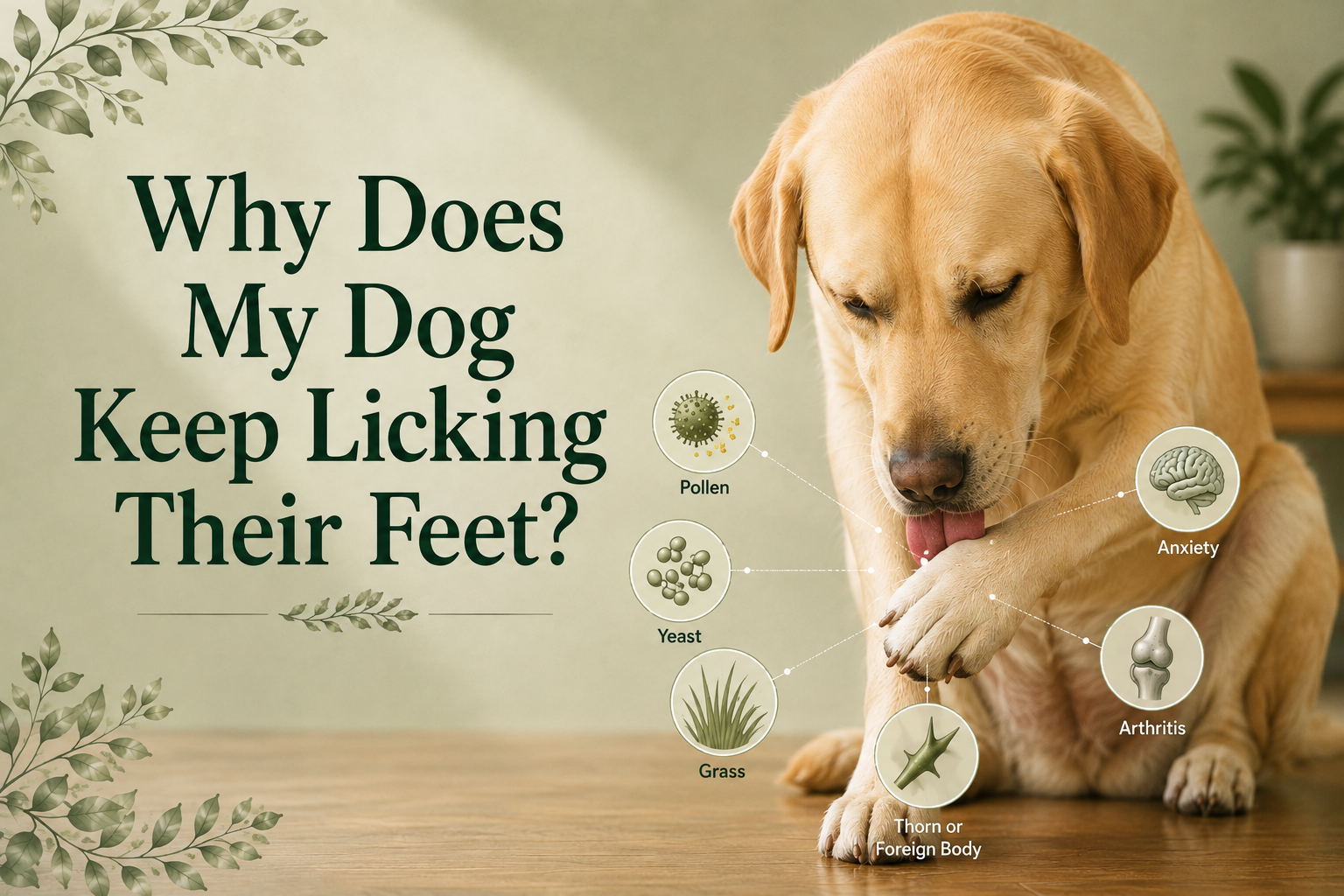
Foot licking is one of the most common reasons dogs visit the veterinarian. While allergies are often responsible, they're far from the only possible cause.
About a 9 minute read
"He's Always Licking His Feet."
This is one of the most common things owners tell me during an appointment.
Sometimes it's just occasional grooming.
Other times...
The licking never seems to stop.
The paws become:
- Red
- Swollen
- Brown-stained
- Hairless
- Painful
Owners often assume the licking is the problem.
In reality...
The licking is a symptom.
Just like coughing, vomiting, or scratching, your dog's paws are trying to tell us something.
The question isn't:
"How do I stop the licking?"
The question is:
"Why is my dog licking in the first place?"
Different Dogs Show Discomfort in Different Ways
When I use the word "licking" throughout this article, I'm also talking about:
- Chewing
- Nibbling
- Biting at the paws
- Rubbing the feet across the carpet
- Constant grooming between the toes
These are all different ways dogs respond to itch, irritation, pain, or discomfort.
Dogs Normally Lick Their Feet
Before we talk about disease...
It's important to remember that healthy dogs do groom themselves.
Occasional paw licking after a walk or before bedtime is perfectly normal.
The concern begins when the licking becomes:
- Frequent
- Intense
- Focused on the same paw
- Severe enough to wake the dog from sleep
- Persistent enough to cause redness or hair loss
That's when it's time to start looking for an underlying cause.
Allergies: The Most Common Reason
By far, the most common reason dogs chronically lick their feet is allergic skin disease.
Every time your dog walks through grass, pollen, dust, or other allergens, those particles contact the skin between the toes and around the paw pads.
In allergic dogs, the immune system overreacts.
The skin becomes inflamed.
Then...
It becomes itchy.
Dogs don't have hands to scratch between their toes.
Instead...
They lick.
Over time, that constant moisture weakens the skin barrier, making infections much more likely.
Where Allergy Dogs Usually Lick
Many allergy dogs focus on:
- Between the toes
- Around the nail beds
- The tops of the feet
- The paw pads
- All four feet
Many owners notice the licking is worse:
- After being outside
- During allergy season
- At night
- After exercise
Yeast: A Common Secondary Problem
One of the biggest misconceptions is that yeast causes the licking.
More often...
The licking comes first.
Constant moisture damages the skin.
Yeast—which normally lives harmlessly on the skin—begins to overgrow.
Now your dog has:
- Allergies
- Plus a yeast infection
Yeast makes the feet even itchier.
Which causes more licking.
Which causes more yeast.
Veterinarians call this another itch-lick cycle.
Signs of Yeast Overgrowth
Common signs include:
- Brown staining
- Red skin
- Greasy feet
- Musty or "corn chip" odor
- Thickened skin
- Constant chewing
Contact Irritation
Sometimes the problem isn't an allergy at all.
The paws simply become irritated after contacting something in the environment.
Examples include:
- Lawn fertilizers
- Ice melt products
- Road salt
- Cleaning chemicals
- Hot pavement
- Rough terrain
Unlike environmental allergies, contact irritation usually improves once the irritating substance is removed.
Foreign Bodies
Dogs explore the world with their feet.
Sometimes things become trapped between the toes.
Examples include:
- Grass awns
- Foxtails
- Splinters
- Thorns
- Small rocks
- Burrs
These dogs often:
- Suddenly start licking one foot
- Hold the paw up
- Limp
- Cry when the paw is touched
Foreign bodies can migrate beneath the skin and cause painful abscesses if not removed.
Arthritis and Pain
Here's something many owners don't realize.
Dogs also lick places that hurt.
A dog with arthritis in the wrist, toes, or elbow may repeatedly lick that area—not because it's itchy, but because it's painful.
This is one reason older dogs that suddenly begin licking one foot deserve a careful orthopedic examination.
Pain and itching often look surprisingly similar.
Anxiety and Behavioral Licking
Not every licking dog has a skin problem.
Some dogs develop compulsive licking behaviors.
This is more common when dogs experience:
- Anxiety
- Boredom
- Separation anxiety
- Chronic stress
These dogs often lick the same location repeatedly, even after the original medical problem has resolved.
Behavioral licking is considered a diagnosis of exclusion.
Before assuming anxiety is the cause, your veterinarian should first rule out medical conditions such as allergies, infection, pain, or foreign bodies.
How Veterinarians Figure It Out
Foot licking has many possible causes.
Your veterinarian may recommend:
- Skin cytology
- Skin scraping
- Careful paw examination
- Nail examination
- Orthopedic examination
- Allergy evaluation
- Food elimination trial
Each test helps narrow the list of possibilities until the real cause becomes clear.
What the Pattern of Licking Can Tell Us
One of the first things veterinarians pay attention to isn't just whether a dog is licking their feet—it's how they're licking them.
The pattern often provides valuable clues about what's causing the problem.
Although no single pattern gives us a diagnosis, it helps us build a list of the most likely possibilities before we even begin testing.
One Foot vs. All Four Feet
One of the first questions I'll ask is:
"Is your dog licking one foot—or all four?"
That simple answer can dramatically change what I'm thinking.
One Foot
When only one foot is affected, I become more suspicious of a localized problem, such as:
- Foreign body
- Broken or infected nail
- Bee or insect sting
- Small cut or wound
- Localized infection
- Arthritis or joint pain
- Soft tissue injury
These dogs often begin licking suddenly and may also limp or hold the paw up.
All Four Feet
When multiple feet are involved, I start thinking about conditions that affect the entire body, especially:
- Environmental allergies
- Food allergies
- Yeast overgrowth
- Contact irritation
- Autoimmune skin disease (less commonly)
These dogs often lick for weeks or months and may also have itchy ears, belly, face, or recurrent skin infections.
Front Feet or Back Feet?
The location matters too.
Mostly Front Feet
This commonly points toward:
- Environmental allergies
- Contact allergens
- Anxiety-related licking
- Elbow or shoulder discomfort
Mostly Back Feet
This makes me think more about:
- Flea allergy dermatitis
- Hip or knee pain
- Localized injuries
The differences between flea, environmental, and food allergies are covered in The Three Types of Allergies in Dogs.
Does the Licking Happen All the Time?
Timing is another important clue.
Mostly After Going Outside
This often suggests:
- Grass
- Weed pollen
- Environmental allergens
- Lawn chemicals
- Contact irritation
Mostly at Night
Many owners notice their dog seems comfortable during the day but begins licking as soon as everyone settles down for the evening.
This can happen because:
- Allergic itching often becomes more noticeable when dogs are resting.
- There are fewer distractions at night.
- Dogs have more uninterrupted time to focus on the itch.
Constant Licking Throughout the Day
Persistent licking throughout the day often indicates:
- Significant allergic skin disease
- Pain
- Chronic infection
- Behavioral or compulsive licking
These dogs generally need a thorough veterinary evaluation rather than simply watching to see if it improves.
Does Your Dog Stop When Distracted?
This is another question I frequently ask.
If your dog immediately stops licking when you call their name, grab a toy, or offer a treat—but starts again a few minutes later—it doesn't necessarily mean the problem is behavioral.
Dogs with allergies, pain, and early skin irritation are often able to pause briefly before the discomfort returns.
On the other hand, if your dog seems completely unable to stop licking despite distractions, the itch or pain may be quite significant.
Either way, the pattern gives your veterinarian another valuable piece of the puzzle.
Can I Prevent Foot Licking?
Sometimes.
The answer depends entirely on why your dog is licking.
Helpful strategies may include:
- Managing environmental allergies
- Treating yeast infections promptly
- Wiping paws after walks during allergy season
- Checking between the toes after hikes
- Using year-round flea prevention
- Maintaining a healthy weight to reduce joint pain
- Providing mental enrichment for anxious dogs
The key is identifying the cause—not simply trying to stop the behavior.
The Bottom Line
Dogs lick their feet for many different reasons, and the licking itself is almost never the disease.
Allergies are the most common cause, but yeast infections, contact irritation, foreign bodies, arthritis, pain, and even anxiety can all produce similar behaviors.
Finding the underlying reason is far more important than simply stopping the licking.
Once the cause is identified, treatment can be tailored to your dog's specific problem, giving them the best chance at long-term comfort.
Key Takeaways
- Foot licking is a symptom—not a diagnosis.
- Environmental allergies are the most common cause of chronic foot licking.
- Yeast often develops as a secondary problem after allergies damage the skin.
- Dogs that suddenly lick only one foot should be evaluated for injuries, foreign bodies, or pain.
- Arthritis and anxiety can both mimic allergic foot licking.
- Successful treatment depends on identifying why your dog is licking.
Need Help With Your Dog's Itchy Paws?
If your dog licks, chews, or bites their feet constantly, identifying the underlying cause early can make a tremendous difference.
Schedule an educational consultation with Dr. Rene'.
Work With Dr. Rene'Continue Learning
Why Do Dogs Get Hot Spots?
How a small irritated patch becomes a painful, oozing lesion in a matter of hours.
Coming soonThe Three Types of Allergies in Dogs
Flea allergies, environmental allergies, and food allergies — how they differ and why it matters.
Read articleWhy Does My Dog Keep Getting Ear Infections?
Recurring ear infections are usually a symptom of an underlying problem — most often allergies.
Read articleUnderstanding Allergy Medications
Where each common therapy acts in the allergic process, and why combinations often work best.
Coming soonEnvironmental Allergies (Atopy)
Pollens, molds, grasses, and dust mites — how atopic dermatitis is diagnosed and managed.
Coming soonFood Allergies in Dogs
What a true food allergy is, how elimination diet trials work, and the myths worth ignoring.
Coming soonJoin the learning community
One thoughtful pet-care email a week — no fear, no fluff.
Get new articles, seasonal safety reminders, and free guides delivered by Dr. Rene'. Unsubscribe anytime.
By subscribing you agree to receive educational emails from Ask Dr. Rene'.