
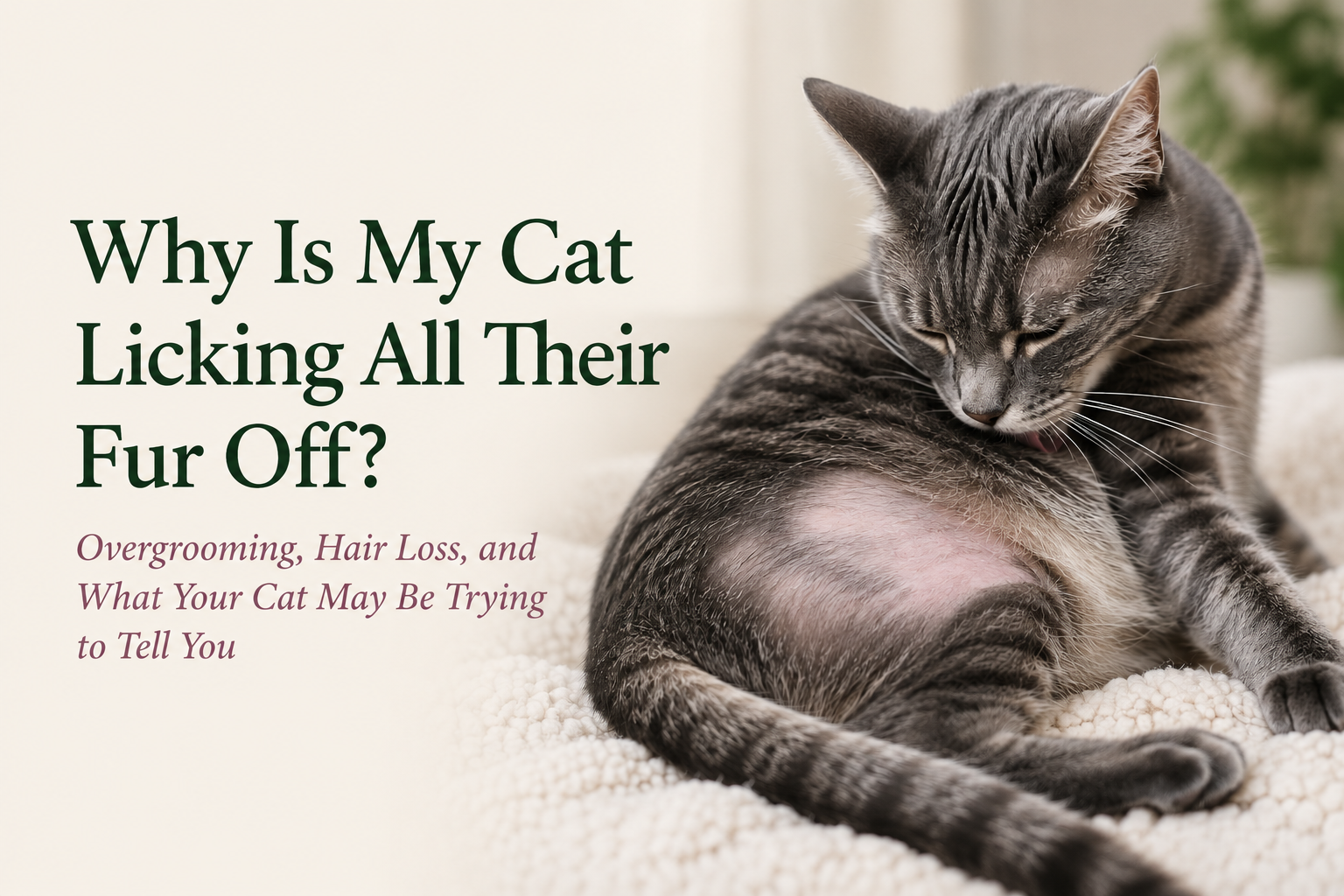
Why Is My Cat Licking All Their Fur Off? Overgrooming, Hair Loss, and What Your Cat May Be Trying to Tell You
Feline Allergy Learning Center · Part 2
Cats are naturally meticulous groomers—but licking until the hair becomes thin, broken, or completely bald is different. Allergies are a common cause, but pain, parasites, skin disease, and behavioral problems can look remarkably similar.
About a 12 minute read
When Does Normal Grooming Become a Problem?
Cats groom.
A lot.
For a healthy cat, grooming is a completely normal part of the day. It keeps the coat clean, removes loose hair, helps regulate body temperature, and is simply part of normal feline behavior.
So when an owner tells me:
"My cat is licking all the time."
The first question is:
Is this actually excessive grooming—or are we just noticing normal cat behavior?
Sometimes the answer becomes obvious because the cat has started losing hair.
You may notice:
- A bald belly
- Thin hair along the sides
- Bare inner thighs
- Hair loss on the front or back legs
- Short, stubbly hair instead of normal fur
- Red or irritated skin
- Scabs or sores
- Constant licking or chewing
At that point, we're no longer talking about ordinary grooming.
Something is driving the behavior.
And our job is to figure out what.
Did the Hair Fall Out—or Did Your Cat Remove It?
This is one of the first distinctions I want to make.
There is a big difference between:
Hair that falls out on its own
and
Hair that has been licked, chewed, or broken off by the cat.
When cats repeatedly lick an area, their rough tongues can break the hair shafts.
Instead of a completely smooth bald area, you may see or feel:
- Very short hairs
- Stubble
- Uneven hair length
- Broken hairs
- A rougher coat texture
This can tell us that the cat is actively removing the hair—even if nobody has ever witnessed the grooming.
Veterinarians sometimes refer to this as self-induced alopecia.
That simply means the hair loss is being caused by the cat's own grooming behavior.
But there's an important point:
Self-induced alopecia tells us HOW the hair disappeared.
It does not tell us WHY the cat is grooming.
Why Do Cats Overgroom?
There isn't one answer.
I generally think about several major categories:
- Itch
- Pain or discomfort
- Parasites or skin disease
- Behavioral causes
And there can absolutely be overlap between them.
Allergies Can Cause Overgrooming
Allergic skin disease is an important cause of excessive grooming in cats.
Cats with allergies don't necessarily develop the dramatic red, inflamed skin that owners expect.
Some simply lick.
And lick.
And lick.
Eventually, the hair disappears.
Possible allergic causes include:
- Flea allergy
- Environmental allergies
- Food allergy
The location of the grooming can give us useful information, but location alone cannot tell us which allergy is responsible. If you haven't read it yet, Part 1: Why Is My Cat Itchy? walks through how allergic skin disease shows up in cats.
For example, an allergic cat may overgroom the:
- Belly
- Inner thighs
- Sides
- Front legs
- Back legs
- Tail region
Some allergic cats also develop:
- Head and neck itching
- Scabs
- Miliary dermatitis
- Eosinophilic lesions
- Ear problems
That's why I look at the entire cat rather than focusing only on the bald area.
Fleas Are Still on the List—Even for Indoor Cats
This deserves its own section because fleas are so commonly dismissed.
I frequently hear:
"It can't be fleas. My cat never goes outside."
Or:
"I've checked. There aren't any fleas."
Unfortunately, neither statement completely rules out flea allergy.
Fleas can enter homes on other animals or through the environment, and cats are remarkably good at grooming away evidence.
A flea-allergic cat may also react to relatively little exposure.
So you don't necessarily need to see a large flea infestation for fleas to matter.
Depending on the cat and household, consistent veterinarian-recommended flea control may be part of the diagnostic process.
We'll go much deeper into flea allergy in Part 3.
Other Parasites Can Cause Itching and Hair Loss
Fleas aren't the only parasites we consider.
Depending on the cat's history, lifestyle, geographic location, and examination findings, other parasites may also need to be investigated.
Some can cause:
- Itching
- Crusting
- Hair loss
- Scaling
- Skin inflammation
This is one reason an itchy or balding cat deserves an actual examination rather than automatically being labeled allergic.
Skin Disease Can Make a Cat Groom More
Sometimes the cat is licking because the skin itself is uncomfortable.
Your veterinarian may consider problems such as:
- Bacterial infection
- Fungal disease, including ringworm
- Inflammatory skin disease
- Other dermatologic conditions
Ringworm is particularly important because it can cause hair loss in cats and can potentially spread to other animals and people.
Not every bald cat has ringworm.
But not every bald cat has allergies, either.
The appearance of the hair loss alone isn't enough to reliably distinguish them.
Pain Can Look Like Overgrooming
This one surprises many owners.
Cats don't only lick because they're itchy.
They may repeatedly groom an area because something underneath it hurts.
For example, a cat may focus on an area associated with:
- Arthritis
- Joint pain
- Back pain
- Injury
- Abdominal discomfort
- Urinary discomfort
- Other sources of pain
If a cat suddenly begins obsessively licking one particular location, I don't want to assume the problem is dermatologic.
I want to ask:
"What is underneath the area this cat keeps licking?"
Yes, Stress Can Cause Overgrooming
Behavioral overgrooming is real.
Some cats respond to stress, anxiety, frustration, or environmental changes by grooming excessively.
Possible triggers can include:
- A new pet
- A new baby or family member
- Moving
- Changes in routine
- Conflict between cats
- Outdoor cats visible through windows
- Inadequate environmental enrichment
- Changes in household activity
- Other chronic stressors
Grooming can become a self-soothing behavior.
And over time, that behavior can become repetitive enough to cause substantial hair loss.
But this is where I want to be careful.
"Psychogenic Alopecia" Shouldn't Be the Automatic Diagnosis
Historically, excessive grooming and symmetrical hair loss in cats were sometimes quickly attributed to stress or anxiety.
The problem is that itching and pain can produce very similar behavior.
A cat can have normal-looking skin and still be itchy.
A cat can hide the grooming behavior from its owner.
And a cat with allergic disease may remove enormous amounts of hair without developing dramatic visible inflammation.
So I don't want:
"The skin looks normal."
to automatically become:
"This must be behavioral."
Behavioral causes belong on the list.
They just shouldn't automatically be at the top of it.
What About a Cat With a Bald Belly?
A bald or thinning belly is a very common presentation.
You may see hair loss extending across the:
- Lower abdomen
- Groin
- Inner thighs
- Sides of the abdomen
The skin may look completely normal.
Possible explanations can include:
- Allergic itch
- Flea allergy
- Food allergy
- Environmental allergy
- Pain or discomfort
- Behavioral overgrooming
- Other dermatologic or medical conditions
In other words:
"Bald belly" describes what we're seeing.
It doesn't tell us the cause.
What If My Cat Is Licking Around the Base of the Tail?
That distribution makes me especially interested in fleas and flea allergy.
It isn't proof.
But hair loss, licking, crusting, or irritation around the:
- Lower back
- Tail base
- Back of the thighs
can fit with flea-associated disease.
This is another reason flea control matters even when the owner hasn't found a flea.
What If My Cat Is Licking One Leg or One Joint?
A very localized pattern deserves attention.
If a cat repeatedly focuses on one:
- Paw
- Leg
- Hip
- Joint
- Side of the body
I want to consider not only skin disease but also pain, injury, foreign material, or another localized problem.
Persistent licking in one location deserves veterinary evaluation.
Does the Skin Have to Look Red?
No.
This is one of the things that makes feline skin disease confusing.
A cat can remove a tremendous amount of hair while the exposed skin still looks relatively normal.
That does not mean the cat isn't uncomfortable.
The skin may also become irritated later because of repeated licking and chewing.
How Will My Veterinarian Figure Out Why My Cat Is Overgrooming?
There isn't one universal test.
The investigation depends on the individual cat.
Step 1: Look at the Pattern
I want to know:
- Where is the hair missing?
- Is the pattern symmetrical?
- Are the hairs broken?
- Is the skin normal or inflamed?
- Are there scabs?
- Are there sores?
- Is the cat scratching too?
- Is one particular area being targeted?
Step 2: Get the History
Important questions include:
- When did this begin?
- Did it start suddenly or gradually?
- Is it seasonal?
- Does the cat go outdoors?
- Are there other pets?
- Is every pet receiving effective flea prevention?
- Has the diet changed?
- Are there gastrointestinal signs?
- Have there been household changes?
- Has the cat shown signs of pain?
- What treatments have already been tried?
Step 3: Look for Medical Causes
Depending on the examination, your veterinarian may recommend things such as:
- Flea combing
- Skin cytology
- Skin scrapings
- Fungal testing
- Parasite treatment or prevention
- Additional testing based on the cat's history and examination
Step 4: Investigate Allergy When Appropriate
That may include:
- Strict flea control
- An elimination diet trial
- Evaluating the pattern for environmental allergic disease
- Treating secondary problems
- Monitoring response to treatment
Step 5: Consider Pain and Behavioral Causes
If the medical investigation doesn't explain the behavior—or the history suggests another cause—we can investigate pain, environmental stressors, and behavioral disease more closely.
Sometimes more than one problem is present.
Should I Stop My Cat From Licking?
The goal isn't simply to physically prevent the behavior forever.
We need to address why the cat wants to lick in the first place.
In some situations, temporary protection may be necessary if a cat is causing significant skin trauma.
But a cone, recovery suit, or other barrier doesn't treat:
- Allergies
- Fleas
- Infection
- Pain
- Anxiety
It only prevents access to the area.
Think of excessive grooming as a clue, not the underlying disease.
Can the Hair Grow Back?
Often, yes.
If the hair follicles themselves are healthy and we successfully address the reason for the excessive grooming, the coat can usually regrow.
But it takes time.
Hair doesn't return overnight just because the licking improves.
And if the cat begins grooming excessively again, the new hair may be removed before the coat fully recovers.
When Should My Cat See a Veterinarian?
I would schedule an examination if:
And if your cat has open wounds, significant self-trauma, appears ill, stops eating, develops urinary difficulty, or shows other concerning systemic signs, don't assume you're dealing with a simple grooming problem.
Contact your veterinarian promptly, or review what counts as a veterinary emergency.
What Can I Do at Home While I Wait for the Appointment?
A few things can make the veterinary visit more useful.
Take Photos
Hair loss can change over time.
Photographs can help document whether an area is expanding or improving.
Take a Video
If you catch your cat repeatedly licking, chewing, scratching, or behaving unusually, record it.
Cats have an amazing ability to stop doing the thing we need to see approximately three seconds before entering the exam room.
Pay Attention to Location
Make a note of exactly where your cat is grooming.
Think About Timing
Did anything change around the time the problem started?
Don't Randomly Treat Everything
Avoid applying human creams, essential oils, or over-the-counter skin products without veterinary guidance.
Some products that are safe for people—or even dogs—may not be appropriate for cats.
The Bottom Line
If your cat is licking enough to create thin hair, broken hair, or bald areas, something deserves attention.
Allergies are an important cause—but they're not the only cause.
Fleas, other parasites, skin disease, pain, and behavioral problems can all lead to excessive grooming.
And sometimes more than one problem is contributing.
The most important thing to remember is:
Self-induced hair loss is a sign, not a diagnosis.
Don't just try to stop the licking.
Figure out why your cat feels the need to do it.
Dr. Rene's Final Thought
Cats make us work for our answers.
They hide pain. They hide itching. They groom when we're not watching.
And then they sit on the exam table looking completely innocent while we're trying to figure out where half their belly hair went.
But their grooming pattern can give us valuable clues. When we combine those clues with the history, physical examination, skin testing, parasite control, and sometimes diet or behavioral investigation, we can usually get much closer to understanding what that cat is trying to tell us.
And once we understand the why, we have a much better chance of helping the hair—and the cat—get back to normal.
References & Further Reading
- Miller J, Simpson A, Bloom P, et al. 2023 AAHA Management of Allergic Skin Diseases in Dogs and Cats Guidelines. J Am Anim Hosp Assoc. 2023;59(6):255–284. doi:10.5326/JAAHA-MS-7396
- Santoro D, Pucheu-Haston CM, Prost C, Mueller RS, Jackson H. Clinical signs and diagnosis of feline atopic syndrome: detailed guidelines for a correct diagnosis. Vet Dermatol. 2021;32(1):26-e6. doi:10.1111/vde.12935
- Diesel A. Cutaneous Hypersensitivity Dermatoses in the Feline Patient: A Review of Allergic Skin Disease in Cats. Vet Sci. 2017;4(2):25. doi:10.3390/vetsci4020025
Next in this series
Feline Allergy Learning Center · Part 2 of 10
Part 3: Flea Allergy in Cats: Why One Flea Can Cause a Huge Problem
Why you may never see a flea on a cat with flea allergy — how flea allergy dermatitis causes itching, overgrooming, scabs, and hair loss, even in indoor-only cats.
Continue reading