
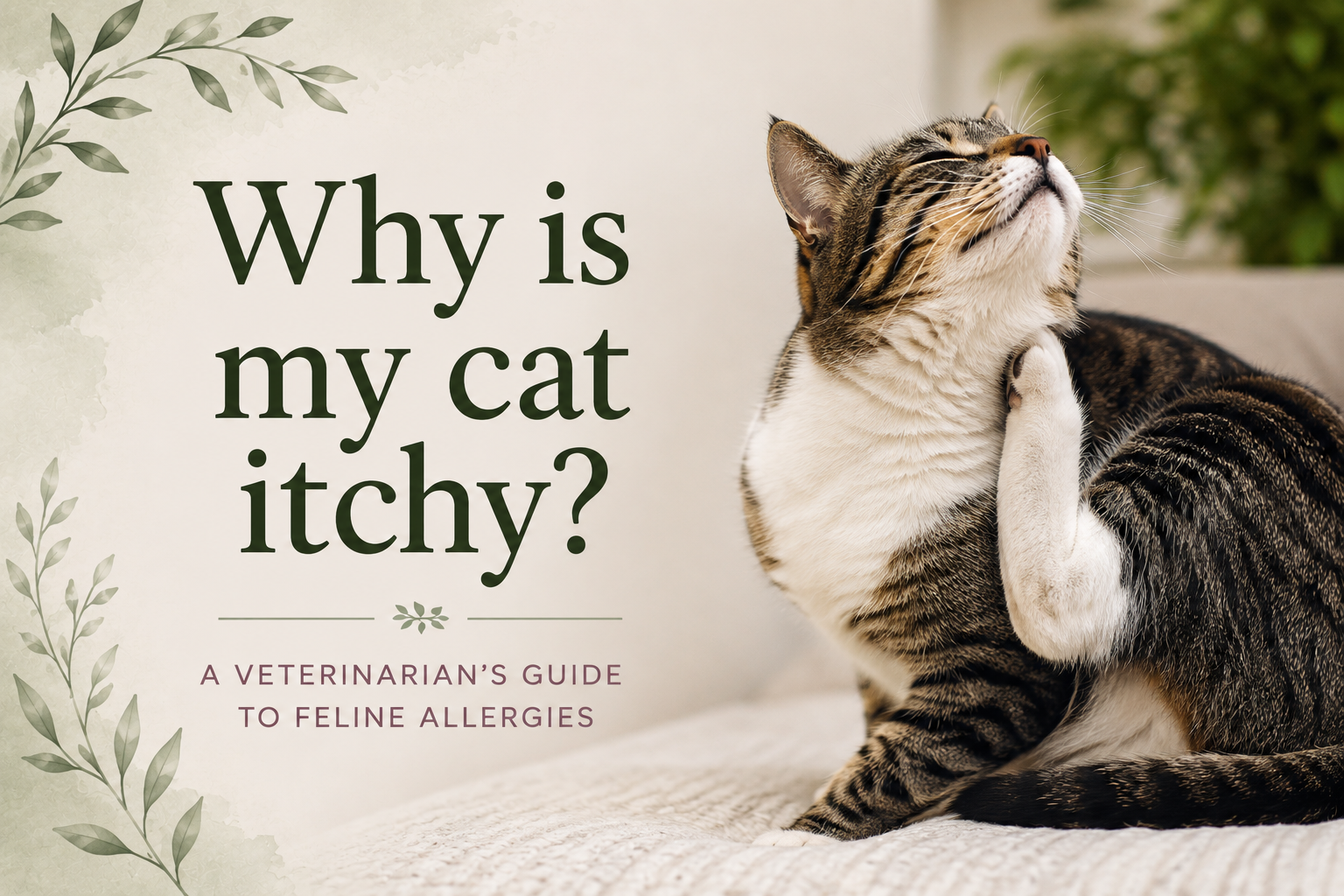
Why Is My Cat Itchy? A Veterinarian's Guide to Feline Allergies
Feline Allergy Learning Center · Part 1
Cats don't always show allergies the way dogs do. Excessive grooming, hair loss, scabs, sores, and head or neck scratching can all be signs of allergic skin disease—but allergies aren't the only reason cats itch.
About an 11 minute read
If Your Cat Is Itchy, Start Here
One of the frustrating things about itchy cats is that they don't always look itchy.
Some cats scratch.
But many cats lick, chew, or groom themselves excessively instead.
You may never actually see your cat scratching. You may simply notice:
- Hair disappearing from the belly or legs
- Short, broken hairs
- Small crusty scabs along the back or neck
- Sores around the head or face
- Red or irritated skin
- Repeated licking or chewing
- Skin lesions that seem to come and go
And because cats are such dedicated groomers, it can be difficult to tell where normal grooming ends and abnormal grooming begins.
That's why when I evaluate an itchy cat, my first question isn't:
"Which allergy does this cat have?"
It's:
"Why is this cat itchy?"
Allergies are one possibility—but they aren't the only one.
What Does Itching Look Like in Cats?
Itching in cats can look very different from what owners expect.
Signs may include:
- Scratching
- Excessive licking
- Chewing at the skin or coat
- Overgrooming
- Hair loss
- Broken or shortened hairs
- Scabs
- Redness
- Sores or ulcers
- Recurrent skin lesions
- Head or neck scratching
- Frequent ear scratching or head shaking
Some cats groom privately, so owners rarely catch them doing it.
In those cases, the hair loss or skin lesions may be the first clue.
The Four Common Skin Patterns We See in Allergic Cats
Here's something important about feline allergies:
The appearance of the skin usually doesn't tell us exactly what the cat is allergic to.
Instead, cats tend to develop several recognizable reaction patterns.
1. Head and Neck Itching
Some cats intensely scratch around the:
- Face
- Ears
- Head
- Neck
In severe cases, they may injure themselves from scratching.
2. Self-Induced Hair Loss
This is sometimes called self-induced alopecia.
The cat repeatedly licks or chews the hair until it becomes extremely short or disappears.
Common areas include the:
- Belly
- Inner thighs
- Sides
- Legs
The skin underneath may look surprisingly normal.
3. Miliary Dermatitis
These cats develop numerous tiny crusts or scabs that owners often describe as feeling like little grains beneath the coat.
They're commonly found around the:
- Neck
- Back
- Base of the tail
Miliary dermatitis is a reaction pattern, not a specific diagnosis.
4. Eosinophilic Granuloma Complex
This term describes several types of inflammatory skin lesions that can occur in cats, including:
- Eosinophilic plaques
- Eosinophilic granulomas
- Indolent ulcers
These lesions are often associated with allergic disease, although other causes may need to be considered.
What Causes Cats to Itch?
There are several major categories I think about.
Fleas and Other Parasites
Parasites belong near the top of the list—not because every itchy cat has parasites, but because they're common and important to rule out.
Possible causes include:
- Fleas
- Flea allergy dermatitis
- Mites
- Lice
- Other ectoparasites
And yes:
Indoor cats can get fleas.
A flea-allergic cat may react dramatically to very little flea exposure.
You also may never find the flea responsible.
Cats are extremely effective groomers, and they can remove fleas and flea dirt before you notice them.
Flea Allergy Dermatitis
Flea allergy deserves special attention because it can cause significant skin disease from relatively little flea exposure.
The problem isn't simply the flea bite itself.
The cat develops a hypersensitivity reaction to components of flea saliva.
Common signs can include:
- Intense itching
- Miliary dermatitis
- Hair loss
- Overgrooming
- Crusting
- Skin lesions around the back, neck, or tail region
This is why reliable flea prevention can be part of the diagnostic process even when nobody has actually seen fleas.
Environmental Allergies
Cats can also develop allergies to substances in their environment.
This is often discussed under the broader term feline atopic skin syndrome.
Potential environmental allergens include things such as:
- Pollens
- Grasses
- Trees
- Weeds
- Dust mites
- Molds
Some cats have seasonal disease.
Others itch throughout the year.
And unlike people, cats with environmental allergies often show their disease primarily through their skin rather than sneezing and watery eyes.
Food Allergies
Food allergy is another possibility.
Cats can develop adverse reactions to ingredients in their diet, particularly proteins.
Food-allergic cats may develop:
- Itching
- Head and neck scratching
- Skin lesions
- Overgrooming
- Hair loss
Some cats may also have gastrointestinal signs, although digestive problems are not required for a food allergy to be present.
And simply changing from one over-the-counter food to another does not reliably diagnose food allergy.
When food allergy is genuinely suspected, we usually need a properly controlled elimination diet trial.
We'll cover exactly how that works later in this series.
Skin Infections Can Make Everything Worse
Compared with dogs, secondary bacterial and yeast infections are not always the dominant feature of feline allergic skin disease—but infections can still occur.
And when they do, they can make an already itchy cat even more uncomfortable.
Your veterinarian may recommend tests such as:
- Skin cytology
- Ear cytology
- Skin scraping
- Fungal testing
- Other testing based on the appearance and history
The goal is to identify what is actually happening on the skin, rather than assuming every lesion is caused directly by allergy.
Could It Be Something Other Than Allergies?
Absolutely.
This is one of the most important lessons in this entire series.
Itching is a symptom. It is not a diagnosis.
Depending on the cat's age, history, lifestyle, examination findings, and skin lesions, your veterinarian may consider other possibilities such as:
- Parasites
- Fungal disease such as ringworm
- Bacterial infection
- Other inflammatory skin diseases
- Pain
- Neurologic disease
- Behavioral overgrooming
- Other underlying medical conditions
That's why I don't like jumping directly from:
"My cat is licking a lot"
to:
"My cat has allergies."
We need to work through the possibilities.
What About Stress and Anxiety?
This deserves special attention in cats.
Owners are sometimes told that a cat licking its hair off is "just stressed."
Stress and behavioral disorders absolutely can contribute to excessive grooming.
But behavioral overgrooming should not automatically be assumed before medical causes have been investigated.
If a cat is licking excessively, I want to think about things like:
itch → pain → medical disease → behavioral causes
rather than labeling the problem behavioral simply because the skin looks normal.
Remember: a cat can lick away the hair while leaving relatively normal-looking skin underneath.
How Does a Veterinarian Diagnose Allergies in a Cat?
There usually isn't one test that gives us the answer.
Instead, feline allergy diagnosis is often a process of excluding other causes of itching and looking at the overall pattern.
Depending on the individual cat, that process may include:
Step 1: History and Physical Examination
We look at things such as:
- When the problem started
- Where the cat is itchy
- Whether signs are seasonal
- Indoor versus outdoor lifestyle
- Other pets in the home
- Flea prevention
- Diet history
- Previous treatments
- Response to previous treatments
- Gastrointestinal signs
- Whether other animals or people in the home have skin lesions
Step 2: Look for Parasites
Even if we don't immediately find fleas or mites, parasite control may still be an important part of the diagnostic plan.
Step 3: Evaluate the Skin and Ears
Depending on the lesions, your veterinarian may recommend cytology, skin scrapings, fungal testing, or other diagnostics.
Step 4: Consider Food Allergy
If food allergy remains possible, a strict elimination diet trial may be recommended.
Step 5: Consider Environmental Allergy
Once other important causes have been excluded or controlled, environmental allergic disease becomes more likely.
Can an Allergy Test Tell Me What My Cat Is Allergic To?
This is an important distinction.
Allergy testing is not generally how we diagnose whether a cat has environmental allergies in the first place.
Environmental allergy is primarily a clinical diagnosis made after evaluating the history and ruling out other important causes of itching.
Allergy testing may later be used to identify allergens for allergen-specific immunotherapy in appropriate patients.
In other words:
Diagnose the allergic disease first.
Use allergy testing later when it serves a specific purpose.
How Are Allergies Treated in Cats?
There is no single treatment plan that works for every allergic cat.
Treatment may involve some combination of:
- Consistent flea control
- Treating secondary infections
- Diet modification when food allergy is suspected
- Anti-inflammatory or anti-itch medication
- Cyclosporine in appropriate patients
- Topical therapy when tolerated
- Environmental management
- Allergen-specific immunotherapy in selected cats
- Management of concurrent medical problems
The treatment plan depends on what is causing the itching, how severe it is, and what works safely for that individual cat.
And because cats are cats, we also have to consider something very practical:
Can we actually administer the treatment consistently without making everyone in the household miserable?
The theoretically perfect treatment isn't very useful if the cat cannot realistically receive it.
Can Cat Allergies Be Cured?
Usually, environmental allergies are managed rather than cured.
But that doesn't mean an allergic cat has to remain uncomfortable.
The goals are to:
- Reduce itching
- Prevent self-trauma
- Control secondary problems
- Reduce flare-ups
- Identify avoidable triggers when possible
- Maintain healthy skin
- Find a long-term treatment strategy the cat and owner can actually live with
A successful plan doesn't necessarily mean zero itching forever.
It means giving that cat a consistently good quality of life.
When Should My Cat See a Veterinarian?
Schedule an examination if you notice:
Seek more urgent veterinary care if your cat develops rapidly worsening signs, significant facial swelling, severe weakness, collapse, or difficulty breathing.
The Bottom Line
Cats absolutely get allergies.
But feline allergic disease doesn't always look like the classic itchy dog most people picture.
Cats may scratch.
They may lick themselves bald.
They may develop tiny crusty scabs.
They may develop unusual inflammatory skin lesions.
And sometimes the skin underneath all that missing hair looks almost completely normal.
The important thing is not to assume every itchy or overgrooming cat has allergies—or that every cat with hair loss is simply stressed.
First, figure out why the cat is itchy.
Then we can build the right treatment plan.
Dr. Rene's Final Thought
Cats are very good at hiding both illness and discomfort.
They're also very good at hiding the evidence.
That makes feline skin disease a little like detective work.
The goal isn't simply to stop the licking or scratching. It's to determine why it's happening and then build a plan that makes sense for that individual cat.
And that's exactly what we're going to work through together in this Feline Allergy Learning Center.
References & Further Reading
- Miller J, Simpson A, Bloom P, et al. 2023 AAHA Management of Allergic Skin Diseases in Dogs and Cats Guidelines. J Am Anim Hosp Assoc. 2023;59(6):255–284. doi:10.5326/JAAHA-MS-7396
- Santoro D, Pucheu-Haston CM, Prost C, Mueller RS, Jackson H. Clinical signs and diagnosis of feline atopic syndrome: detailed guidelines for a correct diagnosis. Vet Dermatol. 2021;32(1):26-e6. doi:10.1111/vde.12935
- Diesel A. Cutaneous Hypersensitivity Dermatoses in the Feline Patient: A Review of Allergic Skin Disease in Cats. Vet Sci. 2017;4(2):25. doi:10.3390/vetsci4020025
Next in this series
Feline Allergy Learning Center · Part 1 of 10
Part 2: Why Is My Cat Licking All Their Fur Off?
Overgrooming, hair loss, and what your cat may be trying to tell you — how allergies, fleas, skin disease, pain, and stress can all lead a cat to lick their fur away.
Continue reading