
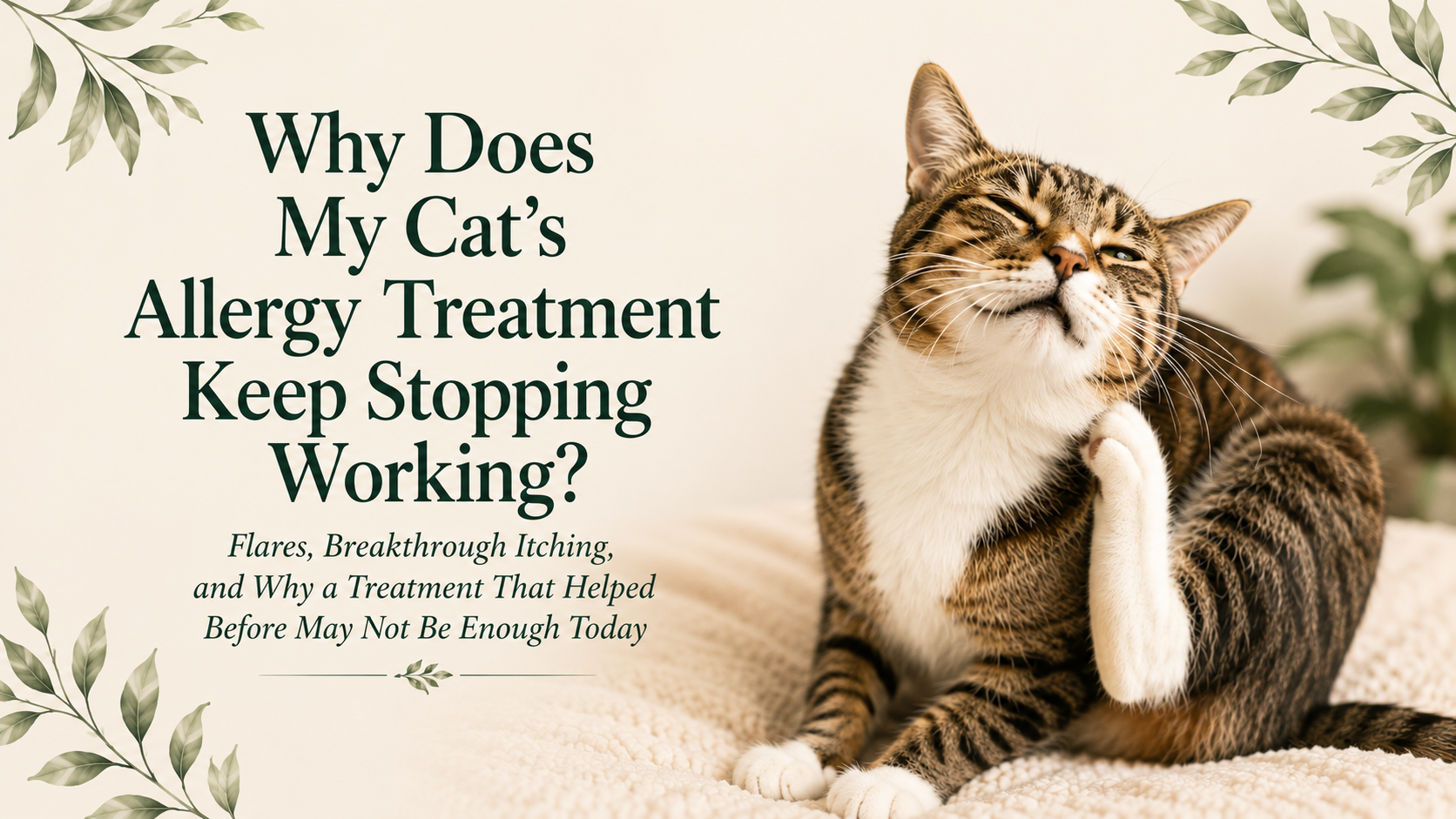
Why Does My Cat's Allergy Treatment Keep Stopping Working?
Feline Allergy Learning Center · Part 8
Flares, Breakthrough Itching, and Why a Treatment That Helped Before May Not Be Enough Today
When a comfortable cat becomes itchy again, the first question usually isn't which medication to increase—it's what changed.
About a 13 minute read
You finally got your cat comfortable.
The scratching settled down. The licking slowed. Their fur started growing back. Maybe their ears finally stayed clean. You found a medication, diet, flea-prevention plan, or combination of treatments that seemed to be working.
And then, suddenly, your cat is itchy again.
For many cat owners, this is one of the most frustrating parts of managing allergic skin disease.
It is easy to assume:
"The treatment stopped working."
Sometimes that is possible.
But much more often, something has changed.
A cat whose allergies were reasonably controlled can develop a flare because another piece has been added to the itch—fleas, an ear problem, a secondary skin infection, a dietary exposure, increased environmental allergens, missed treatments, or even an entirely new problem.
That is why, when a previously controlled cat suddenly becomes itchy again, my first question usually isn't:
"What stronger medication should we use?"
It is:
"What changed?"
First: Allergies Usually Aren't "Cured"
If your cat has an environmental allergy, treatment generally doesn't make their immune system permanently stop reacting to allergens.
Instead, our goal is to manage the disease well enough that your cat stays comfortable.
That distinction matters.
A cat may do beautifully for months and then have a flare. That doesn't necessarily mean everything you have been doing was wrong or that you need to start over.
It means we need to figure out what pushed your cat over their individual itch threshold.
Think of It Like an Itch Threshold
This is one of the most useful ways to understand allergic skin disease.
Imagine your cat has an invisible line.
Below that line, they may have some allergic inflammation, but they remain comfortable enough that you don't see obvious scratching, licking, chewing, or skin disease.
Once the combined sources of itch push them above that line, symptoms appear.
And several small things can add together.
For example, your cat might normally tolerate:
- A little environmental allergy
- A small amount of seasonal pollen exposure
- Mild skin inflammation
without becoming noticeably itchy.
Then they get bitten by a few fleas.
Or develop yeast or bacterial overgrowth.
Or someone gives them food that isn't part of their elimination diet.
Now the total itch is enough to cross the threshold.
Suddenly your cat is scratching again.
The allergy medication may not have stopped working at all.
There may simply be more itch for it to control.
1. Fleas Are Always Worth Reconsidering
I know.
I sound like a broken record about fleas.
But there is a reason veterinarians keep coming back to them.
A flea-allergic cat can react dramatically to flea bites, and you may never actually see a flea.
Cats are also extremely effective groomers. They may remove fleas and flea dirt before you ever notice them.
So when a previously controlled allergic cat suddenly becomes itchy—especially around the lower back, tail base, thighs, belly, head, or neck—I want to know whether flea prevention has remained absolutely consistent.
That includes every susceptible pet in the household.
Questions I may ask include:
- Has a dose been late?
- Was a dose missed?
- Did the product get applied correctly?
- Has another pet in the home missed prevention?
- Has a new pet entered the household?
- Has your cat recently spent time somewhere else?
- Are you using a product appropriate for your cat and your situation?
And remember what we discussed earlier in this series:
Not seeing fleas does not rule out flea exposure.
2. Secondary Problems Can Break Through Good Allergy Control
Allergic skin is not normal skin.
Inflammation changes the skin barrier and can make it easier for other problems to develop.
Depending on the individual cat, we may find things such as:
- Bacterial skin infection
- Yeast overgrowth
- Ear inflammation or infection
- Self-trauma from licking or scratching
- Moist or damaged areas of skin
- Secondary crusting or inflammation
These problems can create additional itch of their own.
So now we have:
Underlying allergy + secondary problem = much itchier cat
This is one reason simply increasing an allergy medication isn't always the right answer.
If there is another treatable problem sitting on top of the allergy—such as a recurring ear problem—I want to find and address that problem.
3. Food Exposure Can Matter
If your cat has a confirmed food allergy—or is currently undergoing an elimination diet trial—dietary exposure matters.
And unfortunately, cats don't read ingredient labels.
Exposure can happen through things owners don't immediately think of as "food," including:
- Treats
- Table food
- Another pet's food
- Flavored medications
- Supplements
- Pill pockets or other medication treats
- Food dropped by children
- Access to trash or dirty dishes
- Hunting or scavenging in cats that go outdoors
During a diagnostic elimination diet trial, these exposures can make the results much harder to interpret.
For a cat with a known food allergy, exposure to a trigger may cause clinical signs to return.
That doesn't mean the diet stopped working.
It may mean the cat was exposed to something outside the diet.
4. Environmental Allergies Can Change With the Seasons
Environmental allergen exposure isn't necessarily constant throughout the year.
Depending on what your cat reacts to and where you live, exposure can fluctuate with:
- Pollen
- Mold
- Humidity
- Weather
- Indoor heating or cooling
- Time spent near open windows or screened porches
- Changes inside the home
Some cats have very obvious seasonal flares.
Others eventually become itchy during much of the year.
And even indoor-only cats can have environmental allergies.
Pollen comes indoors.
Mold exists indoors.
Dust and other environmental allergens exist indoors.
Humans and other animals carry material inside on clothing, shoes, and fur.
Indoor does not mean allergen-free.
5. Sometimes the Treatment Plan Has Become Inconsistent
This is not about blaming anyone.
Long-term treatment plans are difficult to maintain perfectly—especially once the cat looks fantastic.
When symptoms disappear, it is very natural to become less strict about the things that got them there.
Maybe flea prevention gets stretched a little longer between doses.
Maybe topical care happens less often.
Maybe medications aren't given quite as consistently.
Maybe the diet becomes a little less strict.
Maybe a maintenance medication was discontinued because the cat seemed "cured."
Those changes may not cause an immediate problem.
Then several weeks later, the cat starts licking again.
When we investigate a flare, knowing exactly what your cat has actually been receiving is much more useful than telling me what they were originally prescribed.
If something has been difficult to give consistently, tell your veterinarian.
That information helps us build a plan that works in your actual household.
6. Your Cat May Need a Different Level of Treatment During a Flare
Long-term maintenance and flare treatment are not always identical.
A cat may need relatively little intervention while their disease is quiet but temporarily need additional treatment when inflammation increases.
Depending on the cat and the underlying problem, a veterinarian may recommend temporarily changing:
- Anti-itch or anti-inflammatory therapy
- Topical treatment
- Ear treatment
- Treatment for secondary infection
- Flea-control strategy
- Environmental management
- Other supportive care
Then, once the flare settles, the cat may return to their maintenance plan.
The goal isn't necessarily to keep adding medications forever.
It is to use the amount of treatment that particular cat needs at that particular time.
7. Sometimes the Original Diagnosis Needs to Be Revisited
This one is important.
A cat with a history of allergies is still capable of developing something that isn't an allergy.
Once an animal has a chronic diagnosis, it is very easy for everyone—including owners and veterinarians—to view every future symptom through that lens.
But new problems happen.
Hair loss, itching, crusting, ear disease, and excessive grooming can have many causes.
Depending on the pattern and examination findings, we may need to reconsider possibilities such as:
- Parasites
- Infection
- Dermatophytosis (ringworm)
- Pain
- Other inflammatory skin diseases
- Structural ear disease
- Behavioral contributors
- Less common skin disorders
- Other medical conditions
If the clinical picture has changed significantly, the right response may not be to keep escalating allergy treatment.
It may be to reassess the diagnosis.
Myth vs. Fact
The important question is not simply:
"What stronger drug can we give?"
It is:
"Why is this cat less controlled than they were before?"
Should I Just Restart Whatever Worked Last Time?
Not necessarily.
I understand why this is tempting.
You have leftover medication. Your cat looks exactly like they did six months ago. You remember what the veterinarian prescribed last time.
Why not just repeat it?
Because similar symptoms don't guarantee the same cause.
This is especially important with ear medications, antibiotics, antifungals, steroids, and other prescription treatments.
A medication that was appropriate for one episode may not be appropriate for the next.
Sometimes your veterinarian may tell you that a particular previously prescribed treatment is safe to restart under specific circumstances.
That's different from assuming every flare should automatically receive the same treatment.
What Information Should I Bring to the Appointment?
You can make a flare appointment much more useful by giving your veterinarian a clear timeline.
Before the visit, think about:
- When did the itching start again?
- Where is your cat itching, licking, chewing, or losing hair?
- Was the previous treatment ever completely successful?
- What medications or treatments is your cat receiving right now?
- When was each one last given?
- What flea prevention is every pet in the household receiving?
- Has anything changed in your cat's food, treats, medications, or supplements?
- Has anything changed in the household or environment?
- Is the problem seasonal?
- Are there ear symptoms?
- Are there gastrointestinal signs such as vomiting or diarrhea?
Photos can also be extremely helpful—particularly if the skin looked worse several days before the appointment.
What Your Veterinarian May Do During a Flare
The exact work-up depends on your cat's history and examination, but your veterinarian may recommend things such as:
- Careful skin and coat examination
- Flea-comb evaluation
- Skin cytology
- Ear examination
- Ear cytology
- Skin scraping or other parasite testing
- Fungal testing when indicated
- Reviewing flea prevention
- Reviewing diet history
- Reviewing medication administration
- Additional testing when the pattern no longer fits the previous diagnosis
Not every cat needs every test.
The point is to determine what is contributing to this particular flare.
Don't Judge Success by Whether Your Cat Ever Itches Again
With chronic allergic disease, a more realistic measure of success is often:
- Flares happen less often
- Flares are less severe
- Your cat recovers more quickly
- Secondary problems occur less frequently
- Less medication is needed over time
- Your cat spends far more time comfortable than uncomfortable
- You know what to do when symptoms begin to return
A cat who has an occasional manageable flare can still have very well-controlled allergic disease.
Perfection is not the only definition of success.
Comfort and quality of life matter more.
The Goal Is to Find the Missing Piece
When an allergic cat becomes itchy again, there is a natural temptation to focus entirely on the medication.
But allergy management is usually bigger than one medication.
Remember the treatment pyramid from Part 6.
Good control may depend on several pieces working together:
- Flea control
- Diet
- Secondary-problem management
- Itch and inflammation control
- Skin support
- Environmental management
- Long-term individualized treatment
If one of those pieces changes, your cat's symptoms can change too.
So when treatment seems to have "stopped working," don't immediately assume you've run out of options.
Sometimes we simply need to figure out which piece moved.
Dr. Rene's Final Thought
One of the hardest things about chronic allergic disease is accepting that improvement doesn't always happen in a perfectly straight line.
There may be really good months.
There may be frustrating weeks.
There may even be times when something that seemed beautifully controlled suddenly feels like you're back at the beginning.
Usually, you aren't.
Everything we've already learned about your cat still matters.
A flare gives us new information.
We look at what changed, treat what needs treating, adjust the plan when necessary, and work toward getting your cat comfortable again.
The goal isn't a cat who never has another bad day.
The goal is a cat whose bad days become fewer, shorter, and easier to manage.
Next in the Feline Allergy Series
Part 9: Helping Your Allergic Cat at Home
What actually helps between veterinary visits—and which popular "allergy remedies" may be a waste of money or even make things worse.
Coming soon.
References & Further Reading
- Miller J, Simpson A, Bloom P, et al. 2023 AAHA Management of Allergic Skin Diseases in Dogs and Cats Guidelines. J Am Anim Hosp Assoc. 2023;59(6):255–284. doi:10.5326/JAAHA-MS-7396
- Mueller RS, Nuttall T, Prost C, Schulz B, Bizikova P. Treatment of the feline atopic syndrome—a systematic review. Vet Dermatol. 2021;32(1):43-e8. doi:10.1111/vde.12933
- Santoro D, Pucheu-Haston CM, Prost C, Mueller RS, Jackson H. Clinical signs and diagnosis of feline atopic syndrome: detailed guidelines for a correct diagnosis. Vet Dermatol. 2021;32(1):26-e6. doi:10.1111/vde.12935
Next in this series
Feline Allergy Learning Center · Part 8 of 10
Part 9: Helping Your Allergic Cat at Home
What actually helps an allergic cat between veterinary visits—and which popular “allergy remedies” deserve caution before you spend money on them.
Continue reading