
Allergy Learning Center · Part 1
Is My Dog Itchy Because of Allergies? Or Could It Be Something Else?
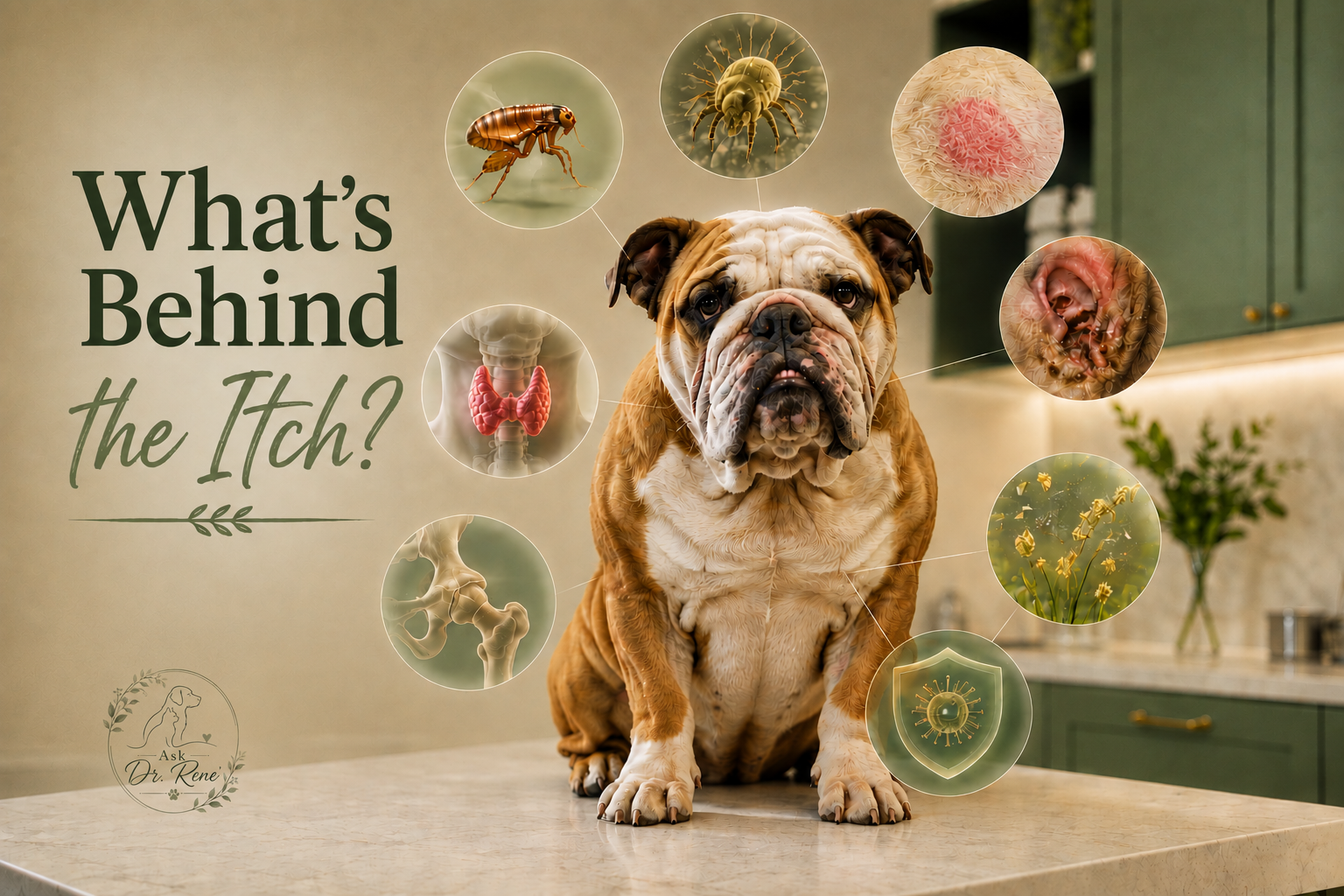
Itching is one of the most common reasons dogs visit the veterinarian—but allergies are only one possible cause. Here's how veterinarians think through an itchy dog.
About a 9 minute read
Few things make both dogs and their owners more miserable than constant itching.
One minute your dog seems perfectly happy. The next they're scratching their ears, chewing their feet, rubbing their face across the carpet, or waking you up in the middle of the night because they simply can't stop scratching.
For many families, the first thought is:
"My dog must have allergies."
Sometimes they're right.
But sometimes they're not.
In fact, many dogs that are eventually diagnosed with allergies also have one or two additional problems contributing to their itch at the same time. Allergies commonly lead to secondary infections, while conditions like fleas, pain, or hormonal disease can exist alongside allergies and make itching even worse.
One of the biggest misconceptions I see in veterinary medicine is that itching automatically means allergies.
Itching is a symptom—not a diagnosis.
Just like coughing doesn't always mean pneumonia and vomiting doesn't always mean stomach disease, itching can be caused by many different medical conditions.
The job of your veterinarian isn't simply to stop the itching—it's to determine why your dog is itching in the first place.
Itching Is a Symptom—Not a Diagnosis
Imagine your car's "Check Engine" light comes on.
The light tells you something is wrong, but it doesn't tell you what.
It could be a loose gas cap.
It could be a faulty oxygen sensor.
Or it could be a major engine problem.
The light is simply a warning.
Itching works the same way.
Scratching, licking, chewing, rubbing, and biting are your dog's way of telling you something isn't right.
The challenge is figuring out exactly what's causing it.
What Causes Dogs to Itch?
Veterinarians often work through a list of possibilities before concluding that allergies are the primary problem.
Although every patient is different, our thought process often looks something like this:
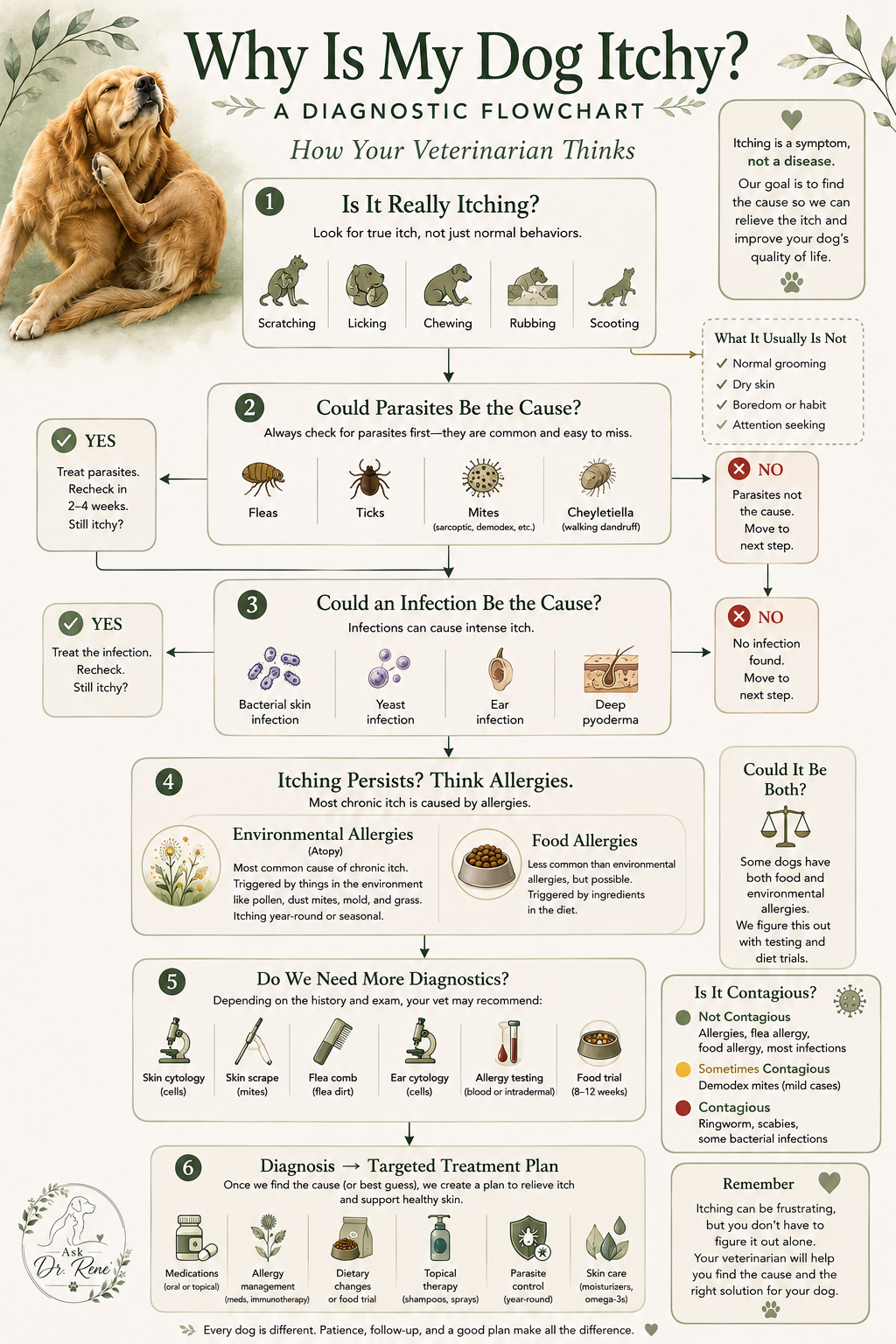
Let's look at the most common causes.
Fleas
One Flea Can Cause Weeks of Misery
Many owners are surprised to learn that they never actually have to see fleas for flea allergy dermatitis to be present.
In fact, the flea responsible for the allergic reaction is often gone long before an owner ever examines their dog.
A single flea bite can trigger an intense allergic reaction in sensitive dogs that lasts for days or even weeks.
Some dogs become so itchy that they create severe skin infections after only one or two flea bites.
Common clues include:
- Scratching near the tail
- Hair loss over the rump
- Small scabs
- Red skin
- Flea dirt
- Seasonal flare-ups
Even indoor dogs can develop flea allergies.
This is why flea prevention remains one of the first recommendations for every itchy dog.
Mange (Mites)
Some microscopic mites cause tremendous itching.
The two most common are:
Sarcoptic Mange (Scabies)
This mite causes intense itching that often seems completely out of proportion to what owners can actually see.
Dogs commonly develop:
- Ear margin crusting
- Elbows
- Hocks
- Belly
- Chest
- Severe scratching
It is contagious to other dogs and can even cause temporary itchy bumps in people.
Demodectic Mange
Demodex mites normally live within hair follicles, but when the immune system can't keep them under control they can multiply rapidly.
Some dogs become itchy because secondary skin infections develop.
Others primarily experience hair loss.
Unlike scabies, Demodex is generally not contagious between healthy adult dogs.
Ringworm
Despite its name, ringworm isn't caused by a worm.
It's a fungal infection.
Ringworm often causes:
- Circular areas of hair loss
- Scaling
- Crusting
- Broken hairs
- Mild to moderate itching
Because ringworm is contagious to people and other pets, identifying it early is important.
Skin Infections
Many dogs are actually itchy because they have a bacterial infection, a yeast infection, or both.
In fact, these infections commonly occur because allergies damaged the skin first.
This creates an important cycle:
1Allergies damage the skin.
2Bacteria and yeast overgrow.
3The infection causes even more itching.
4The dog scratches more.
5The skin becomes even more damaged.
Until both the allergy and the infection are treated, many dogs never become comfortable.
Hormonal Diseases
Some endocrine disorders change the health of the skin itself.
Conditions like hypothyroidism or Cushing's disease don't usually cause dramatic itching on their own, but they weaken the skin's natural defenses.
As a result, affected dogs often develop repeated bacterial or yeast infections that make them itchy.
If your dog keeps getting skin infections despite treatment, your veterinarian may recommend bloodwork to look for an underlying hormonal problem.
Pain Can Look Like Itching
This surprises many owners.
Dogs with arthritis, neck pain, hip pain, or other orthopedic problems may repeatedly lick one specific area of their body.
Because they're licking so often, it appears they're itchy.
In reality, they're trying to soothe discomfort coming from deeper tissues.
Dogs don't understand the difference between itching and aching. They simply know that licking temporarily feels better.
I've seen many dogs treated for "allergies" for months before discovering that arthritis—not itchy skin—was driving the behavior.
Anxiety and Behavioral Disorders
Some dogs lick because they're uncomfortable emotionally rather than physically.
Stress, boredom, separation anxiety, or compulsive behaviors can all cause excessive licking.
These dogs often focus on one paw, one leg, or one area repeatedly.
Over time, constant licking can actually create skin infections, making the situation even more confusing.
Autoimmune Skin Diseases
Thankfully, autoimmune skin diseases are considerably less common than allergic skin disease, but they're important to recognize because they require an entirely different treatment approach.
These conditions often cause:
- Ulcers
- Crusting
- Nose lesions
- Footpad changes
- Severe inflammation
They require very different treatment than allergies, which is one reason an accurate diagnosis matters.
Could My Dog Have More Than One Problem?
Absolutely.
In fact, many itchy dogs have multiple conditions at the same time.
For example:
- Environmental allergies plus a bacterial infection.
- Flea allergy plus food allergies.
- Allergies plus yeast overgrowth.
- Arthritis plus excessive licking.
- Hypothyroidism plus recurrent skin infections.
Veterinary medicine is rarely about finding one perfect answer.
It's about identifying every factor contributing to your dog's discomfort and creating a treatment plan that addresses each one.
How Veterinarians Figure It Out
When I evaluate an itchy dog, I'm asking dozens of questions before I ever recommend a medication.
Some of the questions include:
- Where is your dog itchy?
- When did it start?
- Is it seasonal?
- Are the ears involved?
- Is anyone else in the home itchy?
- Is your dog on flea prevention?
- Have they changed foods?
- Have they had previous infections?
- What medications have already been tried?
- Are they licking because they're itchy—or because something hurts?
The answers help narrow the list of possibilities and determine which diagnostic tests, if any, are needed.
The Bottom Line
If there's one thing I hope you remember from this article, it's this:
Itching is a symptom—not a diagnosis.
While allergies are one of the most common reasons dogs become itchy, they are far from the only cause.
A thorough veterinary examination looks beyond the scratching itself to identify the underlying problem. Sometimes the answer is allergies. Sometimes it's fleas, mites, infection, pain, hormonal disease, or another medical condition entirely.
The good news is that once the true cause—or causes—are identified, most itchy dogs can become dramatically more comfortable with the right treatment plan.
Key Takeaways
- Itching is a symptom, not a disease.
- Allergies are common, but they are not the only cause of itching.
- Fleas, mites, fungal infections, bacterial and yeast infections, hormonal disease, pain, anxiety, and autoimmune disorders can all cause scratching or licking.
- Many dogs have more than one condition contributing to their itchiness.
- Finding the underlying cause is the first step toward lasting relief.
Coming Up Next
Next Article
Why Is My Dog So Itchy? Understanding the Science Behind Allergic Skin Disease
Learn what happens beneath your dog's skin during an allergic reaction, why the itch-scratch cycle develops, and why treating allergies involves much more than simply stopping the itch.
Continue to Part 2 →Explore More Allergy Topics
Why Is My Dog So Itchy?
The science behind allergic skin disease and what happens beneath the surface of your dog's skin.
Coming soonThe Three Types of Allergies in Dogs
Flea allergies, environmental allergies, and food allergies — how they differ and why it matters.
Coming soonWhy Does My Dog Keep Getting Ear Infections?
Recurring ear infections are usually a symptom of an underlying problem — most often allergies.
Coming soonHow Veterinarians Diagnose Allergies
How environmental allergies, food allergies, fleas, infections, and parasites are told apart.
Coming soonThe Itch-Scratch Cycle
How scratching feeds inflammation, and why breaking the cycle is central to treatment.
Coming soonHealthy vs. Damaged Skin Barrier
The skin barrier is your dog's first line of defense — here's what happens when it breaks down.
Coming soonFlea Allergy Dermatitis
Why a single flea bite can cause weeks of misery in a sensitive dog.
Coming soonEnvironmental Allergies
Pollens, molds, grasses, and dust mites — how atopic dermatitis is diagnosed and managed.
Coming soonFood Allergies
What a true food allergy is, how elimination diet trials work, and the myths worth ignoring.
Coming soonWhy Does My Dog Keep Licking Their Feet?
Constant licking of the feet has several causes — allergies are only one of them.
Coming soonHot Spots
How a small irritated patch becomes a painful, oozing lesion in a matter of hours.
Coming soonAllergy Medications Explained
Where each common therapy acts in the allergic process, and why combinations often work best.
Coming soonStill Wondering Why Your Dog Is Itchy?
Every dog is different. A proper diagnosis often requires looking beyond the scratching itself.
Explore the rest of the Allergy Learning Center to better understand allergies, skin disease, infections, and the treatments veterinarians use to help itchy pets live more comfortable lives.
Explore the Allergy Learning CenterJoin the learning community
One thoughtful pet-care email a week — no fear, no fluff.
Get new articles, seasonal safety reminders, and free guides delivered by Dr. Rene'. Unsubscribe anytime.
By subscribing you agree to receive educational emails from Ask Dr. Rene'.